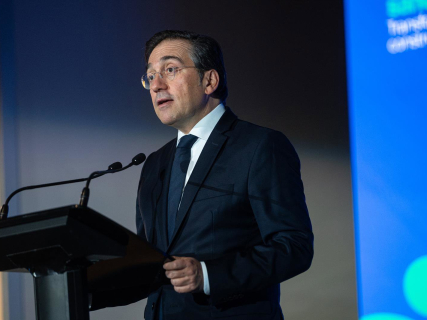

The Minister of Foreign Affairs, European Union and Cooperation, José Manuel Albares, has reiterated that Spain "will never be an obstacle" to allow Kosovo to move forward in its rapprochement with the European Union, despite maintaining its refusal to recognize the independence of this territory. As proof of this commitment, he has claimed the decision adopted in 2024 to accept Kosovar passports as valid travel documents.
"We have our national position on Kosovo, but that does not mean that we are going to be an obstacle ever," the head of Spanish diplomacy stressed during his address at the EU Enlargement Forum, held this Monday in Brussels. In his speech, he emphasized that Madrid will remain willing to promote relations between Pristina, Belgrade and the Community institutions.
Along these lines, Albarres insisted that he has been "very clear over all these years" with regard to the Spanish position. "We will never be an obstacle to dialogue between Belgrade and Pristina and we will never be an obstacle to Kosovo drawing closer to the European Union," he reiterated.
As a concrete example, he mentioned Spain’s decision to accept Kosovo passports as travel documents, coinciding with the entry into force, in January 2024, of the visa exemption for Kosovar citizens who carry out short stays in the Schengen area.
"Spain was not an obstacle and we recognized Kosovo passports as travel documents," the minister recalled, presenting this step as proof that Madrid can help bring Pristina closer to Brussels without changing its position on Kosovo’s independence.
Spain is part of the small group of five member States of the European Union that do not recognize Kosovo’s independence, proclaimed unilaterally in 2008. This position has been intended to prevent the case from being interpreted as a precedent for internal secessionist movements, although the Spanish Government has repeatedly rejected any equivalence between Kosovo’s situation and that of Catalonia or the Basque Country.
Together with Spain, four other EU member states —Greece, Cyprus, Romania and Slovakia— also do not recognize Kosovo’s independence. Kosovo, which aspires to integrate into the community bloc as one of the countries of the Western Balkans, sees its accession process made more difficult precisely by the lack of recognition by five of the Twenty-Seven.
Kosovo officially submitted its application to join the European Union in December 2022, although it has still not managed to obtain candidate country status, which requires the unanimous support of all member states. Added to this obstacle are the problems in normalizing its relations with Serbia, which likewise does not recognize its independence and maintains with Pristina a dialogue mediated by Brussels.
Economic support for the Western Balkans
During his remarks at the forum, Albares also defended the appropriateness of putting together a “substantial financial package” aimed at the Western Balkans, in order to prevent its citizens from becoming frustrated by the slowness of the process of economic convergence with the European Union.
“Most of them, I would say almost all of them, have made major efforts in the direction we have indicated to them, and they are success stories,” he highlighted, while warning that, despite these progress, the gap with the economic levels of the member states continues to widen.
In this context, he has warned of the disaffection that may arise among the population when they perceive that their countries meet Brussels’s requirements without that translating into a sufficient improvement in their well-being. “We do our homework, we do it very well; you tell us that we do it very well, and, year after year, we are getting further and further away,” he said, describing the prevailing feeling among many citizens in the region.