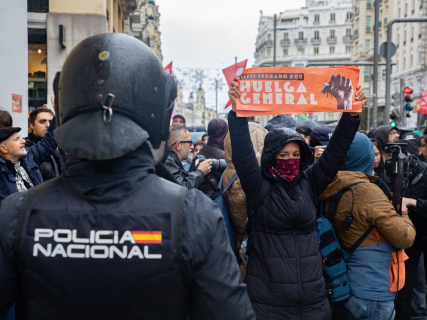

Amnesty International has compiled 61 cases with which it denounces the "excessive use of police force" against demonstrators and journalists who were acting in a "peaceful" manner during the general strike over housing on November 11. The organization asks the Ministry of the Interior that internal investigations to clarify police action be made public "in detail" and that "all non-lethal weaponry used in protests" be reviewed.
As it explains in a statement, based on the observation teams deployed on the ground, on the analysis of abundant audiovisual material, and on 24 personal interviews with witnesses who report a disproportionate use of force, Amnesty International has been able to record "baton strikes against people who were not posing a threat," many of them "to the upper part of the body, including the head, and also against people running away or moving away from the officers, with their backs turned."
The organization also documents "indiscriminate use of pepper spray against people and groups of peaceful demonstrators," in some cases launched "at very close range," in addition to tear gas canisters aimed at "a peaceful crowd that ended up trapped inside" and rubber bullet shots "from behind."
"These actions are incompatible with the principles of necessity and proportionality governing the use of force by the police in a demonstration," Amnesty International stresses, which underlines that the November 11 event "was, in its immense majority, a peaceful protest" and that the "isolated incidents" of violence recorded, especially in Barcelona, do not legitimize the use of force "against those who demonstrate peacefully".
Police action in the protest in Madrid
In this context, the organization focuses part of its analysis on the November 11 protest in Madrid in the afternoon. As it details, the march "was taking place peacefully along Gran Vía and was scheduled to end at Plaza de España," but the National Police "blocked the passage of most of the participants by means of a police cordon and several vans, preventing them from continuing their route."
Amnesty International maintains that this operation was carried out without clear dispersal warnings, so many attendees did not know why they were prevented from moving forward. From that moment on, and always according to the organization, the agents began the dispersal through charges, baton strikes, the launching of tear gas canisters, and firing rubber pellets, while on nearby streets exits were restricted by the police deployment itself.
The entity recalls that General Comment No. 37 of the Human Rights Committee "states that tear gas tends to have indiscriminate effects, and that it can only be used as a last resort" and, consequently, "should only be used in situations of such widespread violence that it is not possible to act against the specific persons who carry it out".
"Its use must be preceded by clear warnings, allow time and safe exit routes, and never occur where people cannot disperse. In Madrid, none of those conditions was met," Amnesty International insists, linking the disproportionate use of this material to blows, a burning sensation, and breathing difficulties among those participating in the protest.
Demands on the Ministry of the Interior
In light of these events, Amnesty International calls on the authorities to guarantee the exercise of the right to peaceful protest and that potentially harmful police interventions against peaceful demonstrators from November 11 onwards be the subject of an investigation "prompt, exhaustive and impartial," whose findings are made public. In addition, it asks that these inquiries reach the chain of command, including the orders transmitted to the officers.
The organization asks the Ministry of the Interior and the Delegations of the Government for an "in-depth" review of the protocols and rules that regulate police action at demonstrations and protests, with special attention to the use of less-lethal weaponry, to ensure that "it meets international human rights standards".
With regard to tear gas canisters, Amnesty demands that the order not to use them "be set out in a public protocol" and that, while they remain in service, they be used only in the face of widespread violence that cannot be dealt with by acting against the people responsible. It also demands that their use must always be preceded by "clear warnings, with time and safe exit routes", that they not be fired in places where people cannot disperse or against encapsulated crowds, and that the canisters never be aimed directly at people.
As for pepper spray, the organization proposes that the Policía Nacional and the Guardia Civil approve and disseminate a specific protocol that includes prior notice, a time margin to move away, the prohibition on using it against passive resistance and on projecting it into the eyes, as well as the obligation to ensure safe exit routes.
Regarding the use of batons, Amnesty International argues that they should only be used against anyone who causes or threatens to cause imminent harm and never "against the head, neck or upper part of the body". It also reiterates the need to ban rubber bullets "because they are inherently inaccurate" and, while they are not withdrawn, that in no case should they be fired at close range, at the upper part of the body, at people who are fleeing, or with the aim of dispersing a peaceful crowd.