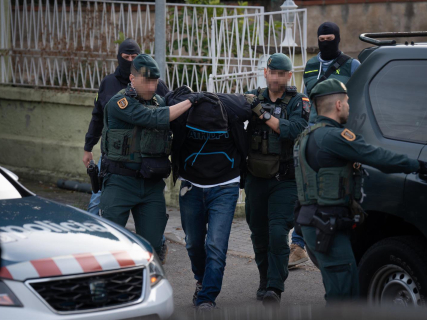

The recent anti-terrorist operations carried out by Spain and Morocco show the interest of the Islamic State, through its affiliate in the Sahel, in consolidating a logistics corridor that connects both countries with what has become the main focus of global jihadism. This web increases the threat to security and raises the risk of attacks.
So argue Colin P. Clarke, an expert in terrorism and director of the Soufan Center, along with Lucas Webber, a researcher at this 'think tank' and director of MilitantWire, and Peter Smith, also a researcher at the latter outlet, in their analysis "The Growing Threat of the Islamic State to Europe and the West," disseminated by Lawfare.
For these specialists, the Sahel "is no longer a remote war zone for Europe and Islamic State Sahel (EIS) is moving from being a regional insurgency to becoming a 'transnational terrorist hub'. To do so, it has designed a 'support corridor, from its strongholds in Mali, Niger and Burkina Faso through northern Morocco to Spain, making use of smuggling routes, diaspora networks and online radicalization to recruit, finance and launch operations on both sides of the Mediterranean'.
Although the volume of would-be volunteers looking to join EIS is much lower than the wave of foreign fighters who, at the time, traveled to Syria and Iraq to join the Islamic State and its 'caliphate', the authors warn that, "with the Intelligence agencies and the security forces focused on other things, it has the potential to produce more terrorist attacks in the West."
Since 2023, the affiliate founded in 2015 by Adnan Abú Walid al Saharaui "has established a logistics route from the Sahel to Morocco and then Spain" that it uses to "recruit personnel, move capital and transport materials, making it a crucial external operational corridor," Clarke, Webber and Smith underscore.
The researchers point out that the terrorist group relies significantly on the existing "criminal infrastructure and smuggling routes" for its logistics and emphasize that its strategy of gaining acceptance among local communities in the Sahel areas where it operates is facilitating both recruitment and the obtaining of resources.
MORE FOCUSED ON THEIR EXTERNAL EFFORTS
"Growing local support has allowed the organization to focus more on its outward efforts from the Sahel and to offer support to other State Islamic State of Islamic filiales," they add, framing in this context "the use of a Morocco-Spain axis, in particular the Tangier- Strait of Gibraltar-Balearic Islands line, as an operational corridor".
EIS makes use of the already consolidated routes of Trans-Saharan smuggling as a "natural route to Europe" and, given the "bottleneck" represented by the Strait of Gibraltar, experts explain that the group "uses the land routes in Ceuta and Melilla, as well as the maritime routes to peninsular Spain and the Balearic Islands", without providing further operational details.
In this scenario, they recall that since 2025 Morocco has disrupted several cells linked to Islamic State Sahel (EIS). Among them, a network neutralized together with Spain last March between Tangier and Mallorca that financed fighters both in the Sahel and in Somalia and prepared an attack on Spanish territory, as well as another structure dismantled in July that stored weapons and had a car bomb ready to be used.
A year earlier, Moroccan authorities had arrested twelve members of a network associated with EIS under the name "Lions of the Caliphate in the Maghreb" in nine cities, whose purpose was to weave an internal structure in the country to send local recruits to the Sahel and Somalia and, in a subsequent phase, carry out attacks in Morocco.
According to the three analysts, "these cases provide evidence of the repeated efforts of actors linked to EIS to establish operational networks within Morocco, placing them at an attack distance from the southern flank of Europe".
PROPAGANDA FOCUSED ON SPAIN AND MOROCCO
The authors also warn that Islamic State propaganda "now explicitly calls for attacks in Morocco, Tunisia and Spain". With regard to Spain, "its exposure emanates from the role of the corridor in financing and logistics" and is framed within "the doctrine of the guided plot in which the recruits receive instructions to stay in place and attack locally instead of traveling to the Sahel".
According to their analysis, Moroccans figure among the main contingents within the Islamic State’s state affiliates both in the Sahel and in Somalia—around 130 are listed—while in Spain among those detained for jihadist activities, cases of individuals who initially intended to travel to Mali have been detected and who ultimately chose to carry out an attack on Spanish territory.
At this point, they warn that "the diaspora communities in Spain, built over decades of North African migration, offer a stable and constant pool for recruitment to which multilinguistic propagandists can direct themselves without the need to have to insert operatives from abroad, bringing African and European audiences closer".
IMPLICATIONS FOR EUROPEAN SECURITY
"The emergence of a pipeline of foreign fighters between the Sahel and southern Europe has clear implications for European security," the experts emphasize, reminding that until now European anti-terrorist policies have focused more on Islamic State Khorasan, the active affiliate in Afghanistan, and on the remnants of Islamic State in the Middle East, "and less on the threat emanating from the Sahel, despite the continued accumulation of data that points to a growing trend".
Along these lines, they lament the limited visibility of the "thriving Morocco-Spain nexus" and the "fragmented coordination among the intelligence services of the EU, Morocco and Spain, despite the shared challenge of preventing an attack".
In their view, the attack on the Pride march in Berlin last July, carried out by a young German of Lebanese origin who first tried to travel to Mauritania in order to go on to Mali, and who later moved to Lebanon—where he was detained—to attempt to reach Syria, before being deported to Germany and receiving a conviction with a suspended sentence, illustrates "the need for closer cooperation between Morocco and Spain in order to ensure the ability to further disrupt the evolving logistics corridor".
"Treating the Sahel as someone else’s problem will invariably send it back to Europe, which must take significant steps to strengthen its defenses against the jihadists’ external operations," Clarke, Webber and Smith conclude in their study.