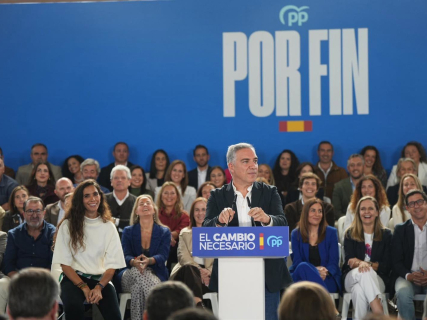

The PP deputy secretary for Autonomous and Municipal Policy and Electoral Analysis and head of the list to Congress for Málaga, Elías Bendodo, has censured this Saturday that at the PSOE rally held on Friday in Valencia, people chanted and cheered the former Minister of Transport Óscar Puente, calling out his name, while “the socialists were puffing out their chests, saying that he resigned six days after the Urda accident,” when, as he has underlined, “he has resigned nine months after the Adamuz accident and 115 deaths later.”
The Popular Party leader has expressed himself in this way during the event to present the PP candidacies for the general elections of 29N for Congress and the Senate for the eight Andalusian provinces, held at the Polideportivo of the Colegio Mayor Nuestra Señora de la Asunción in Córdoba. At the event he was accompanied by the president of the PP-A, Juanma Moreno; the PP-A general secretary and campaign coordinator, Antonio Repullo; the provincial president, Adolfo Molina, and the president of the party’s Council of Mayors in the community and mayor of Córdoba, José María Bellido, as well as all the candidates, who intervened briefly.
Bendodo has insisted that Puente’s resignation does not occur “by any means because of empathy with the victims, as he said,” but, in his view, “he did it because they had polling data saying that they were sinking already completely.” “That is the real socialist empathy with the victims,” he has reproached, and then criticized the ‘lapsus’ of the new minister, Carlos Cuerpo, for stating that the accidents had been recorded on the Madrid-Barcelona line. “They have no idea, it’s that they don’t know where they are, who we are in the hands of,” the Popular Party figure has questioned, who has warned that “that is the real risk of continuing with Pedro Sánchez.”
In this context, he has expressed his support for the residents of Córdoba, Granada and Seville because of the problems and deterioration of the high-speed Andalusian rail connections and has denounced the community’s isolation situation. “We are nine million Andalusians who are here isolated, with no train line,” he has stated.
Subsequently, the PP candidate appealed to “all of us to drive the change in Spain so that President Feijóo manages to ensure that all Spaniards feel proud again to be Spanish and, once and for all, Spain starts working again,” a change he has likened to the one that “Juanma Moreno made possible in Andalucía.”
"A few years ago we drove the change in Andalucía to feel proud again to be Andalusians and, above all, so that Andalucía would start working again, and now the same reasons and the same circumstances are presented," he has said, calling on the candidates for Málaga "to do justice with our land" by considering that they have been "the great ones abandoned in these years of sanchismo, the last provinces of Spain in investment per inhabitant," and he has stated that "no investment" is being made in his province "since the Rajoy government".
The example from Andalucía
On the other hand, PP vice-secretary for Treasury, Housing and Infrastructure and candidate for Congress for Seville, Juan Bravo, has highlighted that "the first message has to be one of remembrance for the victims and the families of Adamuz and Urda"; he has demanded not to spend beyond one’s means and to take into account "future generations"; and he has emphasized the national reconstruction plan of Feijóo and the work developed from the PP of Andalucía "with budgets and by lowering taxes," in addition to "investing more money in health, education, social policies and dependency".
At the event, for a few minutes, numbers one to Congress for Almería, Carmen Crespo, also took part; for Cádiz, María José García Pelayo, who has had a remembrance for Ceuta; Jorge Saavedra, for Granada; and Pilar Miranda, for Huelva, who received prolonged applause when she recalled the president of the Fundación CEOE and former minister of Employment and Social Security in the PP governments, Fátima Báñez, who died in the serious train accident in Urda (Toledo). After Pilar Miranda, Luis Mariano Camacho, for Jaén, also took the floor, as well as Elías Bendodo and Juan Bravo, and the round was closed by Lorena Guerra, for Córdoba.
"Recover institutional normality and responsibility"
Meanwhile, the president of the PP in Córdoba, Adolfo Molina, has recalled that "the Sánchez government has raised taxes up to 140 times," in such a way that "we comply with our obligations and that is why we also have the right to ask the administrations to comply with theirs," he stated, mentioning that "in housing, the Government of Spain promised in Córdoba 238 homes on the grounds of the former Fátima prison, and they have built none"; in response, he highlighted that "the Regional Government and the City Council are promoting 3,600 homes in Huerta de Santa Isabel, almost 2,000 of them protected; that is taking on responsibilities," he added.
Likewise, he described the situation of the roads, with "years waiting for the N-432 dual carriageway to go to Granada". By contrast, he emphasized that "the Regional Government is driving forward the North Ring Road in Córdoba and has built the Variante de las Angosturas". He also referred to water problems, recalling that "in Los Pedroches and El Guadiato they do not forget what it means to go a full year without drinking water," and therefore he demanded of the central Executive Office "to complete the connections of the three reservoirs that there are in the area in order to face future droughts," or, at least, that "they let us carry out the works."
According to Molina, "governing is serving and not using the institutions for one's own benefit," referring to the latest detentions carried out by the Guardia Civil within the framework of the 'caso Koldo', and he defended that "the real change consists in doing things in a different way, in listening, managing, complying and always putting people ahead of any other interest," claiming in this sense what has been achieved by Juanma Moreno in Andalucía, "a land that has gained in trust, opportunities and ambition for the future".
In this way, he stressed that "the change suited Andalucía very well and now we want that change to suit Spain well, alongside Alberto Núñez Feijóo," with the aim of "recovering things as basic as normal institutional practice and the responsibility and seriousness of governing, because Spain needs a Government that addresses the problems that Spaniards have, that gives answers and complies".
"The time for Spain to change"
For his part, the president of the Council of Mayors of the party in the community and mayor of Córdoba, José María Bellido, has emphasized that it is the “obligation and responsibility” of the PP and “the moment for Spain to change, for change to reach all families, self-employed workers and people in order to give them hope in a better future that we are going to have, with the necessary change that the PP represents.”
After referring to the “chapters of different corruption series, an authentic Netflix of corruption day by day from the PSOE,” the People’s Party leader noted that “unfortunately we are starting to normalize seeing corruption cases every day; afterwards, we end up normalizing delays on trains; then, we normalize not only delays, but also stoppages, constant breakdowns, cancellations, and, in the end, that whole cycle of corruption, of not devoting itself to management in the railway system, has led to tragedy, to death, to two terrible accidents—the one in Adamuz and the one in Urda.”
In this regard, Bellido regretted that “that trail of loss of human lives has left us isolated, disconnected and with a very serious economic, social and connectivity problem for all of Andalusia and especially for Córdoba.” However, he highlighted the work carried out this week by the City Council, the Regional Government and the Provincial Council to put in place the air connection with Madrid. And he reiterated that “not all of us are the same and we have started working on useful politics,” to defend “the management policy that Spain needs,” with “the Juanma Moreno model, which we are going to implement in Spain” with Alberto Núñez Feijóo, he concluded.