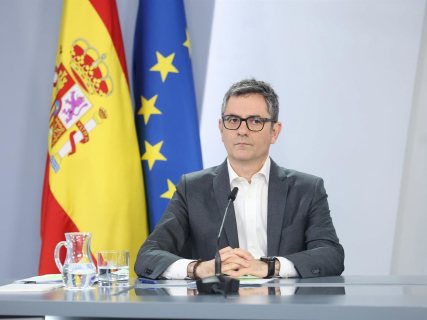

The Minister of the Presidency, Justice and Relations with the Courts, Félix Bolaños, has explained that the Government began to have a "more formed" opinion about the amnesty for those involved in the independence process when it examined it "in depth," an analysis that, as he specified, was carried out after the general elections of July 23, 2023.
Bolaños responded in this way when asked about the opposing stance to this measure that the Executive maintained before the 23J and that it later came to support within the framework of the agreement with Junts and ERC for the investiture of Pedro Sánchez. The president of the Government himself then admitted his "change of opinion" and spoke of making "a virtue out of necessity" with the amnesty.
In an interview on the Ser network, collected by Europa Press, the minister reiterated that the law is "a success," a day after the Court of Justice of the European Union (CJEU) ruled that the regulation does not violate community law.
In line with this argument, he pointed out that within the Executive there was "a conviction" according to which "the solution to the conflict was not to imprison" those who participated in the procés and that the Amnesty Law was the instrument chosen to "articulate" that political conviction.
"Reconciliation has been achieved"
"Does anyone really believe that if the 400 and some people who are going to benefit from the Amnesty Law had been imprisoned, the situation in Catalonia would be better?" he asked, labeling as a "policy of revenge" the stance of those who oppose leaving unpunished the crimes linked to the procés.
"It is a policy of revenge that obviously does not reconcile and does not bring a society together," he stated when alluding to the latest statements by former president of the Government José María Aznar (PP), who maintained, after the CJEU ruling, that "the seditious aggression against the law must not go unpunished."
"If you want these people to go to prison, what you are seeking is revenge and therefore I believe that the Amnesty Law has been a collective achievement of Spanish society to achieve greater cohesion in our country," the minister defended.
In this line, he has asked what is the alternative proposal of the opposition: "To perpetuate the conflict, to bring thousands of people out into the street? To demonstrate against the law?", he lamented. In addition, he has accused the parties opposed to the law of "spreading fear" among the public by claiming that the amnesty broke the Rule of Law and violated the Constitution. "It was all nonsense," he asserted, demanding that the PP "apologize."
According to Bolaños, thanks to this law "reconciliation has been achieved" and the situation in Catalonia has improved because people with different political positions coexist and dialogue, doing politics within the legal and constitutional framework.
Criticism of the "pressure" in the streets
In this context, he pointed out that several parliamentary groups, not only the independentists, were demanding from the Government "a definitive solution to the crisis in Catalonia" both for those facing criminal proceedings and for those affected by cases before the Court of Auditors.
Likewise, he censured the right for the "pressure" exerted against the Executive by mobilizing the public "to the street" with "insults" and "lies," accusing the Government of destroying the Rule of Law. In contrast, he defended that the reforms undertaken have made the laws "stronger" and that Catalan society has been able to "reconcile" positions thanks to an agreement that, he emphasized, will be "for a generation."