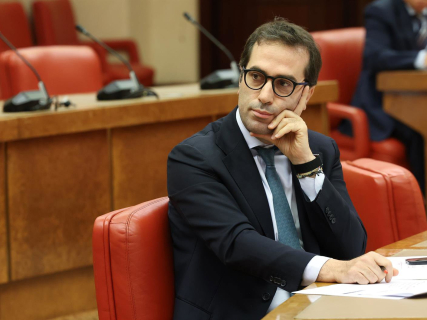

The new Minister of Transport, Carlos Cuerpo, has confirmed this Thursday that he will attend the funeral for the 69 victims of the Urda railway accident (Toledo), even if he is booed during the ceremony. Asked in an interview on La Séptima about the possibility that attendees will whistle at him, he replied with a phrase: "It’s part of my salary."
Cuerpo will attend the religious service on behalf of the Government alongside the Minister of Education, Vocational Training and Sports, Milagros Tolón, while the President of the Executive, Pedro Sánchez, has no plans to attend.
The funeral will be held next Tuesday, November 10, at 7:00 p.m., at the Cathedral of Toledo, and will be presided over by Archbishop Francisco Cerro Chaves. The attendance of Kings Felipe VI and Letizia is expected, along with the president of Castilla-La Mancha, Emiliano García-Page, and the PP leader, Alberto Núñez Feijóo.
Cuerpo’s presence will occur just one week after taking over Transport responsibilities following the resignation of Óscar Puente, who left the Government on November 3 after the railway accidents in Adamuz and Urda.
"We have to recover trust in our railway system"
During the interview, Cuerpo insisted that the Government must keep looking after the victims, their families, and the people affected by the accident, while working to restore citizens’ trust in the rail system.
The minister acknowledged that this trust has been damaged after the two railway accidents that occurred in less than a year.
The objective he has been told by the President of the Government, as he explained, is that the Executive not only continue providing support to families, but also manage to "recover the trust that is currently shaken in our railway system and, in particular, in our safety".
Cuerpo defended that safety must guide the decisions of the Ministry, even when the necessary measures have economic consequences or affect the organization of the services.
"We are at a time of recovery of trust in our railway system. The number one point is safety," he said.
Cuerpo defends Puente’s resignation as a decision "difficult, but correct"
The new Transport official has also backed the resignation of his predecessor, Óscar Puente, after the accidents in Adamuz and Urda.
"I think he has made the right decision, a difficult one, but without doubt a decision that we have to support", he said.
When asked whether the former minister’s departure responded to an exemplary political strategy in the face of the opposition, Cuerpo defended that Puente made the decision to assume responsibilities.
"In this case, he assumes responsibility; he takes charge of those two accidents that we have had in just nine months", he explained.
The minister added that this attitude is what citizens should demand of their public officials because, in his view, "that is the correct way to do politics".
Cuerpo also clarified that Adif’s president, Luis Pedro Marco de la Peña, voluntarily submitted his resignation during a meeting that both held on Wednesday.
"He put his position at their disposal; he pointed out that he wanted to resign", he said. The minister explained that Marco de la Peña considered that he had to assume responsibilities after two accidents with fatalities in less than a year.
"I also think it was the right decision on the part of the Adif president and, therefore, I accepted this resignation", he added.
A new meeting with the unions to move forward on safety measures
The minister announced that this Friday he will hold a new meeting with the railway unions, Adif and Renfe to specify the pending commitments on safety matters.
The appointment is scheduled for 15.30 hours and will continue the first meeting that Cuerpo has already held with the representatives of the train drivers.
The aim is to review the seven commitments that remain open after the accident in Adamuz and agree on how to put them into practice.
Cuerpo insisted that his priority is not to get the unions to withdraw the strike call, but to comply with the agreements reached with the workers.
"The aim is not to call off the strike. Calling off the strike has to be the result of fulfilling certain commitments that we had made, in this case with the unions", he said.
The minister defended that the relationship with railway professionals should be based on trust and that commitments should be specified as soon as possible.
The funeral in Toledo will bring together the main authorities
The ceremony next Tuesday will commemorate the 69 people who died on 28 October, when an AVE from Renfe collided with a stopped Iryo train in the vicinity of Urda.
The funeral was initially scheduled for Thursday, November 12, but the Archdiocese of Toledo moved the date up to Tuesday, November 10, for reasons of institutional scheduling.
The Mass will be presided over by the archbishop of Toledo, Francisco Cerro Chaves, and will include the participation of representatives of the Church of Castilla-La Mancha and the Episcopal Conference.
King Felipe VI and Letizia, who visited the injured and their families after the accident, are expected to attend the ceremony. Representatives of the main political institutions will also attend.
On behalf of the Central Government, Carlos Cuerpo and Milagros Tolón will attend. President Pedro Sánchez will not attend, according to sources from Moncloa.
Cuerpo will arrive at the ceremony after his first meetings with the railway officials and the unions, in a week in which he has defended the need to assume political responsibilities and recover safety and confidence in rail transport.