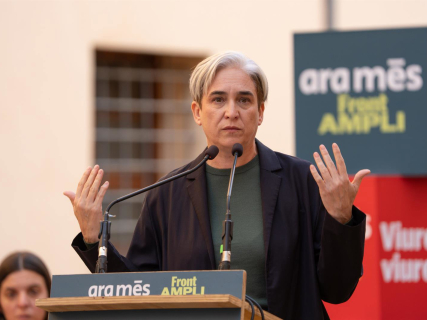

The candidate of Frente Amplio for President of the Government in the general elections of November 29, Ada Colau, has expressed this Saturday 14 her recognition of the "more than 2,000 women in Andalusia who suffered because they were not informed of the result of a mammography," and has advanced that from her formation they propose "ending the waiting lists" and "stopping the privatization of healthcare".
Along these lines, the Frente Amplio candidate has warned that "there are pillars of our society that are threatened" and has denounced that "in Andalusia you are already suffering a right-wing Government that is weakening public healthcare".
In the wake of the ruling in the breast cancer screening programs, Colau has described what happened as a "consequence of a right-wing policy that does not take care of the public healthcare system, with the direct consequence of putting thousands of women at risk of death".
She has also wanted to "thank those brave Andalusian women who are not going to stop until until a strong public healthcare system is defended with all the necessary resources so that an embarrassment like the one that has happened with the mammographies never happens again".
Regarding the healthcare model she defends, the candidate has insisted on the need for a public healthcare system that is "strong" and that "increases its resources". As she explained, "for that we want to raise taxes on the rich, so that we can strengthen our pensions or our public healthcare".
Colau has underlined that "we want a public healthcare system that has sufficient funding to have enough professionals and to end waiting lists," rejecting that it is "a dream," but rather "a reality". "That is why we say that we want to raise taxes on the rich, so that waiting lists come to an end".
PUBLIC HEALTH "DEFINITELY UNIVERSAL"
In her speech, the leader of Frente Amplio called for strengthening the public healthcare system so that "it is truly and definitely universal". She has considered that "it is incomprehensible that even today it is normalized that essential parts of our health, of our body, are not covered by public healthcare".
For this reason, the presidential candidate has specified that her party is committed to "defend public healthcare, to maintain it, to strengthen it and to ensure that the dentist, the eyesight and hearing aids are covered". In her view, "the right and its little buddies who make a business out of the basic needs of people are nervous because they know that we are serious".
In addition, Colau has branded as "a shame" that "in this country menopause is still treated as a thing for women, as if it did not form part of the health of all women in this country, as if we did not have the right for there to be decent protocols in our healthcare centers where each and every one of the women we enter perimenopause and menopause is supported", a stage in which, she has recalled, "you need information, support and, in many cases, treatments".