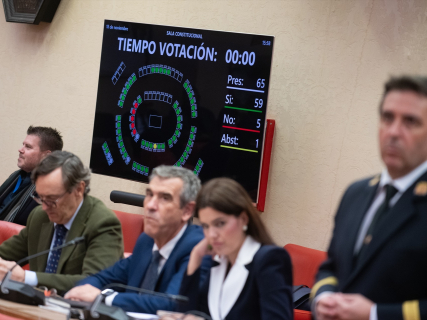

The Standing Committee of the Congress meets this Thursday, 26 November, starting at 09:00, to validate or repeal five royal decree-laws approved by the Government in the past few weeks. Among them are the 4.5% salary increase for public employees in 2027, the tax exemption for the minimum interprofessional wage (SMI), and the new obligations for pay transparency for companies. The appointment is especially symbolic because the session is held on the penultimate day of the campaign for the general elections of 29N.
But today’s is not the only day that the Lower House is taking center stage in the middle of the campaign. Last week, approval was given to another seven royal decree-laws.

Salary increase
The agenda will begin with the debate on the text that establishes a maximum overall pay increase of 4.5% for staff serving the public sector in 2027.
The measure is part of the agreement reached by the Government with UGT, CCOO and CSIF in November 2025, which includes a path of pay increases of up to 11% between 2025 and 2028.
The decree also introduces improvements to compensation for reasons of residence and to the items intended for social action, which had remained frozen for fourteen years. Its application covers staff of the state, regional, and local Administrations, with the particularities provided for each area.
IRPF exemption for the 2027 SMI
After that, it will be the turn of the rule that modifies the tax rules to prevent recipients of the minimum interprofessional wage of 2027 from having to pay IRPF.
The Government has set next year’s SMI at 1,286 euros gross per month in fourteen payments, an increase that does not need parliamentary validation. What will be put to a vote this Thursday is the tax modification approved to neutralize its taxation.
Specifically, the rule provides for a deduction of up to 1,033.58 euros per year, which decreases progressively for incomes above the minimum wage and disappears starting from 23,172 euros.
The same decree also includes the update of the payments on account for 2027 for autonomous communities and local entities, with the aim of adapting their financing to the income forecasts for the next fiscal year.
Pay transparency
The third debate will be devoted to the decree that amends the Statute of Workers and other labor provisions to incorporate into Spanish law the European requirements on pay transparency and working conditions.
Among its main novelties is the obligation to report the salary or the pay range of the advertised positions, with the aim of facilitating candidates’ access to the economic conditions before their hiring.
The regulation also incorporates measures to strengthen pay equality between women and men and provides for consequences for companies that fail to comply with these obligations, including the possibility of terminating certain public contracts.
Incentives for research and technological sovereignty
The session will continue with the incentives for research and technological sovereignty approved in the extraordinary meeting of the Council of Ministers held last Friday.
The regulation introduces a special regime for certain public research centers that develop strategic projects in areas such as artificial intelligence, semiconductors, and other critical technologies. This recognition will have an initial maximum validity of five years, extendable for another five.
It also includes measures to facilitate the hiring of research personnel, speed up certain procedures, and improve incentives for research. Among them is the extension from three to five years of the period of application of the 40% bonus in Social Security contributions for the indefinite hiring of researchers.

Featured story
The Council of Ministers strengthens Spain's scientific and technological sovereignty
5 minutes
Reform of the emissions rights market
The day will end with consideration of Royal Decree-Law 41/2026, also approved on 20 November last, which amends Law 1/2005 to adapt the Spanish scheme for trading greenhouse gas emissions rights.
The text introduces changes to the obligations of the regulated entities, including fuel and gas traders, within the expansion of the European emissions trading system.
It also regulates compensation mechanisms for certain industries exposed to the risk of carbon leakage and authorizes the Government to extend the system to new sectors under the conditions set out in European legislation.
The Executive believes that, just as last week, the measures will pass through Parliament without incidents.