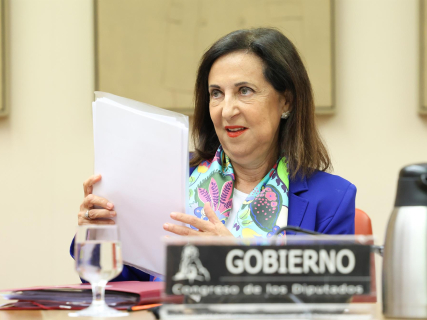

The Minister of Defense, Margarita Robles, has insisted in Congress that the military intelligence services, including the agents of the National Intelligence Center, acted in the days leading up to the massive entry of migrants in Ceuta and transferred their data to the Security Forces and Corps and to the Government Delegation. However, she has refused to provide more details, citing that the duty of secrecy is "a burden."
During her appearance before the Defense Commission, Robles expressed her recognition to the military who participated in managing the migration crisis at the end of July and particularly highlighted the work of the Armed Forces Intelligence Center (CIFAS) and the CNI. Their actions had been questioned after the arrival of thousands of people in the autonomous city, after the Minister of the Interior, Fernando Grande-Marlaska, stated in a press conference that no one had alerted about an entry of migrants of the magnitude recorded in Ceuta.
In contrast to that version, the Defense official maintains that the intelligence services fulfilled their duty, including the 25 CNI agents deployed in the area, whose activity is protected by the duty of secrecy, "which is a guarantee for their actions," although on many occasions "it operates as a burden by preventing publicity for the actions they carry out."
Robles detailed that these forces "provide their services and carry out their mission in Ceuta, monitoring the situation in the area daily from multiple perspectives: relations with neighboring countries, the geopolitical situation on the southern flank, the actions of organized mafias, their use of networks, the rise and increase of jihadist terrorism, and obviously the development of irregular migration, addressing the situation of neighboring countries, the Sahel, as well as destabilizing actions through hybrid threats made by international agents."
Coordination with the Interior and military deployment in Ceuta
The minister emphasized that, during those same days, the military "carried out the work that was and is required of them and that they shared and analyzed with the State Security Forces and with the personnel of the Government Delegation."
Likewise, he has pointed out that there are currently more than 3,000 military personnel stationed in Ceuta, the majority belonging to the General Command of Ceuta, whose deployment has been reinforced with units from the Canary Islands and Balearic Islands that are already operating on the ground.
Robles has reviewed some of the tasks performed by the Armed Forces in the city. In the land domain, he indicated that they collaborate with the deployment of the Civil Guard on the border perimeter, participate in surveillance and presence tasks to prevent irregular settlements and prevent disturbances of the order, and support in marking routes and in the organization and grouping of groups of immigrants.
In the maritime area, the crisis forced the intensification of surveillance of the waters near Ceuta, to locate possible access points, to install buoys, and to develop different actions at the Tarajal border crossing.
The Navy has taken on part of these missions and has made available to the State the frigates 'Navarra' and 'Santa María' for tasks of presence, surveillance, and deterrence in the vicinity of the autonomous city, thus contributing to the protection of maritime spaces of sovereignty and national interest.
The patrol vessel 'Vigía', dedicated to maritime surveillance and naval presence, and the maritime action ships 'Rayo' and 'Tornado', which have carried out logistical missions, particularly the transfer of material from the Canary Islands to the area, have also intervened.
At the end of his speech, Robles reiterated his gratitude to the Armed Forces for their involvement during the crisis in Ceuta and highlighted the "great work" carried out on the ground.