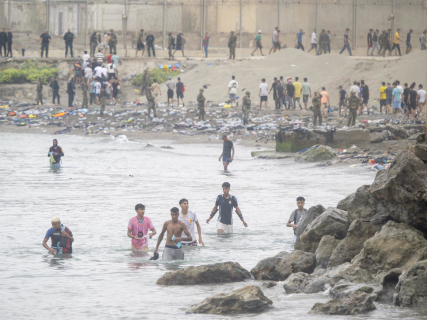

The Spanish Institute of Migratory Analysis (IEAM) has claimed that Spain should strengthen its management capacity at the borders following the recent migratory crisis recorded in Ceuta and that, furthermore, it should request a "clear European backing" in light of the situation faced by the autonomous cities.
"Ceuta and Melilla are Spanish territory and the external border of the European Union (EU) and their protection cannot be considered an exclusively national responsibility," the agency pointed out in a statement in which it insists on the community dimension of the problem.
"Each country going its own way facilitates third States exploiting European divisions. If it were demonstrated that a country deliberately uses migratory movements to pressure a member State, the response should be European," they emphasized, calling for a common strategy.
In that note, the IEAM formulates several proposals that, in their view, the Government should adopt to face what they describe as the largest migratory crisis in its history. In this regard, they remind that a border must be "legally guaranteed, but also operationally functional," combining respect for legality and effectiveness.
At the same time, they urge the Executive to open a "detailed investigation of the sequence of events." "It is necessary to know when the calls were detected, what information Spain and Morocco shared, what decisions were made, and at what moment the devices were overwhelmed," they specified, demanding clarity about what happened.
Permanent early warning mechanism
The independent agency also considers that Spain must design a stable "early warning" mechanism specific to Ceuta and Melilla. In the face of indications of a new crisis, such as concentrations of young people or variations in border deployments, "reinforcements and political contacts must be automatically activated," they point out.
From the IEAM, they also deem it "essential" to increase direct investment on the ground. "Migratory cooperation cannot consist solely of financing vehicles, cameras, fences, and security forces." Therefore, they urge the Government and the EU to "invest in long-term measures, youth employment, education, territorial development, and legal mobility in Morocco and in other countries of origin and transit," in order to tackle the root causes.
In parallel, they wonder what would have happened if "tens of thousands of people had come from sub-Saharan countries with which Spain does not have operational readmission mechanisms," warning that the situation "would have been much more difficult to manage" and would have caused a "prolonged saturation of Ceuta, Melilla, and the mainland reception system" leading to a "blockage of procedures that could last months or years."
"It is not enough to reinforce the border once the movement has already begun. The main lesson from Ceuta is that anticipation is more effective, safer, and more humane than managing a completed crisis," they emphasized, defending prevention as a key tool.
Finally, the IEAM warns that resorting to the "frustration" of thousands of young people as a "political instrument" puts their lives at risk and turns them into "means of pressure." "Respect for the sovereignty and territorial integrity of Spain is also a matter of European sovereignty and territorial integrity," the statement concluded, calling for a firm and coordinated response.