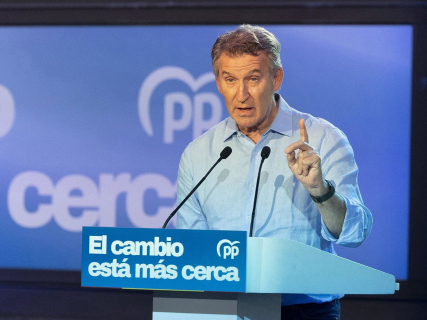
Feijóo 'nationalizes' Ayuso's law recognizing the unborn child

The leader of the PP incorporates one of the most symbolic measures promoted by the Madrid president into his program and commits to approving a state law of aid for pregnant women and their families if he reaches La Moncloa

2 minutes

fotonoticia 20260706124454 1920

fotonoticia 20260706124454 1920

Add DEMÓCRATA to Google

Ask FREN

Published

Last updated

2 minutes

Most read

Alberto Núñez Feijóo has taken another step this Monday in the adoption of policies promoted by the president of the Community of Madrid, Isabel Díaz Ayuso, by announcing that, if he governs Spain, he will approve a state law inspired by the so-called law of the conceived unborn recently approved in the Madrid Assembly.

With this commitment, the president of the national Popular Party nationalizes one of the most representative norms of the Madrid Executive and turns it into a proposal for the entire country, reinforcing Ayuso's political weight within the PP's national project.

During an interview on Antena 3, Feijóo assured that he wants the conceived unborn to have effects when accessing certain public aid, so that pregnant women and their families can benefit before birth from benefits linked to the composition of the family unit.

From an autonomous law to a commitment for all of Spain

The initiative takes as reference the law approved last week by the Madrid Assembly, which recognizes administrative effects for the nasciturus within autonomous competencies.

The Madrid norm allows pregnancy to count for accessing certain social aid, scholarships or benefits whose concession depends on income or the number of family members. It also advances some benefits associated with large families before the birth of the child when the requirements provided by autonomous legislation are met.

Now, Feijóo proposes to transfer that model to the state level through a national law.

A gesture with strong political implications

Beyond its content, the announcement has an obvious political reading. The law of the conceived unborn has become one of the initiatives most identified with Isabel Díaz Ayuso during this legislature and had generated an intense debate between the regional government and the opposition.

By publicly assuming this commitment, Feijóo incorporates into the PP's national discourse one of the political banners of the Madrid president, at a time when the popular party is intensifying its ideological profile on issues related to family and birth rates.

The PP insists that it does not affect the abortion law

The popular leader defended that the measure seeks to reinforce support for pregnant women and families, and recalled that during his time as president of the Xunta de Galicia he promoted similar policies.

From the PP they maintain that the recognition of the unborn conceived would have exclusively administrative and social effects for access to public aid, without modifying the current regulation on abortion.

The opposition, on the contrary, considers that the norm introduces a legal recognition with an important symbolic and ideological burden and frames the initiative within the PP's strategy to reinforce its discourse on family and birth matters.

More key points, information and questions with FREN

AI-GENERATED CONTENT

What is the current status of the parliamentary processing of the law on the unborn conceived at the state level?

As of today, there is no law on the unborn conceived at the state level under parliamentary processing in the Cortes Generales. In the available information from the Congress of Deputies and the Senate, there is no bill nor any proposed law whose official title contains the expression “unborn conceived” (nor variants such as “conceived and unborn”). There is also no other state initiative (questions, non-law propositions, etc.) whose title includes that phrase. Consequently, there is no officially identifiable parliamentary processing at the state level with the name you mention.

Situation in the Congress and the Senate

The review of law-level initiatives from the Congress of Deputies and the Senate shows that:

– There is no Bill registered by the Government whose official title mentions “unborn conceived”.
– There is no Proposed Law registered by parliamentary groups or other legitimized subjects that includes the expression “unborn conceived” in its denomination.
– Expanding the search to any type of initiative in both Chambers (including non-law propositions, motions, oral and written questions, interpellations, etc.), no title appears that jointly contains the words “conceived” and “unborn”.

This allows us to state quite clearly that, in the Cortes Generales, there is no officially recognizable state legislative initiative called “law on the unborn conceived,” neither in processing nor finalized, at least regarding its official title.

Limitations regarding the content of the texts

To rule out that there might be a law colloquially known as “on the unborn conceived” but with a different title, it would be necessary to review the full content of all bills and proposed laws searching for that expression within the text. This operation involves going through a very large volume of parliamentary documents, and queries over the entire history exceed the maximum available time, so it has not been completed comprehensively.

This means that, with the consulted tools:

– It cannot be guaranteed 100% that the expression “unborn conceived” has never been used within the body of some state initiative with another title.
– It is verified that no law-level initiative (nor other control initiative) at the state level carries that expression in the official title.

In practical terms, to answer your question about the processing status, this implies that there is no law that the Chambers themselves formally identify as “law on the unborn conceived” whose phase (consideration, committee, plenary, Senate, etc.) can be detailed.

References at the regional level

However, the use of the expression “law to consider the unborn conceived as a member of the family unit” appears in a regional parliament, but not as a state law:

– Two Written Questions have been located in a regional chamber (not in the Congress or Senate), formulated by a deputy from a group identified as GPMM.
– Their titles question the regional government about what economic measures and objectives are foreseen in a “new law” to consider the unborn conceived as a member of the family unit.

It is important to emphasize that:

– These initiatives are control questions, not bills or proposed laws.
– They do not belong to the Cortes Generales, so they do not affect the processing of a hypothetical state law with that name.
– What they reveal is that, in that specific regional scope, a possible regulation on the unborn conceived has been politically announced, but they do not provide data that a legislative text is already being processed.

Conclusion on the processing status

With the available parliamentary information, the answer is that there is no “law on the unborn conceived” under processing at the state level. There is no record in either the Congress or the Senate of a bill or proposed law with that official denomination, nor can a “last action” or a “status” (admission, consideration, plenary debate, approval, expiration, etc.) be indicated because the initiative, as such, is not registered.

If in the public debate a future “law on the unborn conceived” promoted by some party or government is being discussed, as of today that remains in the political or programmatic realm, but it has not translated into concrete legislative processing in the Cortes Generales identifiable by that name.

What are the powers and attributions of a regional president like Isabel Díaz Ayuso according to current legislation?

The president of an autonomous community such as the Community of Madrid — a position currently held by Isabel Díaz Ayuso — is, according to current legislation, the highest institutional representative of the Community and the ordinary representative of the State within it, as well as head of the regional Government and hierarchical superior of the entire regional Administration. According to the Statute of Autonomy and Government and Administration legislation, they are responsible for directing the Government's action, appointing and dismissing vice presidents and councilors, coordinating the Administration, and assuming political responsibility before the Assembly. Likewise, they participate in parliamentary confidence mechanisms (investiture, votes of confidence, and motions of censure) and may issue decrees organizing the Government, such as those setting the number and names of Ministries. All this is framed within the block of constitutionality (Constitution and Statute) and regional legislation on Government and Administration.

Basic framework: Statute of Autonomy of the Community of Madrid

The Statute of Autonomy, approved by Organic Law 3/1983, of February 25 and amended by Organic Law 2/1991, Organic Law 10/1994, and Organic Law 5/1998, is the norm that defines the figure of the Madrid President.

The statutory text expressly establishes that:

1) Institutional and State representation. “The President of the Community of Madrid holds the supreme representation of the Autonomous Community and the ordinary representation of the State within it, presides over and directs the Government's activity, appoints and removes Vice Presidents and Councilors, and coordinates the Administration.” This wording appears in the Statute itself (current wording after the 1998 reform, included in Organic Law 5/1998).

2) Delegation of functions. The President may delegate “executive and representative functions to the Vice Presidents and other Government members,” allowing task distribution without losing political leadership.

3) Political responsibility before the Assembly. The Statute indicates that “the President is politically responsible before the Assembly,” which controls the Government's action and may demand that responsibility through a motion of censure, which must include an alternative candidate for the Presidency (a “constructive” motion of censure).

Relationship with the Assembly: investiture, confidence, and censure

The Statute also details the parliamentary confidence relations:

Investiture. After each regional election or when there is a vacancy in the Presidency, the President of the Assembly proposes a candidate, who presents their program and requests the Chamber's confidence. If they obtain an absolute majority in the first vote or a simple majority in the second, “the King shall proceed to appoint them President of the Community of Madrid,” according to the statutory text reproduced in Organic Law 3/1983 in its consolidated version.

Vote of confidence. The President, “after Government deliberation, may submit a vote of confidence to the Assembly on their program or a general policy declaration”; if lost, they must resign, and a new investiture process opens.

Motion of censure. The Assembly “may demand the political responsibility of the President or Government by adopting a motion of censure by absolute majority,” which must always be accompanied by an alternative candidate, who is invested if the motion succeeds.

Regional Government and Administration legislation

More organically and administratively, the President's powers are developed in Law 1/1983, of December 13, on Government and Administration of the Community of Madrid, to which several later norms expressly refer: Law 7/1993, Law 18/1995, Law 15/1998, and especially Law 3/2007, on urgent measures for modernization of Government and Administration, which updates administrative organization.

This last norm places the President as a superior organ of the Administration, along with the Vice President, the Government Council, the Councilors, and the Vice Councilors, according to the amendment of article 38 of Law 1/1983 included in Law 3/2007. From this position, the President has functions of general political direction, promotion and coordination of sectoral policies, and resolution of competence conflicts between Ministries, as well as signing decrees approving the Government and Administration structure.

Government organization: practical example

At the regulatory level, a clear example of these powers is Decree 52/2019, of August 19, “of the President of the Community of Madrid, establishing the number and denomination of Ministries.” These types of decrees show how the President specifies the political structure of the Madrid Executive, distributing government areas and setting the architecture of their cabinet.

Other relevant normative references

The amended Statute and the Government and Administration law are complemented by a broad body of constitutional norms and doctrine affecting the distribution of powers and the functioning of Madrid institutions, such as resolutions and rulings published in the BOE related to the Community of Madrid: for example, the positive competence conflict 1301-2007, the appeal on regional fiscal measures 2964-2009, the one related to Law 9/2018 of Madrid Budgets 127/2019, or more recent appeals against Madrid laws on administrative organization and public management (2113-2024, 2287-2025, or the ruling 84/2025), among many others.

Although these decisions do not directly redefine the President's powers, they delimit the competence framework of the Community in areas such as public service, health, financing, or institutional organization, within which the political and executive powers of the Presidency operate.

What were the results of the last regional elections in the Community of Madrid and how many deputies does the Popular Party have in the Assembly of Madrid?

The last regional elections in the Community of Madrid were held on May 28, 2023, and resulted in a clear victory for the Popular Party, which obtained an absolute majority in the Assembly. According to official counting data, the PP achieved 71 seats out of a total of 135, with 47.34 % of the votes (1,586,985 ballots). This means that currently the Popular Party has 71 deputies in the Assembly of Madrid, comfortably surpassing the absolute majority threshold, set at 68 seats.

Overall results of the 2023 regional elections in Madrid

In the May 28, 2023 elections in the Community of Madrid, the distribution of seats in the Assembly was configured as follows, according to consolidated counting data:

  • Popular Party (PP): 71 seats, 1,586,985 votes, 47.34 %
  • Más Madrid – Greens – Equo (MM‑VQ): 27 seats, 615,171 votes, 18.35 %
  • PSOE: 27 seats, 609,718 votes, 18.19 %
  • Vox: 10 seats, 245,215 votes, 7.31 %
  • Podemos‑IU‑Green Alliance: 0 seats, 158,831 votes, 4.73 % (fell below the effective representation threshold)

The total of 135 seats reflects a proportional representation system with an electoral threshold that, in practice, left Podemos‑IU‑AV's candidacy out of the Assembly despite surpassing 4 % of the votes. All this information is recorded in the official results published and disseminated, among others, by RTVE (resultados-elecciones.rtve.es), the Community of Madrid's own institutional portal (elecciones.comunidad.madrid), and is consistent with other compilers such as El País, Público, or the encyclopedic summary on Wikipedia.

Absolute majority of the PP and balance of forces

The absolute majority in the Assembly of Madrid is set at 68 deputies. With 71 seats, the PP not only reaffirmed the victory obtained in the previous regional election but also consolidated a sufficient margin to govern alone, without needing coalition agreements. Other electoral analysis sources also point out that, adding Vox's 10 seats, the right-wing bloc reached a total of 81 deputies in 2023, well above the required majority.

The opposition balance was divided between two large progressive groups of similar size —Más Madrid and PSOE, both with 27 seats— and a reduced Vox with 10, while the alternative left space (Podemos‑IU‑AV) was left out of the Chamber. This scenario, confirmed by official data from the Electoral Board and results portals (Central Electoral Board, RTVE, Community of Madrid), gives the PP a wide parliamentary margin.

Current number of Popular Party deputies in the Assembly

Based on these results, and with no record of subsequent changes due to resignations or replacements altering the initial party distribution, the relevant figure for political and parliamentary purposes is that the Popular Party currently has 71 regional deputies in the Assembly of Madrid. This absolute majority conditions:

  • The election and stability of the Presidency of the Community of Madrid.
  • Control of the Assembly's Board and main committees.
  • Approval of regional laws and budgets without depending on other groups.

Looking ahead, some published polls — such as the GAD3 estimate collected on gad3.com and replicated in aggregators like Electográfica — even point to the possibility that the PP could slightly increase that representation in the next regional elections scheduled for 2027, reaching around 72 seats. However, these are only demographic projections, while the current and legally relevant data remains the official 2023 result: 71 Popular deputies.

In parallel, the Community of Madrid is already working on the technical organization of the next elections, as recorded in institutional information about the technological device for the 2027 regional elections (comunidad.madrid/noticias), confirming that the current seat distribution — including the PP's absolute majority of 71 — will remain the regional political framework until that electoral date.

How was the Board of the Assembly of Madrid distributed after these elections and what weight does the PP have in it? What changes were there compared to the previous regional elections in Madrid in terms of PP seats and other parties? What implications does this absolute majority of the PP have for the approval of laws and budgets in the Community of Madrid?

Play

Test your knowledge with FREN!

How much do you know about this topic? Answer the following 3 questions.

What does Feijóo propose to do if he governs Spain regarding the law of the conceived unborn?

Question 1 of 3

What does the law of the conceived unborn approved in the Community of Madrid allow?

Question 2 of 3

What does the PP assure about the impact of the measure regarding the abortion law?

Question 3 of 3

Hola, soy Fren. ¿Cómo te ayudo?