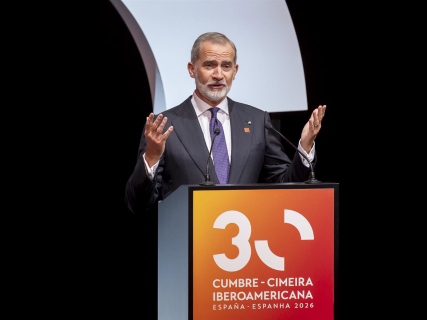

King Felipe VI has urged the 22 States that make up the Ibero-American Community to maintain and strengthen support for the summit system, not only because of its "positive impact" on citizens' lives, but because, in an international scenario that is moving toward a multipolar order, they represent an "example of understanding and cooperation" and also a "counterpoint to rivalries".
The message was conveyed by him to the Heads of State and Government during the opening ceremony of the XXX Ibero-American Summit, held at the Teatro Real in Madrid, before the official dinner that the Kings will later offer at the Royal Palace to the participating delegations.
The monarch, who has said he is "proudly able to recognize himself in the mirror of Ibero-America," has encouraged "continuing to support with renewed force" both the Ibero-American Community, founded in 1991 in Guadalajara (Mexico), and its summit mechanism.
"Not only for its positive impact in so many areas," Felipe VI has emphasized, "but also as an example of understanding and cooperation, as a counterpoint to tensions and rivalries, as living proof that political concertation processes are not empty rhetoric, but that they result in benefits for the day-to-day lives of our citizens".
The meeting in Madrid constitutes, in the words of the King, "a great opportunity" to "assert our community with facts, with tangible achievements" and, at the same time, "to continue proclaiming to the world our clear and sustained commitment, as Ibero-Americans, to the word, dialogue, equality, respect for the rules, listening to minorities, science, entrepreneurship and innovation; our commitment to social advances that reach everyone and are for everyone".
"So let’s make use of it," he encouraged those in attendance, among whom there are ten Heads of State and three vice presidents, while the rest of the countries are represented at the level of ministers of foreign affairs.
Felipe VI has asked "to be protagonists of our future" and "to continue drawing the path that took us from Guadalajara to Madrid and, within two years, will take us" to Honduras, a country that for the first time will be the host of an Ibero-American Summit in 2028. That journey, he has pointed out, "obliges us to keep working on a society that is more just, more prosperous and more inclusive" and to continue "making Ibero-America" jointly.
In his address, the King has highlighted the ties that bind the countries on both sides of the Atlantic, from “two powerful common languages” and “a culture of inexhaustible wealth” to “our hospitable, associative and enterprising spirit,” and, in addition, “a shared ethics, a set of principles and values, whose ultimate background was, and remains, respect for the dignity of the person”.
The Ibero-American Community as a tool for unity
Along these lines, he has recognized “the intuition” of the leaders who promoted the Ibero-American Community of Nations by “turning all that body of knowledge” into “an instrument of unity and development based on dialogue, cooperation and solidarity,” as reflected in the Guadalajara declaration. “An instrument that, if well used, opens the way to a space of greater freedom and prosperity for some 700 million people,” he added.
Felipe VI has recalled that in the 35 years that have passed “everything or almost everything has changed,” although he has pointed out that, despite differences, both then and now people are experiencing a period of “accelerated change.” At that time, the world was leaving behind a bipolar order and was moving, “not without uncertainty, toward what seemed to be a new world order.”
“Today we also note the imminence of a historic watershed, a change of paradigm, the gradual shaping of a multipolar order with contours still unclear but different from those the world knew starting in the year 45,” he warned.
In this context, he has recognized that “no one knows precisely what the world will be like in the coming years,” but he has also made clear that it will “continue to demand answers and solutions to challenges greater than any of our countries, considered individually.” In view of this, he has argued that Ibero-American nations can “respond with a harmonious voice or 22 discordant voices; with a shared hope or with 22 formulas to reflect uncertainty.” “Choosing the right path will be the historical responsibility of the 22 Ibero-American nations,” he emphasized.
Praise for the King’s role in Ibero-America
On the other hand, the Ibero-American Secretary General, Andrés Allamand, has wanted to highlight the track record of Felipe VI, who, even before acceding to the throne, “has always had a firm commitment to Ibero-America,” in reference to the fact that, since he was Prince of Asturias, he has been responsible for representing Spain at the inauguration ceremonies of Ibero-American presidents.
"Away from all stridency, he is a leading actor of the Community since when it is necessary he smooths out rough edges, calling not only on governments but on the entire range of organizations that are our great social capital, he provides long-range ideas and injects the enthusiasm that must feed every organization", Allamand has said when referring to the monarch’s role in the Ibero-American sphere.