
Frente Amplio has launched a new digital tool called "Tax the Rich", an application that allows estimating how much could be raised with the tax on the ultra-wealthy that the candidacy defends for these general elections, applied to the 50 largest fortunes in the country, as well as the volume of additional funding that could be allocated to public services such as healthcare, education, or rail transport.
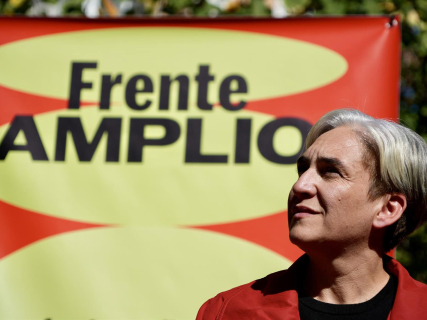
This initiative represents one more step in publicizing the levy announced this Thursday by Frente Amplio candidate Ada Colau. The proposal consists of applying a rate of 2% on the total wealth of those who accumulate more than one million euros, a percentage that would be raised to 3% for assets above 50 million euros.
The simulation that Frente Amplio puts forward through this "app" is based on selecting the 50 richest people in the country, using data from the magazine "Forbes" as a reference, and applying the tax rate envisaged to check the potential revenue from the tax. According to its calculations, the combined wealth of these major fortunes would amount to about 250,550 million euros.
The candidacy emphasizes that the figures offered by the application are estimates and not real tax data, as they are based on journalistic information about the wealth of these people and on the hypothetical collection of the tax if it were to be approved and come into force. For this reason, the result of the simulation would be different in each specific case.
The application includes individual profiles of major businesspeople such as Florentino Pérez, Amancio Ortega and his daughter Sandra Ortega, Juan Roig, Rafael del Pino, or Alicia Koplowitz, among other prominent names.
The tool allows selecting the 50 fortunes in a block, by groups, or individually, and assigning them different options for the effective tax rate, as well as different scenarios for actual collection of 50%, 75%, or 100% to see how total revenue changes.
Once the parameters are set, the "app" offers an estimate of the impact that this extra revenue would have on public services, allocating resources across 20 specific areas, such as housing, railways, education, or healthcare. In this way, the user can visualize, for example, how many kilometers of rail tracks could be renewed, how many new spots could be created in public education, or how many teaching and healthcare professionals could be added to the system.
Frente Amplio calculates, for example, that with a rate of 2% and assuming that 75% of the theoretical amount could be collected, the reinforcement for the public system would reach 3.758 billion euros annually. If a rate of 3% were applied and a collection of 100% were achieved, revenue would exceed 30.000 million in four years, an amount higher than the 24.100 million of the Adif 2022-2026 investment plan, which the application itself uses as a reference.
Among the simulations it offers, the "app" includes a revenue figure of 1.109 billion euros from these large estates which, according to Frente Amplio’s calculations, would make it possible to finance 1.365 professionals in Primary Care, open almost 15.000 public education places for children aged 0 to 3 years, or build 592 public housing units and buy another 353 from large holders.
With this interactive tool, Frente Amplio encourages people to back the campaign "Let the rich pay" and to visualize in a simple way the effect that this tax would have on improving public services. In addition, it places this tax proposal as one of the main pillars of its electoral strategy.