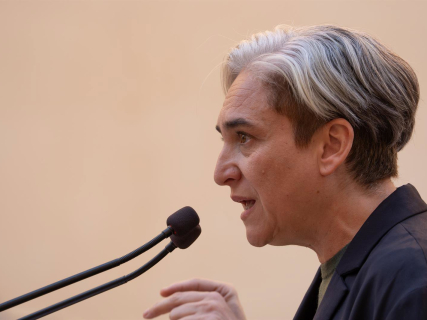

The candidate of Frente Amplio, Ada Colau, has advanced this Sunday that her formation will carry in its program the proposal to “put an end” to the inheritances of the great fortunes, considering that they generate “an enormous inequality” which, in her view, “is not justified”. “We have to put justice,” she has said.
“If we enter strongly in the next progressive government, we commit to taking forward as a proposal the fact of ending inheritance from significant amounts of money,” Colau indicated in an interview on the program 'La Última Hora' by La Séptima, collected by Europa Press.
The leader has advanced that, in addition to “attacking housing,” “there also has to be justice” in the area of succession. In her judgment, “we have talked about the tax on the rich but there is another factor of very great inequality in this country, which are inheritances. One thing is inheriting a series of minimum resources from the fruits of the effort and work of your family, and another thing is inheritances of many millions of euros”.
She has specified that “it will not be a measure that affects the social majority; it will be a measure, just like the tax, that affects the great fortunes, those who have millions of euros. We are not talking about people who have one, two or three homes; we are talking about people who have fortunes”.
In this line, she has emphasized that it is “a matter of bad social organization” that “generates inequality and precariousness” and that, for that reason, she considers it essential to review the distribution of wealth not only “through the tax on the great fortunes” but also “by touching the great inheritances”.
“We are going to introduce inheritances as a proposal; we are going to propose to touch the inheritances of the great fortunes. Tomorrow morning our spokesperson Pablo Bustinduy will give the details,” she has said.
Debate on the unity of the alternative left
Under the heading “WHO DOESN’T WANT TO BE THERE CAN’T BE FORCED”, Colau was asked about the fragmentation of the alternative left. She rejected that the situation responds to “personal issues,” pointing out that that would be “unacceptable” and would be “out of place”. “Who doesn’t want to be there can’t be made to,” she has maintained.
He has insisted that it “could not be accepted that, for personal matters, there would be no greater unity; I think that’s out of place. We owe ourselves to the citizenry; this is not a group of friends, this is not a social club; this is about entering the institutions to serve the people. No personal issue could justify a political decision.”
In this context, he has explained that, although “some political formation did not want to be there, it was invited up until the last moment,” underscoring that “each one will have to answer for their strategies” and warning that it must be “clear” “who the adversary is”: “Our adversary is a possible government of the far right, of PP and Vox, and therefore each one is responsible for their decisions.”
Colau has also reminded: “I myself, when the Broad Front was being formed and before the coalition agreements were closed, explained publicly that everything could be discussed, that the name could be changed, that the candidate could be changed, that the people were asking us for unity. I think everyone saw what happened. Whoever didn’t want to was not there, and whoever wanted to be there because we believe we have a lot at stake, are,” he concluded.