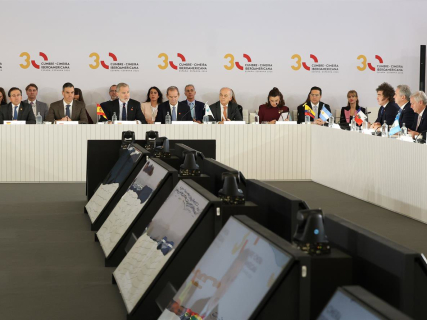

The heads of State and Government of the 22 countries that make up the Ibero-American Community have expressed their concern about the expansion and diversification of transnational organized crime and have agreed that addressing it requires an “coordinated action”.
This position is reflected in one of the special communiqués approved during the Ibero-American Summit held this Wednesday and Thursday in Madrid.
In the text, the leaders express their “concern about the expansion, diversification and growing capacity to adapt of transnational organized crime that affects the security of persons, their human rights, the rule of law, institutional stability, democracy and economic growth”.
Likewise, they note that “transnational organized crime can operate through cross-border networks that cover crimes such as the illicit trafficking of narcotic drugs and psychotropic substances, money laundering, corruption, trafficking in persons, the illicit trafficking of migrants, extortion, the manufacture and illicit trafficking of firearms, their parts, components and ammunition, smuggling, crimes that affect the environment, illegal mining and cybercrime, among others”.
From this diagnosis, the Ibero-American leaders emphasize that “its prevention and combating require a coordinated action by the States” and specify that this joint response must be developed “within the framework of the United Nations Convention against Transnational Organized Crime and its protocols, as well as other relevant international instruments”.
In addition, they point out that this common action against transnational crime must be carried out “with full respect for sovereignty, the applicable International Law, Human Rights, due process and national legal systems”.
Along these lines, they stress “the importance of strengthening, in accordance with the International and domestic Law of each State, police, judicial, customs, migration, financial, tax and border cooperation, as well as timely and secure information-sharing between the competent authorities” and also advocate for promoting “greater coordination between INTERPOL, AMERIPOL, EUROPOL, and other bodies and cooperation mechanisms”.
In parallel, they consider it a priority to “deprive organized criminal groups of their financial and logistical capabilities by strengthening cooperation between financial and tax authorities, Intelligence authorities, investigation of money laundering, detection, freezing, seizure, confiscation and recovery and return of assets, the traceability of goods, port security and control of supply chains, as well as preventing the diversion of weapons and ammunition to unauthorized recipients.”