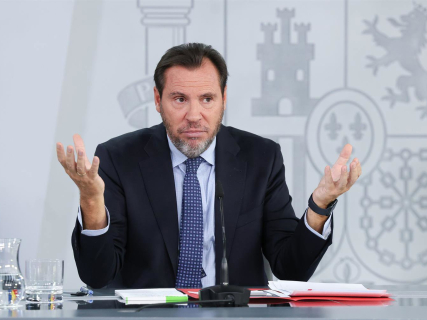
Óscar Puente turns to a Forges cartoon after his resignation denouncing the classic “all politicians are the same”

The former Minister of Transport shares an illustration by the cartoonist accompanied by a brief message, hours after leaving the Government and receiving the support of Pedro Sánchez

fotonoticia 20261103150910 1920

fotonoticia 20261103150910 1920

Add DEMÓCRATA to Google

Ask FREN

Published

Last updated

2 minutes

Most read

Elecciones 29N · Encuestas

La media de las encuestas

Media a 3 de noviembre de 2026 · 17 institutos

  • PP30,4 %
  • PSOE27,4 %
  • Vox19,2 %
  • Frente Amplio6,5 %
  • ERC2,4 %
  • Podemos2,4 %
010203040ene 2024jul 2024ene 2025jul 2025ene 2026jul 2026

Media del último estudio de cada instituto en 30 días y su evolución semanal desde el 23J. Partidos con al menos un 2 %.

Todas las encuestas

Elecciones generales del 29 de noviembre · Demócrata

Óscar Puente has turned to cartoon humor to comment on social media hours after announcing his resignation as Minister of Transport. This Tuesday, the socialist leader shared a Forges cartoon about the perception of politicians, along with a brief message: "Today is a day to remember the great Forges".

The illustration shows a character who firmly states that "all politicians are the same," while another, much smaller one, replies: "That’s what you would like."

The post comes on a particularly significant day for Puente, who has left the Executive after political pressure over the train accidents in Adamuz (Córdoba) and Urda (Toledo), and after receiving messages of support from several members of the Government.

A cartoon about the differences between politicians

The former minister has not added explanations to the illustration, although his post coincides with messages circulated by Pedro Sánchez and other progressive leaders, who have claimed his resignation as an exercise in political responsibility.

The President of the Government has publicly defended Puente after his resignation and has said that "politicians like him dignify our country and show us that not all of us are the same".

The Minister of Health, Mónica García, has also used a similar expression when saying goodbye to her colleague on the Council of Ministers: "No, not all politicians are the same", after describing his decision as an "honorable gesture".

The coincidence between these messages and the content of the cartoon allows the post to be interpreted as a response to the idea that all leaders act in the same way, although Puente has not specified to whom he is directing his message.

The farewell of a minister especially active on social media

The choice of a cartoon to accompany his first posts after his resignation is significant given Puente’s track record on social media, where he has been at the center of numerous clashes with opposition leaders and journalists.

During his time at the Ministry of Transport, the Socialist leader turned X into one of his main channels of political communication, with interventions that were often ironic and critical of his opponents.

His exit from the Government comes after, this Tuesday, he announced before the Permanent Delegation of the Congress that he was resigning from the post due to the severity of the two rail accidents that occurred during his term.

While the Government thanks him for his decision and highlights his political responsibility, PP and Vox consider the resignation insufficient and demand that responsibilities also reach the head of the Executive.

In this context, Puente has opted to recover a cartoon by the late humorist Antonio Fraguas, Forges, whose criticism of generalizations about the political class takes on a new meaning in the debate opened up after his resignation.

More key points, information and questions with FREN

AI-GENERATED CONTENT

What is the process for replacing a minister in Spain after a resignation?

The replacement of a minister after a resignation corresponds to the Prime Minister and the King: the Prime Minister proposes the dismissal and the appointment of the replacement, and the King formalizes them through royal decrees. No investiture vote for the new minister or approval by Congress is required. The procedure allows the vacancy to be immediately filled or the department to be temporarily maintained under the responsibility of another Government member.

1. Submission of resignation and formalization of dismissal

The minister communicates to the Prime Minister their decision to resign. It is important to distinguish between the political announcement and its legal effect: a public appearance, a letter, or a communication on social media do not replace the formal act of dismissal.

Article 100 of the Constitution assigns to the King the appointment and dismissal of Government members, at the proposal of its Prime Minister. Therefore, it is the Prime Minister's responsibility to submit the dismissal proposal and the King's to formalize it. This is not a discretionary decision of the monarch regarding the minister's continuity.

The dismissal is articulated through a royal decree, signed by the King and countersigned by the Prime Minister, which is published in the Official State Gazette. To determine when it takes effect, one must refer to what the decree stipulates.

2. Selection and appointment of the replacement

The Prime Minister chooses the person who will assume the ministry and proposes their appointment to the King. They may select someone already part of the Government or bring in an outsider. It is not mandatory to be a deputy or senator to be a minister.

The chosen person must meet the legal requirements to be part of the Government, including having Spanish nationality, being of legal age, and enjoying active and passive suffrage rights. They must also meet the suitability conditions required for senior officials and not be disqualified from holding public employment or office.

The appointment is formalized through another royal decree, also signed by the King, countersigned by the Prime Minister, and published in the Official State Gazette. The dismissal and appointment can be published on the same day, avoiding an interruption in the political leadership of the department.

3. Oath or promise and taking office

The incorporation of the new minister includes the act of oath or promise before the King. Subsequently, the handover of the portfolio usually takes place at the ministry's headquarters, where the outgoing official symbolically transfers responsibility to the incoming one.

It is advisable to separate both levels: the legal handover rests on the formal appointment and its effects, while the portfolio handover facilitates institutional continuity and makes the change of responsibility visible.

4. Temporary coverage of the vacancy

If a replacement is not immediately appointed, a temporary substitution can be established. In case of vacancy, the Government Law provides that another Government member assumes the management of the department's affairs through a royal decree of the Prime Minister.

This solution allows ministerial activity to continue while the definitive appointment is decided. It does not necessarily imply merging ministries or modifying their structure.

5. Role of Parliament and Government continuity

Congress does not confirm the new minister through a specific vote. It may oversee their performance through questions, interpellations, or appearances, but this oversight is different from the appointment.

Finally, the resignation of a minister does not cause the dismissal of the entire Government, nor does it require new elections or a new investiture. The Prime Minister can carry out the individual replacement and maintain the rest of the team.

What are the competencies of a Minister of Transport according to Spanish legislation?

A Minister of Transport has two main responsibilities: to lead their department, like any minister, and to propose and execute the state policy on transport, infrastructure, and mobility. They do not personally decide all sector matters: many competencies belong to management bodies and public entities, and others require agreements of the Council of Ministers.

1. General competencies as a minister

Article 4 of the Law 50/1997, of the Government establishes that ministers have "competence and responsibility in the specific sphere of their action." This includes:

  • Developing the Government's action in their department, following the agreements of the Council of Ministers and the Prime Minister's guidelines.
  • Exercising regulatory power, that is, issuing provisions in the ministry's own matters within the legal framework.
  • Exercising the powers granted by laws and organizational rules.
  • Countersigning, when appropriate, the King's acts related to their competencies.

Presidential direction does not eliminate the minister's direct responsibility for their management. Additionally, Law 40/2015 contemplates efficacy control of entities attached to the department: evaluating their objectives and resource use, without replacing the corresponding economic-financial controls.

2. Specific competencies in Transport

Article 1 of the Royal Decree 253/2024, which develops the structure of the Ministry of Transport and Sustainable Mobility, assigns the department the following matters:

  • State infrastructures: proposing and executing policies on land, air, and maritime transport infrastructures of state competence, and planning and programming their investments.
  • Transport services: controlling, ordering, and administratively regulating the corresponding services. This covers roads, railways, aviation, and maritime transport, through the competent bodies.
  • Sustainable mobility: promoting it in its social, economic, and environmental dimensions, including active mobility. It includes promoting connections between different transport modes and cooperating with territorial administrations in urban mobility plans.
  • Other matters: normative regulation of postal services and management of state services of astronomy, geodesy, geophysics, and cartography.

3. How these competencies are exercised

The minister directs the department mainly through the Secretariat of State for Transport and Sustainable Mobility and the Undersecretariat. The Secretariat of State assumes, under their direction, functions of planning, investment programming, infrastructure execution, and coordination of attached bodies and entities.

Therefore, political leadership does not equate to personal management of each action. Competencies are distributed among the ministry's bodies and corresponding entities. The Government Law allows delegating certain powers to secretaries of state, undersecretaries, and other management bodies, respecting legal limits.

In crises and emergencies, Royal Decree 690/2025 strengthened coordination, prevention, and victim assistance within the Secretariat of State. Direct management remains with the sectorally competent centers and entities.

4. Limits of decision-making capacity

The minister cannot alone approve decisions reserved for the Council of Ministers. These include draft laws, royal decree-laws, and regulations whose approval corresponds to the Government. They can promote proposals within their scope but must respect the legally established body and procedure.

They also do not concentrate all competencies over any transport or infrastructure existing in Spain: the royal decree expressly delimits the state scope and requires coordination with other departments. In short, their role is to direct, regulate, and promote the state's sector policy, respecting the distribution of responsibilities.

What has been Óscar Puente's political career before becoming a minister?

Before becoming a minister, Óscar Puente developed his career mainly in Valladolid: he was a local PSOE leader, opposition councilor, and mayor for eight years. His national projection came as spokesperson of the Socialist Federal Executive between 2017 and 2021 and later as a deputy for Valladolid in 2023, a few months before joining the Government.

Early steps: membership and local responsibilities

Born in Valladolid in 1968 and a Law graduate, Puente worked as a lawyer between 1995 and 2015. Therefore, during his early municipal activity years, he combined politics with his profession, which he left upon becoming Mayor. His affiliation to the PSOE dated back to 1990, well before holding public office. These backgrounds appear in his official biography.

In 2004, he assumed the Deputy Secretary-General of the Provincial Executive of the PSOE of Valladolid. In 2007, he obtained his first councilor seat and, since 2008, presided over and acted as spokesperson of the socialist municipal group, replacing Soraya Rodríguez. In 2009, he was elected secretary general of the party's Municipal Executive, a responsibility he held until 2021. Thus, he gathered internal leadership and institutional representation functions (Transport biography).

Eight years in opposition and two terms as mayor

Between 2007 and 2015, his institutional activity was in opposition to the municipal government of Javier León de la Riva, from the PP. In 2010, he secured socialist support to be a mayoral candidate. That stage preceded his arrival at city government, as reconstructed by Demócrata.

The change came in June 2015. Although the PP had been the most voted force, Puente gathered the necessary support from other candidacies to become mayor, ending two decades of popular governments. In 2019, the PSOE won the municipal elections and Puente renewed the Mayorship. He remained at the head of the City Council until June 2023 (Demócrata).

His municipal experience also included responsibilities outside Valladolid. He presided over the Spanish Network of Healthy Cities of the Spanish Federation of Municipalities and Provinces —FEMP— between November 2015 and December 2019. Afterwards, he was a member of its Governing Board from September 2019 to May 2023, and represented the federation in the Urban Initiatives Network from October 2020 to May 2023 (Transport biography).

The PSOE federal leadership

While mayor, Puente supported Pedro Sánchez in the 2017 socialist primaries. After Sánchez's victory, he became spokesperson of the PSOE Federal Executive Commission, a position he held between June 2017 and October 2021. It was his first sustained national-level responsibility, compatible with managing the City Council (Demócrata).

2023: from City Council to Congress and Government

In the May 2023 municipal elections, the socialist candidacy was again the most voted in Valladolid. However, the agreement between PP and Vox allowed Jesús Julio Carnero to access the Mayorship. Puente thus closed his eight years as mayor (Demócrata).

His next step was to lead the socialist candidacy for Valladolid in the general elections of July 23, 2023, in which he obtained a seat. In September, he was the PSOE's rebuttal during Alberto Núñez Feijóo's investiture debate. Finally, in November, he was appointed Minister of Transport and Sustainable Mobility: thus culminating a career that had passed through municipal opposition, the Mayorship, federal leadership, and Congress (Demócrata).

Play

Test your knowledge with FREN!

How much do you know about this topic? Answer the following 3 questions.

What resource did Óscar Puente use on social media after announcing his resignation?

Question 1 of 3

What was the main reason Óscar Puente resigned as Minister of Transport?

Question 2 of 3

What have PP and Vox demanded following Óscar Puente's resignation?

Question 3 of 3