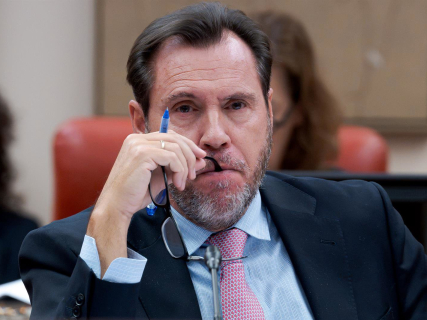
Óscar Puente resigns and will not be on the PSOE lists for the next 29N

Óscar Puente has announced his resignation as Minister of Transport following the railway accident in Urda. The announcement comes after the Government had ruled out on Tuesday itself both his resignation and his dismissal.

fotonoticia 20261103202151 1920

fotonoticia 20261103202151 1920

Add DEMÓCRATA to Google

Ask FREN

Published

Last updated

1 minute

Most read

Elecciones 29N · Encuestas

La media de las encuestas

Media a 2 de noviembre de 2026 · 16 institutos

  • PP30,5 %
  • PSOE27,4 %
  • Vox19,1 %
  • Frente Amplio6,4 %
  • ERC2,4 %
  • Podemos2,4 %
010203040ene 2024jul 2024ene 2025jul 2025ene 2026jul 2026

Media del último estudio de cada instituto en 30 días y su evolución semanal desde el 23J. Partidos con al menos un 2 %.

Todas las encuestas

Elecciones generales del 29 de noviembre · Demócrata

Óscar Puente has announced his resignation as Minister of Transport after the Urda rail accident. The minister says he made the decision in the first moments, although he made it public this Tuesday.

The announcement changes the scenario that the Executive itself had described hours earlier. Sources from the Government had assured that Puente would not resign, that Pedro Sánchez would not remove him, and that he would maintain his candidacy as the PSOE’s top candidate for Valladolid for the elections on 29 November.

From Government backing to the resignation announcement

The day had begun with the defense of his continued leadership of Transport. At the press conference after the Council of Ministers, Puente had argued that he had not adopted decisions that contributed to the accident and had claimed his response since the tragedy occurred.

The minister had drawn a distinction between the calls for resignation from Ada Colau, whom he said he could understand, and those from the PP and Alberto Núñez Feijóo, whom he criticized for having a double standard of measurement. His departure is announced after that appearance and the explicit support that the Executive had conveyed to him.

An appearance under pressure from the opposition and the partners

Puente had gone this Tuesday to the Standing Committee of the Congress to explain the Urda accident, which left 69 dead. The appearance took place amid demands for resignation from both the opposition and a large part of the Government’s parliamentary partners.

Before his intervention, Sumar, Podemos, Compromís, BNG, PNV and Junts had demanded that he step aside or be removed. ERC had opted to first listen to the minister’s explanations, according to the information published about the start of the session.

The resignation announcement comes 26 days before the general elections. Until then, the Government had maintained that Puente should remain in charge of the measures to recover confidence in the railways and that his candidacy for Valladolid was not in question.

More key points, information and questions with FREN

AI-GENERATED CONTENT

What is the procedure for replacing a resigning minister in the Government of Spain?

The replacement of a resigning minister corresponds to the king, at the proposal of the president of the Government. The resignation must be formalized by the dismissal of the officeholder; the appointment of their replacement is also made by royal decree. An investiture vote or authorization from the Congress of Deputies is not necessary.

1. Submission of resignation and proposal for dismissal

The minister communicates their intention to leave office to the president of the Government. Mere communication or public announcement of the resignation does not equate to formal dismissal: this must occur through the corresponding act.

Article 100 of the Constitution establishes that the other members of the Government shall be appointed and dismissed by the king, at the proposal of its president. Therefore, the political decision and initiative correspond to the president of the Government, who proposes to the king the dismissal of the outgoing minister and the appointment of the person who will replace them.

2. Formalization through royal decrees

The dismissal and appointment are formalized through royal decrees, signed by the king and countersigned by the president of the Government. The countersignature means that the latter assumes responsibility for the act. Both decrees are published in the Official State Gazette.

It is important to distinguish the two decisions: one ends the exercise of the office by the resigning minister and the other appoints the new officeholder. It is not necessary for the entire Government to resign nor for the president to request parliamentary confidence again due to changing one of their ministers.

3. Choice and requirements of the replacement

The president chooses the person proposed as the new minister. They do not have to be a deputy or senator: someone outside the General Courts may be appointed, provided they meet the legal requirements.

The Government Law requires, among other conditions, being Spanish, of legal age, enjoying the rights of active and passive suffrage, and not being disqualified by a final judicial sentence from holding public employment or office. The suitability requirements and obligations established for senior officials of the General State Administration must also be met.

4. Oath or promise and taking office

After their appointment, the new minister takes the oath or promise before the king and assumes office. Subsequently, the handover of the portfolio may be held with the outgoing officeholder or with whoever was provisionally attending the ministry.

This handover facilitates administrative continuity but does not replace the formal appointment. There is also no parliamentary confirmation hearing as a condition to assume office. The new minister is subject to the control of the Courts in the exercise of their functions.

5. Provisional coverage of functions

If the replacement does not join immediately, the functions may be covered through substitution. The Government Law provides that, in case of vacancy, absence, or illness, another member of the Government, designated by royal decree of the president, takes charge, specifying the cause and nature of the substitution.

This solution does not make the substitute the definitive head of the department. It allows maintaining its operation while the replacement is resolved.

6. If the Government is acting in a caretaker capacity

The situation requires an additional distinction: a caretaker Government continues attending to its responsibilities with the corresponding legal limitations. Temporary coverage of a portfolio should not be confused with an ordinary reshuffle of the Executive.

In summary, the usual process is: communication of resignation, presidential proposal, dismissal and appointment through royal decrees, official publication, and oath or promise of the new minister.

What powers does the Minister of Transport and Sustainable Mobility have according to Spanish legislation?

The Minister of Transport and Sustainable Mobility directs the state policy on transport infrastructures and services, promotes sustainable mobility, and exercises the management functions of the department. To specify their powers, it is necessary to distinguish between the personal powers of the minister as a member of the Government, and the matters of the ministry, whose management is distributed among its bodies.

1. Functions proper to the minister

Article 4 of the Law 50/1997, of the Government attributes to all ministers competence and responsibility within their scope of action. In Transport, this includes:

  • Developing the Government's action in the matters of the department, in accordance with the agreements of the Council of Ministers and the guidelines of the president.
  • Exercising regulatory power in the matters proper to the ministry, within legal limits and the distribution of powers with the Council of Ministers.
  • Exercising other powers attributed by laws, Government organization rules, and other provisions.
  • Countersigning, when appropriate, acts of the king related to their powers.

This responsibility is exercised under the direction and coordination of the president of the Government, without eliminating the minister's direct responsibility for their management.

2. Matters they direct

Article 1 of the Royal Decree 253/2024, of March 12, specifies the scope of the department. It is responsible for proposing and executing government policy on:

  • Land, air, and maritime transport infrastructures of state competence. Includes planning and programming of the corresponding investments.
  • Transport services: their control, organization, and administrative regulation within the state scope.
  • Sustainable mobility: its promotion in social, economic, and environmental dimensions, including active mobility.
  • Postal services: their regulatory organization.
  • State geographic services: promotion and direction of those related to astronomy, geodesy, geophysics, and cartography.

The regulation guides these functions to guarantee safe and sustainable mobility based on social justice criteria. Therefore, the department's powers are not limited to building infrastructures: they also cover services, investments, and coordination between transport modes.

3. How these powers are exercised

The minister does not personally make all administrative decisions. Royal Decree 253/2024 places under their direct dependence the Secretariat of State for Transport and Sustainable Mobility and the Undersecretariat.

The Secretariat of State is responsible, under their direction, for defining and proposing policies on infrastructures, mobility, and general organization of state transport. Its scope includes strategic planning, programming, monitoring and evaluation of the railway network, and promotion of intermodality, that is, the combination of different means of transport.

The Deputy Directorate-General for International Relations, which coordinates the department's international relations and representation, especially before the European Union, in collaboration with Foreign Affairs, also reports directly to the minister. The organizational framework was modified by Royal Decree 690/2025, affecting articles 2 and 8.

4. Limits of their action

They do not have universal competence over all Spanish transport. The regulation limits their action to the state scope and requires coordination and respect for the powers of other departments. Also, their capacity to propose must be distinguished from the final decision: approving bills, royal decree-laws, and certain regulations corresponds to the Council of Ministers, according to article 5 of the Government Law.

What requirements must a candidate meet to appear on the PSOE electoral lists in general elections?

To appear on a PSOE candidacy for the Congress or the Senate, one must pass two different filters: be legally eligible and obtain the party's internal approval. Meeting electoral requirements does not guarantee a position: the PSOE decides inclusion and order through its procedures. Being a member is not essential, as independents may be included.

1. Personal legal requirements

The Organic Law of the General Electoral Regime (LOREG) requires Spanish nationality, legal age, and voter status, without incurring causes of ineligibility. These are legal prohibitions to run; they should not be confused with incompatibilities, which affect the exercise of office once elected. The framework can be consulted in the consolidated LOREG.

  • Not being disqualified: convictions and penalties preventing the exercise of passive suffrage, i.e., the right to be elected, must be checked.
  • Not holding a position declared ineligible: certain institutional, judicial, administrative, or military responsibilities prevent running while that situation persists.
  • Not duplicating candidacies: a person cannot run simultaneously for Congress and Senate nor in more than one constituency.
  • Formally accepting the candidacy: identification and electoral documentation required to prove compliance with legal conditions must be provided.

It should not be assumed that any public employment prevents running. The specific position and whether it requires resignation before running or resolving an incompatibility after obtaining the seat must be distinguished.

2. Membership and internal conditions

The internal framework consists of the Federal Statutes, the Development Regulation, and the instructions of each call. For members, the validity of their organizational rights, fulfillment of obligations, and absence of sanctions preventing party representation are relevant.

Membership does not guarantee a place. Independents may also be included but must have the acceptance of competent bodies. It is not advisable to make particular conditions approved for another territorial process a general requirement for national elections.

3. Ethical commitments and transparency

Besides being eligible, the person must comply with internal conduct and transparency obligations applicable to candidacies: acceptance of the ethical code, declarations of assets, activities, and interests, and commitments regarding conflicts of interest and accountability. These requirements may be broader than the legal minimums.

An internal sanction may prevent representing the PSOE without constituting a general electoral prohibition. These are different levels: one determines who can legally run; the other, who can do so under the socialist banner.

4. Selection and approval of the list

Territorial proposals go through the bodies responsible for preparing and reviewing candidacies, including the Federal List Commission, before final approval by the Federal Committee. The initial proposal does not guarantee either final inclusion or a specific position. The procedure allows federal review, as reported by Demócrata on the candidacies.

Not all members need to win primaries. Endorsements, deadlines, and pre-candidacy requirements correspond to internal processes where required; they should not be automatically attributed to each list position.

5. Electoral validation

The candidacy must comply with current parity rules, including alternation between women and men when applicable, and be properly submitted. Finally, the competent Electoral Board verifies the requirements and proclaims the candidacies: PSOE approval does not replace electoral proclamation.

Play

Test your knowledge with FREN!

How much do you know about this topic? Answer the following 3 questions.

Following what event did Óscar Puente submit his resignation as minister?

Question 1 of 3

What had the Government stated regarding Óscar Puente's continuity before his resignation?

Question 2 of 3

What measure was approved in the Council of Ministers coinciding with Puente's resignation?

Question 3 of 3