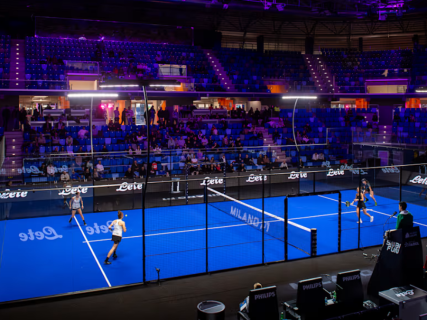

The 2026 World Padel Championship reaches its decisive day with a record figure: 1.2 million euros in prizes. The amount, announced by the International Padel Federation (FIP), is split equally between the two tournament brackets: 600,000 euros for the men’s competition and another 600,000 for the women’s.
The final this Saturday, November 7, in Doha thus puts the focus not only on world titles, but also on the economic dimension of a competition that faces national teams and that has increased its endowment considerably compared with the previous edition.
The figure represents the largest prize pool announced to date for an official padel competition. However, the 1.2 million do not correspond to the two champion teams nor are they distributed directly among the players who play in the finals.
Who organizes the World Championship and where does the money come from
The FIP World Cup is the main national-team tournament of the International Padel Federation (FIP), which organizes this edition in collaboration with the Qatari federation. Doha hosts the tournament at the Khalifa International Tennis and Squash Complex, which is also the venue for previous major international padel events.
The FIP confirmed in July that Qatar would be the host for the 2026 and 2028 editions. The choice was justified by the country’s sports infrastructures, its organizational experience, the conditions for the athletes, and the financial guarantees offered to host the championship.
The international federation is the one that has announced the economic endowment and its distribution. However, the public information released about the tournament does not break down what specific portion of the 1.2 million comes from FIP funds, the local organization, sponsors, or other commercial agreements. Therefore, it is not possible to attribute the full cost of the prize to a single entity or sponsor.
600,000 euros for each competition
The main characteristic of the prize pool is its equal distribution. The FIP has established two identical allocations: 600,000 euros for the men’s bracket and 600,000 for the women’s.
Equality applies to the set of each competition, not necessarily to the amount that each team receives according to its ranking. In each bracket, 16 countries participate, distributed into four groups of four teams. After the initial phase, the eight best teams advance to the quarterfinals, while the remaining teams continue competing to determine the positions from ninth to sixteenth place.
The international federation has confirmed the total amount and the breakdown by categories, but has not published a detailed table that would make it possible to know exactly how much corresponds to each place or how much the two champions will receive. For this reason, it cannot be stated that the winning teams will each pocket 600,000 euros: that amount is the full endowment of their bracket and must be distributed among the participating federations according to the established system.
The money goes to the federations, not directly to the players
Another important difference from the professional circuits is who receives the prize. In the World Cup for national teams, the financial rewards are routed through the national federations, which can subsequently decide how to manage or distribute the amounts among the members of their teams.
The experience from the 2024 edition helps to understand it. The Federación Española de Pádel received then 75,000 euros for the results of its men’s and women’s teams: the women’s team won the title and the men’s team finished as runners-up. On that occasion, the players agreed to allocate the entire prize to those affected by the dana in Valencia.
That precedent shows that the money does not necessarily have to end up in the athletes’ pockets. The decision about its subsequent destination depends on the management of each federation and on the agreements it reaches with its teams.
An endowment that grows versus 2024 and will rise again in 2028
The economic increase is notable compared with the previous World Cup, which was also held in Doha in 2024. In that edition, the endowment was 500,000 euros, distributed equally between the men’s and women’s categories. The 1.2 million this year multiplies the amount from two seasons ago by 2.4.
The economic bid will continue in the next edition. When it announced the awarding of the World Cups of 2026 and 2028 to Doha, the FIP advanced that the 2028 championship allocation will reach 1.35 million euros, also with an equal distribution between men and women.
The figure reflects the growth of a competition that brings together the main national teams and seeks to strengthen its position within the international calendar. In any case, the World Cup prize should not be confused with that of Premier Padel, the professional doubles circuit that has its own categories, tournaments, and prize tables.
The FIP World Cup faces countries and rewards the results of their selections; Premier Padel, in contrast, organizes tournaments in which professional pairs compete. They are different competitions, with their own economic systems and allocation criteria.