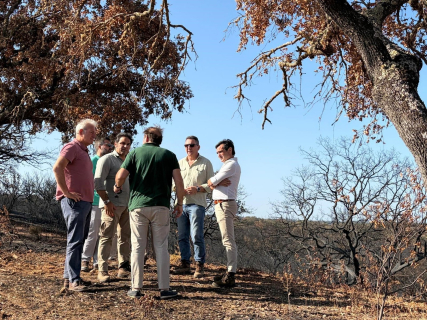

Asaja-Huelva has accompanied the territorial delegates of Agriculture, Fishing, Water and Rural Development and of Sustainability and Environment of the Junta de Andalucía, Álvaro Burgos and Pedro Yórquez, on a tour of several farms damaged by the recent wildfires that have ravaged the Andévalo region of Huelva.
During the visit, farms located in the four affected municipalities were inspected: Alosno, Gibraleón, San Bartolomé de la Torre, and Villanueva de los Castillejos. In the section carried out in Alosno, the mayor of the municipality also joined, as detailed by the organization in a press release.
The delegates were accompanied by representatives of Asaja-Huelva and by affected owners, who showed them on-site the damage caused by the fire in productive dehesas, agricultural and livestock farms, forestry, enclosures, water conduits, infrastructure, pastures, and trees.
Asaja-Huelva emphasizes that the territorial officials were "deeply impressed" by the current state of the farms. Both were previously familiar with many of these farms due to their institutional work, so "they were able to personally verify the enormous transformation suffered by a territory that was in full productive activity."
The agricultural organization interprets this visit as a new demonstration of the Junta's involvement, especially through the Ministry of Agriculture, Fishing, Water and Rural Development, which was the first administration to react after the fires, has fulfilled the commitments made, and has maintained constant contact with Asaja-Huelva and with the owners of the affected farms since then.
Coordination between administrations and declaration of severely affected area
This trip comes after the meeting held a few days ago in Gibraleón between Asaja-Huelva, several affected owners, the Government Subdelegation, and the mayors and municipal representatives of the four affected municipalities. In that meeting, the Subdelegation and the town councils expressed their willingness to work in a coordinated manner to promote the declaration of an Area Severely Affected by a Civil Protection Emergency and to expedite the arrival of aid to the owners of the farms.
The subdelegate of the Government also committed to processing the submitted documentation and to personally convey the situation to the Secretary of State for the Environment. Asaja-Huelva understands that both that meeting and the visit of the territorial delegates represent relevant steps, but emphasizes that the magnitude of the damages requires that institutional commitments be turned into effective measures, sufficient economic support, and agile administrative procedures as soon as possible.
They demand exceptional measures and regulatory changes
The agricultural organization insists on its demand for the area to be declared severely affected by a civil protection emergency, popularly known as a catastrophic zone, and requests the implementation of an extraordinary aid package that allows for the restoration of the farms, the replacement of infrastructures, and the reactivation of agricultural, livestock, and forestry activities.
Asaja-Huelva again focuses on the situation of helplessness suffered by the owners, who are victims of the fire and, however, forestry regulations require them to face costly restoration work, often without having insurance that covers the damages or sufficient public support to undertake them.
Therefore, the organization demands a review of forestry legislation and the procedures applicable after a fire, so that the recovery obligations are accompanied by public funding, technical assistance, and manageable deadlines for the owners.