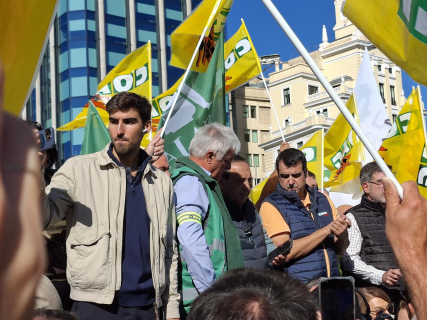

Asaja, COAG and Unión de Uniones have decided to postpone the tractor rally and the demonstration of farmers and livestock breeders scheduled for this Wednesday in Madrid as a result of the serious train accident that occurred in the province of Toledo, which has left at least thirty dead. As a sign of mourning, the organizations have agreed to observe five minutes of silence for the victims of the accident.
For this day, thousands of farmers and livestock breeders had been called, together with hundreds of tractors from numerous parts of the country, with the intention of filling the streets of the capital and demanding urgent measures that ensure the profitability and continuity of the agricultural sector.
The organizers had arranged for the tractors to arrive early in the day in five columns coming from Torrejón de la Calzada, Guadalajara, El Espinar, Buitrago del Lozoya and Arganda del Rey. The objective of the protest was to denounce the increase in production costs, the lack of profitability of the farms and "the threats that compromise the future" of agriculture and livestock breeding.
However, the collision between a Renfe train and another from Iryo in Urda (Toledo), with at least 30 dead, has led the agricultural organizations to suspend Wednesday's mobilization and postpone it to another date yet to be determined, maintaining as a gesture of respect the minutes of silence in memory of those affected.
Tractor rally postponed to defend the profitability and future of the countryside
The tractor rally, which Cooperativas Agroalimentarias de España had also joined, is not being considered canceled, but only delayed, the organizations insist. The protest is structured around five major demands, among them a shock plan against the rise in production costs and the immediate implementation of professional agricultural diesel, with reduced and stable taxation and bonuses applied directly at the time of refueling.
The sector is calling for a lasting solution and, while it arrives, "sufficient extraordinary measures" to deal with the extra cost of fuel and the rest of the inputs that are suffocating the rural world. They warn that, if action is not taken, productions such as cereals could be ruined and at serious risk of disappearance.
In the field of agricultural policy, the organizations demand that the next Common Agricultural Policy (CAP) be "strong enough to protect the income" of farmers and ranchers, reject any cut to the community budget allocated to the countryside, and call for a truly common CAP, with "sufficient" funding and its two pillars clearly differentiated.
Another of the key demands is to achieve "fair prices" and guarantee effective compliance with the Food Chain Law. They consider it unacceptable that farmers and ranchers continue to be the weakest link, bearing cost increases that they cannot pass on to the prices they receive for their products.
Likewise, they show their rejection of unfair competition derived from certain trade agreements. They denounce that European products cannot compete with imports that are not subject to the same requirements and reiterate their opposition to the EU-Mercosur agreement in its current conditions and to the agreement with Morocco, calling for regulatory reciprocity and rigorous border controls.
Finally, the fifth axis of the protest focuses on administrative simplification. They call for "less paperwork and fewer regulations," because they maintain that farmers and ranchers need to devote their time to working on their farms and not to a growing volume of procedures, records, and bureaucratic obligations.