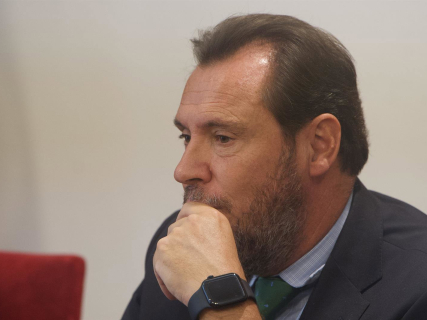
The president of the Road Engineers blames Óscar Puente for the railway accident

José Trigueros accuses Óscar Puente of the AVE and Iryo tragedy and denounces a serious failure of the safety system and railway maintenance.

fotonoticia 20261028112414 1920

fotonoticia 20261028112414 1920

Add DEMÓCRATA to Google

Ask FREN

Published

Last updated

2 minutes

Most read

Elecciones 29N · Encuestas

La media de las encuestas

Media a 27 de octubre de 2026 · 15 institutos

  • PP31,0 %
  • PSOE27,3 %
  • Vox18,9 %
  • Sumar6,3 %
  • Podemos2,9 %
  • ERC2,3 %
010203040ene 2024jul 2024ene 2025jul 2025ene 2026jul 2026

Media del último estudio de cada instituto en 30 días y su evolución semanal desde el 23J. Partidos con al menos un 2 %.

Todas las encuestas

Elecciones generales del 29 de noviembre · Demócrata

The president of the Association of Civil Engineers, Canals and Ports and of Civil Engineering, José Trigueros, has directly pointed to the Minister of Transport and Sustainable Mobility, Óscar Puente, as responsible for the accident between an AVE and an Iryo train on the Madrid-Seville line, a crash that has caused at least a dozen deaths.

In statements to Europa Press, Trigueros, who also chaired the Institute of Engineering of Spain (IIE), has strongly criticized the management of the head of Transport at the helm of the country's railway infrastructure.

"It cannot be that our infrastructure is run by incompetent people, who should be dealing with their Ministry and not posting tweets. It is a disgrace how our infrastructure is. I hold the minister responsible," he stated, questioning the lack of rigor and oversight in the maintenance of the network.

Although at first the possibility of human error as the origin of the accident was pointed to, the president of the association has focused on safety protocols and on the system that must prevent this type of failure.

According to what he warned, "if that failure is based on possible human error, that protocol is badly made". "It cannot be that in the 21st century an accident of this nature occurs. I feel ashamed of the lack of maintenance and control," he concluded, underscoring that the ultimate responsibility lies in the design and supervision of the systems.

Trigueros has insisted that "the cause of the accident is none other than one, the failure of the safety system of the line. The failure of the LZB, a safety system that apparently broke down first thing in the morning," pointing to this mechanism as a key element that would not have worked properly.

The engineer has recalled that in high speed the tracks are divided into blocks and that "in which if there is a train stopped in that block another train cannot enter because the signal has to be red". From his point of view, "what is incomprehensible is that the line is resumed" without the protection system being fully operational.

Along these lines, he stressed that the LZB system "failed" early in the morning "and it is supposed that they were restoring the system and trains were beginning to run." In his view, in a high-speed environment "we cannot afford human errors in high speed. If the traffic light is red, the train stops. It cannot be that Spanish high speed becomes the biggest disaster in Europe".

Trigueros has stressed that, even if the driver "runs a red light", the safety system must act immediately: "the system, automatically if it works well, stops the train": "There cannot be two trains in the same block".

For this reason, he maintains that "what has happened is because the train did not stop it, the system should have stopped it. The driver has no fault whatsoever because the train has to stop it", exonerating the driver and attributing the origin of the accident to the system failure and the lack of oversight by the Ministry.

More key points, information and questions with FREN

AI-GENERATED CONTENT

What is the current status of the official investigation into the Urda railway accident and what are the next steps planned by the authorities?

The investigation of the Urda railway accident is, as of October 28, 2026, in an initial phase of collection and analysis, with no official cause established nor technical conclusions published. Adif is examining its systems and the sequence of events. No specific investigation timetable or official forecast for restoring traffic has been communicated.

What is confirmed

The accident occurred this morning, around 8:54 a.m., at kilometer point 118 of the Madrid-Andalucía high-speed line, between Mora and Orgaz and Urda. Adif confirmed a rear-end collision between two trains from Renfe and Iryo. Initial information from the Ministry places AVE 2080 behind Iryo 6076 and indicates that the impact caused the derailment of the last two cars of the latter, according to Demócrata.

Adif and Renfe teams have traveled to the site to assess the damage and coordinate assistance. Adif is reviewing safety systems, facilities, and the operational sequence, without having identified the cause yet, according to information from EFE. The Minister of Transport, Óscar Puente, went to the Atocha H24 control center to gather information before offering public explanations.

What hypotheses are being examined

Initial government information points to a possible failure of the LZB, the system that continuously monitors traffic and transmits speed and operating condition instructions to the cab. That failure would have forced the trains to stop and then resume traffic through alternative procedures.

A possible human error during that resumption has also been suggested. However, Adif has not confirmed the failure nor its relation to the collision. As explained by Demócrata, it remains to be clarified what instructions were transmitted, how both trains were coordinated, and whether they were indeed operating under lateral signaling. These are preliminary hypotheses, not an accredited attribution of responsibility.

Status of the technical and judicial investigation

The consulted sources do not show a public communication confirming the formal opening of a specific file by the Railway Accident Investigation Commission, the appointment of the investigative team, or the publication of a preliminary report on Urda. Nor is there verifiable identification of the judicial body in charge, specific proceedings, or persons under investigation.

Therefore, the operational analysis already carried out by Adif must be separated from the independent technical investigation and any possible criminal investigation. It is not appropriate to transfer reports, courts, or conclusions related to the Adamuz accident to Urda.

Next steps and deadlines

The immediate confirmed action is to continue analyzing the systems and reconstruct the accident sequence. The pending technical issues are:

  • Determine if there was an LZB failure and when it was detected.
  • Specify the traffic regime used and the authorizations transmitted.
  • Establish why protections did not prevent the rear-end collision.
  • Assess the damage and the conditions necessary to restore service.

The approved text of Law 2/2024 provides that the technical investigation shall begin ex officio as soon as the authority becomes aware of the accident, without delay exceeding two months from its notification. This is a general framework, not an announced timetable for Urda. There is also no official reopening date; Renfe maintains the 900 10 10 20 number for affected persons and families, according to customer service information.

What are the legal powers and responsibilities of the Minister of Transport and Sustainable Mobility regarding railway safety?

The Minister of Transport and Sustainable Mobility has competencies in political leadership, regulatory promotion, planning, and management control of the state railway system. However, not all safety powers are concentrated in this office: the State Railway Safety Agency (AESF) exercises technical safety authority, while infrastructure managers and railway companies assume their own safe operation obligations.

1. System leadership and planning

Article 5 of the Law 38/2015, on the railway sector assigns the Ministry the indicative strategy for development, maintenance, and renewal of the General Interest Railway Network, as well as planning and establishing or modifying its lines, stations, and terminals. These competencies allow guiding investments and priorities that affect safety but do not replace the required technical authorizations.

Royal Decree 253/2024 distributes its exercise: the State Secretariat programs investments prioritizing safety and maintenance; the General Secretariat of Land Transport promotes and coordinates actions; and the Directorate General of the Railway Sector prepares plans, studies, and regulatory proposals. It is important to distinguish the department's attributions from those exercised personally by its head.

2. Regulatory promotion and coordination

The minister directs the department that prepares and promotes railway regulation. However, Article 5 of Royal Decree 253/2024 expressly reserves AESF's competencies over operational safety, interoperability, and dangerous goods. Interoperability is the technical compatibility necessary for different system elements to function jointly.

Therefore, regulatory development does not correspond exclusively to the minister: Law 38/2015 also tasks AESF with proposing, developing, and implementing the safety regulatory framework. The Directorate General must coordinate with it on new technologies and international representation, without displacing its technical competencies.

3. Control of infrastructure managers

Articles 25 and 30 of Law 38/2015 allow the Ministry to intervene through financing agreements, monitoring activity programs, and technical control. Royal Decree 253/2024 assigns the State Secretariat strategic direction, evaluation, and control of results of ADIF, ADIF-High Speed, and Renfe-Operator.

This control allows demanding coherence between investment, maintenance, and public objectives. It does not equate to personally managing traffic nor assuming operational decisions that correspond to each entity.

4. Powers assigned to AESF

Law 38/2015 identifies AESF as the authority responsible for safety on the General Interest Railway Network. Its responsibilities include:

  • Supervising compliance with safety obligations and inspecting infrastructure, vehicles, personnel, and railway operations.
  • Authorizing fixed subsystems and vehicles within the legally assigned scope.
  • Issuing, modifying, or revoking safety certificates of companies and safety authorizations of administrators.
  • Acting on personnel qualifications, training and maintenance centers, and exercising sanctioning power in railway safety.

Article 3.6 of Royal Decree 253/2024 provides its attachment to the Ministry through the General Secretariat of Land Transport but recognizes its functional autonomy. Its Statute, approved in 2014, also establishes that resolutions of its higher bodies exhaust the administrative route: this attachment does not grant the minister a general power to override its decisions.

In short, the minister is responsible for the department's orientation and organization and the competencies assigned by the legal framework; AESF technically supervises safety, and operators and administrators must maintain their own management systems. Political leadership, technical supervision, and operational responsibility are distinct functions.

What is the professional and political background of José Trigueros, president of the Association of Civil Engineers?

José Trigueros has a career focused on civil engineering and senior management in public administration, with responsibilities in infrastructure, environment, coasts, and territorial planning. He has presided over the Association of Civil Engineers, Canals and Ports and Civil Engineering since 2020 and was re-elected in 2023. His political dimension mainly comes from the public offices he has held: the consulted sources do not evidence an electoral career nor organizational responsibilities in a party.

Education and professional profile

He is a Civil Engineer from the Polytechnic University of Madrid. He completed his training with an MBA from the Instituto de Empresa and a diploma in Public Investments from the National Institute of Public Administration, according to his profile on the Association's website.

His specialization combines technical knowledge of public works with training in management and investment. This combination fits a career developed mainly in the direction of departments and public agencies, rather than an exclusively business or academic trajectory.

Responsibilities in the Administration

In the Community of Madrid, he held three general directorates listed in his institutional biography:

  • General Directorate of Roads and Infrastructure.
  • General Directorate of Environmental Assessment.
  • General Directorate of Urban Planning and Territorial Strategy.

In the General State Administration, he was Director General of Quality and Environmental Assessment and Director General of Coasts, both positions in the Ministry of Environment. His experience thus covers both infrastructure planning and management and its relationship with environmental protection and territorial planning.

He also directed the Center for Studies and Experimentation of Public Works (CEDEX). Information published on the occasion of his election as head of the Spanish Engineering Institute in 2020 placed the start of that responsibility in 2017. This past position should be distinguished from his subsequent activity: a communication from February 2026 identifies him as a CEDEX official, not as its director (biographical note).

Leadership in engineering organizations

He assumed the presidency of the Association of Civil Engineers in January 2020. In December 2023, he was re-elected for four years, consolidating his role as a professional representative of civil engineering (first term; 2023 re-election).

In 2020, he was also elected president of the Spanish Engineering Institute, replacing Carlos del Álamo. This should be treated as a stage of his career, without assuming his current continuity. The announcement of that appointment also noted his position as a board member of the Madrid Branch of the College of Civil Engineers.

Among his recognitions are the Professional Merit Medal from the College of Civil Engineers and the Road Honor Medal with special mention from the Technical Road Association.

Political career and public presence

The fundamental distinction is between holding senior administrative positions and having a partisan career. His responsibilities as director general are documented, but the consulted sources do not show affiliation, organizational office in a party, or mandate as deputy, senator, or councilor.

He does maintain political dialogue from his professional representation. On February 23, 2026, he participated in a meeting with PP officials on dam maintenance and safety; that participation alone does not prove party membership (meeting communication).

He also appeared before the Senate commission on the DANA on September 18, 2025. There he advocated accelerating hydraulic works and prioritizing dams and diversions, according to Demócrata. His profile is, in summary, that of a technician with administrative government experience and professional representation, not that of an accredited partisan leader.

Play

Test your knowledge with FREN!

How much do you know about this topic? Answer the following 3 questions.

What security system is mentioned as the main cause of the railway accident according to José Trigueros?

Question 1 of 3

What opinion does Trigueros express about the driver's responsibility in the accident?

Question 2 of 3

What is José Trigueros' main criticism of Óscar Puente's management as minister?

Question 3 of 3