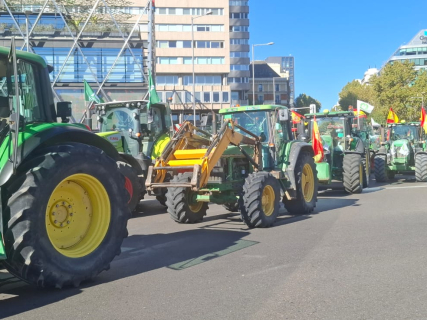
The farmers suspend the tractor protest and observe several minutes of silence

The three agricultural organizations calling the protest, ASAJA, COAG and Unión de Uniones, are suspending the demonstration called in the wake of the railway tragedy that occurred in Toledo.

WhatsApp Image 2026 10 28 at 11.29.33

WhatsApp Image 2026 10 28 at 11.29.33

Add DEMÓCRATA to Google

Ask FREN

Published

Last updated

1 minute

Most read

Elecciones 29N · Encuestas

La media de las encuestas

Media a 27 de octubre de 2026 · 15 institutos

  • PP31,0 %
  • PSOE27,3 %
  • Vox18,9 %
  • Sumar6,3 %
  • Podemos2,9 %
  • ERC2,3 %
010203040ene 2024jul 2024ene 2025jul 2025ene 2026jul 2026

Media del último estudio de cada instituto en 30 días y su evolución semanal desde el 23J. Partidos con al menos un 2 %.

Todas las encuestas

Elecciones generales del 29 de noviembre · Demócrata

Although hundreds of them were already gathered in Madrid’s Plaza de Colón, the agrarian organizations calling for the October 28 Demonstration have decided to suspend their protests out of respect for those affected by the railway accident that occurred this very morning. 

"ASAJA, COAG and Unión de Uniones, out of respect and solidarity with the victims of the very serious train accident that occurred today, call off the tractor protest planned for today and postpone their demands actions for later. We express our sincerest condolences to the families of the deceased people and wish the injured a speedy recovery", they said in a brief statement.

The protesters, who since the news broke, were informed by the farmers and ranchers traveling from Andalusia to Madrid, have decided to hold five minutes of silence in Plaza de Colón for the victims of the unfortunate train crash. Hundreds of farmers and ranchers from various parts of Spain had gone there. 

"Today is a terrible day", said the general secretary of COAG, Andrés Góngora, "it is a heartbreaking day. We all have the misfortune in our heads. Spain is in mourning and we farmers are Spain. In a moment of mourning, what remains is to stand in solidarity with all the affected people and demand that these misfortunes cannot happen. But the problems continue and so does the unity of action. The mobilizations are postponed, not called off", he stated. For his part, the president of ASAJA, Pedro Barato, asked for the cooperation of the protesters to keep order in Madrid today and promised to "keep working for the countryside".

The five demands claimed by farmers and ranchers are concentrated in the following demands:

  • A shock plan against production costs, with a professional agricultural diesel fuel now. 
  • A strong CAP that protects the income of farmers and ranchers. 
  • Fair prices and an Enforcement of the Chain Law that is complied with. 
  • No to unfair competition from the trade agreements with Mercosur and Morocco.
  • Less paperwork and fewer rules, so they can dedicate themselves to work. 


More key points, information and questions with FREN

AI-GENERATED CONTENT

What is the status of the parliamentary processing of reforms or laws addressing the demands of farmers and ranchers in Spain?

As of October 28, 2026, the main news is that the pending agrarian reforms in the Cortes Generales expired with the dissolution on October 6: they are no longer progressing towards approval. This does not eliminate the already approved regulations nor the aids established through royal decree-laws. It is therefore advisable to separate the reforms that were not completed, the approved measures, and the projects still in preparation.

State reforms that were not approved
  • Food chain. The proposal from the Republican Group, presented in March 2024, aimed to strengthen the negotiation of cooperatives, establish cost references, simplify contracts, and prohibit resale at a loss. It expired on October 6, 2026, without becoming law. (Text of the proposal).
  • Strengthening AICA. The socialist proposal published on August 29, 2025 sought to transform the body into the State Agency for Food Chain Inspection, with greater autonomy and management flexibility. It also expired: that transformation was not approved through this initiative. (Proposal on AICA).
  • Taxation of the primary sector. The proposal promoted by the PP in the Senate reached the Congress in May 2025 and was sent to the Treasury for amendments. It proposed raising tax thresholds, improving modules, and allowing income calculation over three fiscal years. It expired without final approval. (Proposed tax reform).
  • Income and revenue insurance. The PP proposal published in Congress on January 19, 2026 expired. The equivalent Senate initiative had been admitted and awaited debate to decide whether to begin processing; it was also affected by the dissolution. These proposals should not be confused with the annual subsidy plans for policies, which are different instruments. (Congress proposal; Senate procedure).
  • Strategic food system. The proposal from the Senate expired in Congress. Another PP initiative on this matter had already been rejected on December 9, 2025. The proposal for the Rural Guarantee Mechanism, aimed at evaluating the rural impact of policies, also expired. (Food system; Previous rejection; Rural mechanism).
Approved aids: different parliamentary situation

The government projects derived from royal decree-laws 8/2023, 4/2024, 7/2024, 5/2026, and 7/2026, related to drought, economic crises, DANA, and adverse meteorological phenomena, also expired. The expiration of their conversion into laws does not repeal the previously validated royal decree-laws; each aid retains its conditions and deadlines. The dissolution is recorded in the Official State Gazette (BOE) of October 6.

In parallel, Agriculture announced on September 29 the approval of an extension of diesel aid until December 31. It is a temporary aid, not a permanent tax reform. The draft order on modules for 2027 remains in public information until November 3: it is also not an approved parliamentary law.

Regional scope and summary

In Catalonia, the urgent support measures project for the agricultural and forestry sector had already been completed: the approved text was published on May 19, 2026. The proposal for direct professional agriculture protection is still being processed and published amendments on October 19. (Approved text; Published amendments).

In summary: the indicated state structural reforms were not completed and will need to be promoted again; the approved aids and administrative changes of the CAP follow a different path. Demands regarding imports and reciprocity also largely depend on European decisions.

What are the main competencies of the general secretary of COAG and the president of ASAJA according to Spanish agrarian legislation?

The general secretary of COAG and the president of ASAJA mainly perform functions of representation, leadership, and defense of agrarian interests. The fundamental legal precision is that Spanish agrarian legislation does not grant them, by virtue of these positions, their own administrative powers: their specific faculties depend on the statutes of each organization and the agreements and powers granted by their bodies.

Legal framework: professional representation, not public authority

COAG and ASAJA are private professional agrarian organizations. It is important to distinguish between the functions that the regulations recognize for an organization as a sector interlocutor and the internal powers of those who hold its general secretariat or presidency. That an entity participates in negotiations with Agriculture does not mean its leader can approve regulations, grant subsidies, or impose decisions on farmers.

The associative framework includes the right of association and the regulations corresponding to the professional nature of these entities. However, it should not be assumed that all general provisions on associations apply in the same way. To define each position, the decisive reference is their statutes; to participate in a consultative body, the specific regulation of that body also matters.

Main functions of the general secretary of COAG

The institutional structure of COAG places the general secretariat as the central reference of its Executive Commission and assigns statutory responsibilities, along with transversal areas such as communication and economy. Its main functional areas are:

  • Institutional representation: conveying COAG's positions before public administrations, European institutions, and other interlocutors, within the received mandate.
  • Executive coordination: articulating the ordinary work of the organization and matters common to its different agrarian sectors.
  • Execution of agreements: promoting decisions adopted by competent bodies, without replacing the powers corresponding to them.
  • Interlocution and communication: expressing the entity's demands and participating in dialogue on policies affecting farmers and ranchers.
  • Organizational functioning: coordinating transversal responsibilities and exercising functions validly delegated.

These functions do not imply an unlimited power to contract, dispose of assets, or represent COAG legally. Each action requires statutory backing or the corresponding power.

Main functions of the president of ASAJA

The presidency of ASAJA performs a function of superior representation and institutional guidance. The institutional information of ASAJA about its assembly shows the link of the presidency with that body and its role in defining priorities. Its main areas are:

  • Representing the organization: acting as interlocutor before the Government, territorial administrations, European institutions, and other entities.
  • Promoting its advocacy orientation: defending professional interests and conveying proposals on agrarian policy, profitability, and production conditions.
  • Promoting internal agreements: driving decisions of governing bodies and coordinating institutional activity.
  • Acting through express powers: signing documents, agreements, or other commitments only when allowed by statutes or granted powers.

The complete national statutes that would allow affirming, as verified powers, their regime of convocations, casting vote, appointments, or delegations have not been located in the consulted sources. National attributions should also not be confused with those of territorial associations.

Practical difference and limits

The main distinction is internal organization: in COAG, the executive coordination of the general secretariat stands out; in ASAJA, the superior representation of the presidency. Both can negotiate and defend proposals, but they do not decide public agrarian policy by themselves nor automatically bind the entire sector. The scope of any commitment depends on their mandate and representation.

What legal requirements must be met to organize a demonstration or tractor rally in Madrid?

To organize a demonstration or a tractor rally in Madrid, the basic rule is to notify it in advance, not to request authorization to demonstrate. It must be peaceful and unarmed. In a tractor rally, it is also necessary to distinguish the exercise of the right of assembly from traffic obligations: notifying the protest does not equate to obtaining freedom to circulate or occupy any road.

1. Prior notification and deadlines

Article 21 of the Spanish Constitution recognizes this right. Articles 8 and 9 of Organic Law 9/1983 require organizers to notify in writing the call to the competent governmental authority in Madrid:

  • Ordinary call: between ten and thirty calendar days before holding it.
  • Urgent call: with a minimum of twenty-four hours, only when there are extraordinary and serious causes justifying that urgency. It is not enough to have organized the event late.

The notification corresponds to the organizers or promoters. If an association, union, or other legal entity calls it, its representative must do so. The callers must be in full exercise of their civil rights.

2. Mandatory content of the written notice

The notification must clearly identify who calls and how the protest will develop. It must include:

  • Name, surname, address, and official identification document of the organizers or representative; if there is a calling entity, also its name, nature, and address.
  • Place, date, time, and expected duration.
  • Purpose or objective of the mobilization.
  • Planned itinerary, when circulating on public roads.
  • Planned security measures and those requested from the authority.

In a tractor rally, it is advisable to add, as practical information, the expected number of vehicles, their characteristics, and the gathering and departure points. This helps specify the security device, although it is not listed as an autonomous section in the cited legal content.

3. Route, traffic, and tractors

The governmental authority forwards the notification to the affected city council, except in the legally provided urgent call. The city council has twenty-four hours to report on the route, coincidence with other events, and security conditions; its report must be reasoned and is not binding.

The notification does not replace traffic obligations. Before closing a tractor rally, the legal suitability of vehicles and drivers and the possibility of using each planned section must be verified. It should not be assumed that the right to demonstrate allows access with tractors to any road or to make cuts on one's own initiative. As an organizational recommendation, entries, exits, and emergency accesses should be coordinated.

4. Limits, responsibility, and sanctions

The prohibition requires founded reasons of public order disturbance with danger to persons or property; disagreement with the demand is not enough. Against a prohibition or modification not accepted, the law provides for an administrative contentious appeal within forty-eight hours.

Organizers must take measures to maintain good order. Those who cause damage are directly responsible; promoters may be subsidiarily liable if they did not take all reasonable means to prevent them.

The Citizen Security Law considers certain breaches of notification and development obligations attributable to organizers as minor infractions, with fines from 100 to 600 euros. Other behaviors may have different consequences: that amount is not a general limit for any incident.

Play

Test your knowledge with FREN!

How much do you know about this topic? Answer the following 3 questions.

What action did the calling agricultural organizations take after the train accident that occurred on the morning of October 28?

Question 1 of 3

How many minutes of silence did the farmers and ranchers gathered in Plaza de Colón observe?

Question 2 of 3

Which of the following is NOT one of the main demands of the farmers and ranchers mentioned in the news?

Question 3 of 3