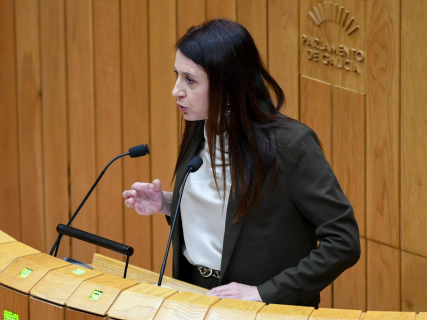

The councillor for Rural Affairs, María José Gómez, has rejected the European Commission's proposal on the Common Agricultural Policy (CAP) for the period 2028-2034 and has demanded a budget "sufficient and without cuts" that preserves its nature as a common policy, maintains the structure of the two pillars, and guarantees specific allocations for rural development.
She has also said that the Xunta has been working since July 2025 to defend the interests of the Galician countryside and has warned that the potential effect of the proposal could mean up to 80 million euros less per year.
In an interpellation by the BNG in a plenary session of the Parliament, Gómez emphasized that the position of the regional executive is to prevent the future of Galician farms from being conditioned by the financial capacity of each Member State and to avoid rural development losing relevance in EU policies. "We do not agree with the proposal presented by the European Commission," she insisted.
The councillor recalled that the Xunta appeared publicly on 18 July 2025, one day after the community initiative became known, to warn of a possible shortfall of more than 20% in agricultural funds and an estimated impact of around 80 million euros per year for Galicia, also considering the increase in co-financing requirements. She clarified that this is a forecast and not a loss that has already materialized.
Gómez defended that the Galician Government has sought a joint position with the sector. To this end, in January 2026 a specific commission was created in the Consello Agrario Galego to study the future CAP, and in February, this body gave the green light to a document agreed with agricultural organizations that sets out the main Galician demands: sufficient funding, continuity of the two pillars, differentiated funds, protection of rural development, and the participation of the autonomous communities.
The person responsible for Medio Rural has indicated that this text was sent to the Ministry and to the community institutions. Along this line, she has reminded that on March 3 she traveled to Brussels to meet with the European Commissioner for Agriculture, Christophe Hansen, to whom she conveyed the need to adapt the community instruments to the productive and territorial specificities of Galicia, such as the weight of family holdings, the dairy and livestock sectors, the dispersion of the population, and areas with natural limitations.
She has also referred to the positions put forward in meetings with the Ministry and the autonomous communities, in which she has demanded greater capacity for decision-making for the regional governments in the planning and management of the funds and the recovery of the working groups to prepare the next strategic plan.
At the sectoral conference of October 21, she requested sufficient funding and that the funds earmarked for rural development continue to be protected, in addition to a moratorium for the entry into force of the Digital Notebook of the Holdings, scheduled for January 1, 2027.
He calls on the State to take advantage of financing channels
Gómez has warned that there are two additional financing possibilities that, in his view, the central Government cannot afford to let pass: the option of reserving 10% of the Single Fund for rural development and the 47,000 million euros that could be mobilized through the intermediate review of the national and regional association plans.
The Xunta, he has assured, is willing to contribute its own resources to co-finance the necessary actions, but he has stressed that regional funds cannot replace a CAP "sufficiently funded nor compensate for European cuts." He has also attributed to the central Government the responsibility for making use of those additional avenues and for defending the sector’s demands before the EU.
BNG asks for more decision-making capacity for Galicia
For his part, the BNG deputy Secundino Fernández has questioned the effect, as he understands it, that the community agricultural policies have had since Spain’s entry into the EU in 1986 and has linked it to the loss of population in rural Galicia. He has stated that 250 Galician municipalities have lost inhabitants since then and that more than a third has recorded a decline of more than 50%.
The nationalist parliamentarian has warned that the proposal for the CAP 2028-2034 foresees a cut in funding of more than 20% and has linked this reduction to the diversion of resources to military spending.
Likewise, he has rejected the elimination of the two CAP pillars, which until now have been financed through the FEAGA and the FEADER, and their integration into a single centralized fund through national plans, considering that this would imply a renationalization of agricultural policy and would leave Galician priorities subject to decisions from Madrid.
Fernández has demanded that Galicia have room to define and adapt the guidelines of the future CAP to its productive reality and has defended maintaining and increasing funding, preserving the two pillars and prioritizing small family farms, population retention in the territory, and generational renewal.
In his address, he criticized the regional minister for not having presented a document with concrete proposals from the Xunta on issues he considers key for the sector, such as the aid system by area, the disappearance of historical rights, the limits and degressivity of aid, the definition of active farmer, or support for sectors such as dairy, wine and grape-growing, and beef cattle.
He has also asked about the measures planned for areas with natural constraints, agri-environmental aid, organic production, the incorporation of young people into farming, and investments in agri-food industry, innovation, and land recovery. “What does the Xunta propose? We don’t know,” he summarized.
Gómez accuses the BNG of not demanding that the central Government
In his final turn, the regional minister has reiterated that the Xunta does not accept budget cuts, the disappearance of differentiated funds, or a model that conditions aid on the economic capacity of each State.
He has said that the Galician Government has submitted statements of objections to the different versions of the European regulations since July 2025 and that it will continue to defend its position before the Ministry and the European Commission.
In addition, he has reproached the BNG for not requiring the central Government to defend the interests of Galician farmers and ranchers, and has insisted that it is the State that must negotiate at the Community level. “Defending Galicia also means demanding responsibilities from those who govern in Madrid when they are not defending our interests,” he said.