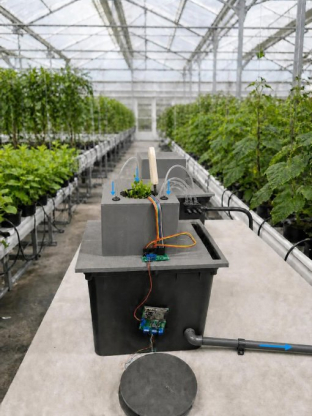

Researchers from the Department of Computer Technology and Computing at the University of Alicante (UA) have developed an intelligent growing system capable of monitoring and regulating at all times the growing conditions of plants through sensors, connected devices, and artificial intelligence (AI), and that "increases productivity by 30 percent".
The solution, currently protected through a patent application, combines in the same structure a multilayer design with aerated substrate, a water reservoir that takes advantage of the benefits of hydroponic cultivation, and a growth support with substrate, as the academic institution has detailed in a statement.
"This hybrid design, tested in authorized facilities for the cultivation of medicinal cannabis, has achieved production yields higher than 30% in relation to current industrial methods," explains Francisco Javier Ferrández, the UA researcher.
The system is characterized by its three-level configuration, connected to a network of sensors and devices that make it possible to collect data, exchange information, and make decisions in an automated manner.
In the lower part, a water reservoir is located where parameters such as pH, temperature, and electrical conductivity are monitored. The middle section, made up of gravel, improves aeration and drainage, while the top layer contains the substrate where the plant develops.
"Since it is a multilayer model, the intermediate zone acts as an air cushion with an inert material that oxygenates roots, drains, and cushions variations in humidity and temperature," describes Ferrández.
According to the UA, this architecture makes it possible to achieve a functional and controlled separation between the water storage, the medium where the roots are established, and the growing substrate, "optimizing water management and the aeration of the roots".
As for irrigation, the researcher adds that "the technology designed has achieved up to a 40% saving in water consumption compared with conventional automation systems, since it has a calibrated drain and an autonomous controller that prevents pooling of water".
"The result is an invention that controls all parameters in real time, learns, predicts, and acts autonomously. With all of this, we manage to improve root development by giving the plant the light, water, and nutrients it needs, while at the same time simplifying the farmer's or producer's supervision and maintenance tasks", details the UA researcher.
Uses in agriculture and trials
Among the possible applications of the technology designed by the UA are greenhouses, seedbeds, forest nurseries, floriculture, and ornamental production, as well as food horticulture.
Individualized control of growing conditions is equally advantageous for research and agronomic trials, as well as for specialized sectors in medicinal and aromatic plants, since it facilitates the systematic collection of data in the different stages of development, the university has emphasized.
"This advance is the result of the synergy between agricultural science and the application of enabling technologies such as AI and the Internet of Things (IoT), marking a milestone in the digitalization of the farming sector", the researcher stresses.
The UA has an operational prototype in the format of a potted plant that has already been tested under real growing conditions. The institution's Office for Research Results Transfer (OTRI) is looking for companies interested in obtaining a license for its commercial exploitation and thereby boosting its implementation in the agricultural sector.