Artificial intelligence has also arrived at public procurement. As more and more administrations begin to use algorithms to manage files and automate procedures, bidding companies are also turning to AI systems to draft technical offers, interpret specifications, identify award criteria, or even estimate the chances of success of a proposal.
It is a costly process, in which having good advisors is part of the competition among bidders. Today, many of those tasks can be performed in a matter of minutes. An AI model is capable of summarizing a specification of hundreds of pages, automatically extracting evaluation criteria, identifying exclusionary requirements, drafting complete technical reports, proposing improvements aligned with the subjective award criteria, and even adapting the language of the offer to the usual style of each contracting administration.
The optimization of offers through the AI represents an extraordinary leap in productivity. But it also raises questions about the adequacy of regulation in public procurement to this new technological reality. For example, one initial aspect is that which affects equality of opportunity among economic operators.

In this regard, it is worth remembering that public procurement is based on principles such as equality, free competition, and non-discrimination. However, the availability of advanced AI tools can become a new factor of competitive inequality. In other words, those companies that have resources to train models on thousands of previous bids, integrate their own document bases, or develop specialized assistants in public procurement will have more chances of being awarded.
Paradoxically, the technology that promised to democratize access to knowledge could end up concentrating competitive capacity even more in those who have greater technological resources. There is also a second, less visible risk, which is the homogenization of offers.
We refer to a scenario in which when multiple companies use similar models trained on the same data and optimized to maximize the score according to certain criteria, the proposals inevitably tend to resemble each other. The differences in style disappear, the structures converge, and the proposed improvements begin to repeat.
The consequence can be a progressive loss of real innovation. If all artificial intelligences reach similar conclusions on how to maximize the score of a tender, the offers will end up looking like slightly different versions of the same document. And if all the responses are the same, the ability of contracting bodies to distinguish which is truly the best proposal is considerably reduced.
It also deserves special reflection the impact of AI on the drafting of the tenders themselves. AI models work better the more precise the instructions they receive. Curiously, that same logic can be transferred to the design of administrative tenders. Ambiguities, contradictions, or excessively open criteria can be exploited by AI assistants capable of detecting inconsistencies that would go unnoticed by a human reader.
This will likely force administrations to draft tenders that are much clearer, structured, and technically consistent. Not only to facilitate competition but to avoid strategic interpretations automatically generated by AI systems.
At the same time, one can imagine a near future in which the Administration itself uses artificial intelligence to review the received offers. Tools capable of automatically checking compliance with requirements, detecting internal contradictions, identifying possible plagiarism among bidders, or even analyzing the coherence between the commitments offered and the documentation provided.
But here appears another challenge of enormous legal relevance, in addition to new risks of illegality, such as automatic awarding; or the risk of prompt injection, that is, the insertion of instructions invisible to the eyes of the contracting table, but readable by the AI when evaluating -in a more beneficial way- the offer in question. There is also an additional risk that is just beginning to be debated.
If both companies and administrations use AI models trained on previous tenders, the system can enter a feedback loop. The models will learn from past decisions; the new specifications will incorporate patterns detected by those models; the bids will adapt to those same patterns, and future decisions will reinforce them again.
Unintentionally, we could be automating not only the document management of public procurement but also certain interpretative inertia, making it difficult for truly innovative solutions to emerge for the public sector.
Public procurement is one of the main instruments for executing public policies and managing collective resources. Precisely for this reason, the revolution of artificial intelligence demands something more than efficiency: it demands preserving trust that decisions continue to be made according to the merit of the bids and not to the power of the algorithms that draft them.
about the author:
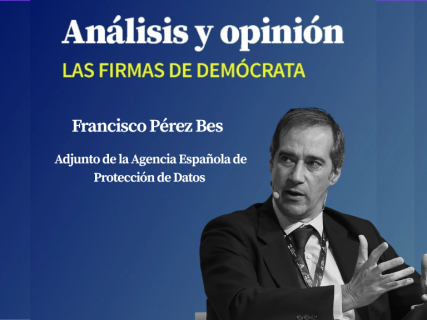
Francisco Pérez Bes is deputy of the Spanish Agency for Data Protection. In addition, he was a partner in the Digital Law area of Ecix Group and is a former Secretary General of the National Cybersecurity Institute (INCIBE).