Spain continues to be a full democracy, but that should not serve as comfort when we fail in basic matters of public integrity. According to the Economist Intelligence Unit's Democracy Index 2025, Spain scores 8.20 and ranks 22nd worldwide among full democracies. This is undoubtedly good news. However, it is worth putting the data into perspective. Spain has not managed to recover the levels prior to the institutional and economic crisis: in 2006 it reached 8.34 points, and in the following years it experienced a deterioration linked to citizen distrust, corruption cases, and political tensions.
In this context, it is not surprising that Ireland reaches 9.19 points and is among the best-rated democracies in the world. Its best result is also based on a more robust institutional framework, among other areas it stands out for its regulation of lobbying, where it has developed more advanced transparency and control instruments.
And that is precisely one of Spain's democratic deficits: the lack of effective regulation of influence activities or lobbying. Compared to countries in our neighborhood like Ireland, France, or Germany, or more recently Portugal, which do have more developed frameworks to regulate the activity of interest groups, Spain continues to drag an anomaly that is difficult to justify: it still does not have complete regulation of lobbying and, at the same time, repeatedly fails to comply with transparency obligations already in force for deputies and senators.
We are not, therefore, talking about a non-existent or marginal activity. The lobby exists, it is legitimate in a democracy and is a natural part of the dialogue between public officials and civil society. Furthermore, it is a fully recognized professional activity. It is enough to observe that thousands of professionals openly identify themselves on platforms like LinkedIn as specialists in public affairs, institutional relations, lobbying, or advocacy. In Spain, this community is represented, among others, by the Association of Professionals of Institutional Relations (APRI), which brings together nearly 300 professionals and 40 organizations. Ignoring this reality does not make it disappear; on the contrary, it leaves it without clear rules.
Spain continues to drag an anomaly difficult to justify: it does not yet have complete regulation of lobbying
The most recent alarm signal comes again from the Spanish Parliament itself. The annual report of the Office of Conflict of Interests on compliance with the Code of Conduct in 2025 indicates that, beyond the mandatory organic meetings of Plenary Sessions, Committees, or Working Groups, only 75 deputies (21.4% of a total of 350) and 55 senators (20.7% of 266) published other types of activities or meetings. That is, barely 20% of the honorable members of each Chamber are reflecting additional activity in their agendas. And the most relevant thing is not just the figure, but the content: the report itself warns that these entries are made occasionally, usually refer to attendance at events, and rarely include meetings with interest groups.
It is not a new or unknown problem. The Association of Professionals of Institutional Relations (APRI) has reminded the Chamber on several occasions of the non-compliance with the obligation to publish institutional agendas, also pointing out the absence of an effective sanctioning mechanism and insufficient regulatory development. When an obligation exists on paper, but is not accompanied by supervision or consequences for non-compliance, it ceases to be a real accountability tool and becomes an empty formality, coinciding with the warnings of the GRECO —the Group of States against Corruption of the Council of Europe— in its repeated monitoring reports on Spain, where they insist on the need to establish more precise rules on the relationship between parliamentarians and interest groups, as well as on guaranteeing the effective publication of agendas.
The concern is not limited to Parliament, where the Code of Conduct has proven to be of very limited effectiveness and the proposal to reform the regulations and regulate the activity of interest groups remains paralyzed. In the executive branch, the situation is no better: significant shortcomings persist in transparency regarding influence. In this regard, GRECO has insisted on the need to regulate contacts with interest groups, strengthen the transparency of these interactions, and ensure the traceability of influence.
For deputies, senators, and members of the Government, having clear rules is not an obstacle, but a guarantee
That is why the debate should not be limited to whether Spain "passes" or not in international rankings. The real question is another: can a democracy be satisfied? Are we improving transparency mechanisms? Democratic quality is not only measured by holding free elections or by having consolidated freedoms, it is also measured by the robustness of its integrity mechanisms, by the transparency of decision-making, and by equal access to public-private dialogue.
Regulating lobbying —with public agendas, registries of interest groups, clear rules, and effective sanctions— does not mean stigmatizing it. It means, precisely, the opposite: recognizing it as a legitimate activity in a democracy, ordering it, and subjecting it to a transparent and common framework for everyone. It means offering legal certainty to those who professionally represent interests, but also to those who listen to them. For deputies, senators, and members of the Government, having clear rules is not an obstacle, but a guarantee: it allows them to listen better, decide with more information, know the plurality of interests at stake, and do so, moreover, with transparency and institutional support. And that also protects them, because it reduces opacity, avoids suspicion, and reinforces the legitimacy of their representative function. That is what it is about: making influence traceable and ensuring that the rules of the game are the same for everyone and that Spain not only passes in democracy, but stops failing in institutional transparency, and specifically in lobbying transparency.
about the signing:
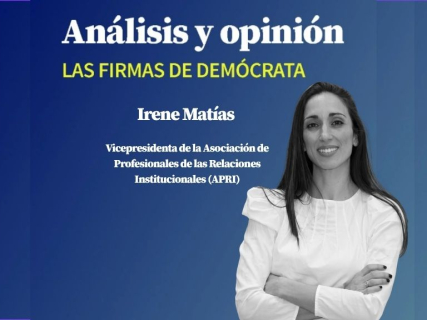
Irene Matías is vice president of the Association of Professionals of Institutional Relations (APRI)