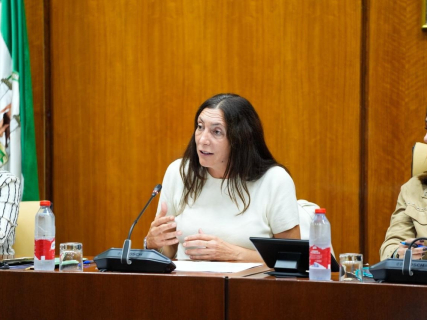

The Junta de Andalucía has announced that starting in 2027 the co-payment for dependency care will be eliminated for people with amyotrophic lateral sclerosis (ALS) who have an acknowledged dependency situation of Grade III+, as the head of Social Services, Families and Equality, Loles López, has advanced during her appearance before the parliamentary commission, in which she detailed the budget project for her department for next year. The accounts total 4,297 million euros, that is, 648.89 million more than in the previous year, which represents an increase of 17.78%.
This decision is part of the reinforcement of the Andalusian system for dependency care, which will have 3,308.27 million euros, 26.72% more than in 2026, which means 697.65 million additional. In addition to the elimination of co-payment, the allocation intended for financial aid for people with ALS will grow by 30.76%, to reach 2.35 million euros. López has recalled that these aids of up to 14,000 euros were created by the Government of Juanma Moreno "while the law was in a drawer" and has pointed out that the budget increase will make it possible to cover the many expenses that these patients face.
The councillor has defended the consolidation of the new Andalusian dependency model and has stressed that the budget will allow continued strengthening of the services. Funding for the Home Help Service will increase by 34.36% compared with 2026 and 1,500 new places will be made available in residential and day centers for older people and people with disabilities. At the same time, the Andalusian Telecare Service will see its budget increase by 45.52%, which will facilitate the continuity of the digitalization process and the incorporation of new technological devices.
The amounts of the economic benefits will also be increased. The aid for care in the family setting for Grade III+ (ALS) will be set at 2,000 euros per month, while the one corresponding to Grade III will go from 445.40 to 660 euros. In the economic benefit linked to the service, the amounts will reach 2,000 euros for Grade III+, 1,200 for Grade III, 660 for Grade II and 350 for Grade I. The family respite program will have 2.4 million euros, 41.81% more than in 2026. The Ministry expects to continue increasing funding for the home help service and residential care to ensure the sustainability of the sector.
In his appearance, López has questioned that the new state dependency law has come into force without sufficient financial provision for its rollout, something that, as he has indicated, the law itself recognizes in its twenty-second additional provision. He has demanded that Andalucía receive the same financial treatment as the País Vasco, where a state contribution of 50% of the cost of dependency is planned for 2025 and 2026. Similarly, he has criticized that the law incorporate a specific additional provision for Cataluña without, as he has pointed out, the Ministry having yet clarified its scope.
In the field of equality and the fight against gender-based violence, the policies of the Junta will have 57.65 million euros, 7.64% more than in 2026, which amounts to 4.09 million additional and 34.31% more than in 2018. López has insisted on the importance of maintaining the institutional and social commitment in the face of this issue: "Gender-based violence, unfortunately, exists. We have to fight it from social unity and, unfortunately, we have not yet achieved real and effective equality between men and women."
Among the most relevant items are the 10.65 million earmarked for the Comprehensive Service for Care and Sheltering of victims of gender-based violence, 3.7% more than in 2026, and the 3 million for projects aimed at women at risk of exclusion or vulnerable to machista violence, 50% more than this year. Psychological care for women victims of gender-based violence will have 2.37 million, 21.53% more, and services for victims of sexual violence will have 1.67 million, including legal advice, legal assistance, and immediate psychological care 24 hours a day.
Funding for benefits aimed at orphans of victims of gender-based violence is also increased, reaching 400,000 euros, 33.33% more than in 2026. The Ministry will continue to drive awareness-raising programs and campaigns and the work of the Red Andaluza de Entidades Conciliadoras. Loles López has emphasized that "we create rights and expand resources," has denounced the problems detected in the telematic protection bracelets for victims of machista violence, and has censured that its operation has been defended by arguing that no woman had been killed while wearing one of these devices.
On matters of families, López has reiterated that they constitute a "priority" for the policies of the Andalusian Executive. During his appearance he stated that "families are the foundation of everything" and highlighted their role as a support network. The budget includes new tax measures to ease the economic burden on households, "while the Government of Spain has raised taxes more than 140 times", such as deductions for the purchase of glasses and contact lenses for children under 25 years of age and for the rental of housing for large families, in addition to the elimination of inheritance and gift tax between siblings when the habitual residence is inherited.
These initiatives add to the five regional deductions already in effect in the IRPF for rent, birth or adoption, promotion of sport, veterinary expenses, and support for families with members with celiac disease. Likewise, the budget includes the application of Decree 78/2026, of 15 April, which regulates the recognition of the status of single-parent family, as well as the reform of the regulations on large family titles.
In the area of reconciliation, subsidies for local entities, non-profit organizations, and public universities will be maintained for reconciliation and shared-responsibility actions, along with aid intended to allow self-employed workers with children under three years of age to hire people to replace them and thus facilitate the balance between working and personal life. The protection of children and the fight against child poverty will have 256.15 million euros. Among the most significant items is that allocated to family treatment teams, which will grow by 20.24% in 2027 and serves families with minors in situations of risk or lack of protection through psychosocial and psychoeducational interventions.
In the field of social inclusion, the Andalucía Social Integration Minimum Income will have an allocation of 35 million euros, 4.74% more than in 2026, which means an additional 1.58 million. At the same time, the roll-out of the Regional Andalusian Strategy for Cohesion and Social Inclusion (ERACIS+) will continue, which will have 41.55 million euros to improve the living conditions of people residing in disadvantaged areas through socio-labour integration itineraries.
Finally, in the field of strategic planning, in 2027 the regulatory development of the Law on Children and Adolescents of Andalusia will continue and the implementation of the Strategy for Equal Treatment and Non-Discrimination of LGTBI People and Their Families 2024-2028 will proceed. Likewise, a new Andalusian Volunteering Plan for the period 2027 will be processed and a new decree-law will be approved aimed at continuing to reduce bureaucracy in matters of dependency.