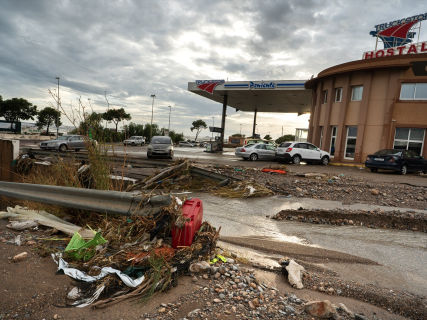

The strong storm of rain and storms that has hit Andalusia this Saturday, October 17, has left at least 155 incidents managed by emergency services, with special intensity in the province of Almería, which concentrates 121 warnings, almost 80% of the total. The precipitation has caused flooding in homes and roads, overflowing of streams, landslides, and the dragging of vehicles by the force of the water, forcing emergency teams to carry out numerous interventions to assist isolated people. Despite the seriousness of some situations, no personal injuries have been reported, according to the balance released by the Andalusian Emergency Agency (EMA).
The day has been marked by the activation of the red alert from the State Meteorological Agency (Aemet) in the regions of Poniente Almeriense and Almería capital, where the rains have reached extraordinary intensity. The accumulation of water has particularly affected municipalities such as El Ejido, Roquetas de Mar, Vícar, Dalías, and the capital of Almería, with numerous streets flooded and difficulties in circulating through different roads. In light of the worsening situation, the Junta de Andalucía raised at 15:36 hours the Emergency Plan for Flood Risk to emergency phase, operational situation 1, a measure aimed at reinforcing the coordination of available resources.
The first vice president of the Junta and counselor of Presidency, Health, and Emergencies, Antonio Sanz, has asked citizens to exercise maximum caution and avoid exposing themselves to risky situations. Through his social networks, he has insisted on the importance of not crossing streams, channels, or flooded roads, neither on foot nor by vehicle, due to the speed with which water currents can increase. Authorities are maintaining surveillance over the affected areas and remind that the effects of the precipitation may continue even after the intensity of the rain decreases.
Almería, the most affected province: flooding, dragged vehicles, and isolated people
Almería has been the main focus of emergencies, with a total of 121 incidents managed by the 112 Andalucía service. The most serious situations have been recorded in the municipalities of Almería, Dalías, El Ejido, Huércal de Almería, Níjar, Pulpí, Roquetas de Mar, Viator, and Vícar, where the rainfall has caused significant water accumulations both in urban areas and on the road network.
Among the warnings received, the flooding of homes, garages, and premises, the overflowing of a stream, and landslides at various points in the province stand out. Emergency teams have also had to intervene in response to vehicles swept away by the currents and people who had become isolated due to water accumulation, both in their homes and inside cars. These situations are compounded by damage to urban furniture and difficulties in accessing certain areas due to the state of the roads.
The municipality of El Ejido has also recorded the highest precipitation accumulations of the day. According to the meteorological data collected until 6:00 PM on Saturday, 69.2 liters per square meter had been measured, a particularly significant amount for having occurred in a relatively short period. The rains have also affected other towns in the Almeria Poniente, where the intensity of the storms has forced the mobilization of municipal and regional resources to address the incidents.
The A-7, closed in both directions due to flooding in El Ejido
One of the most important consequences of the storm has been the impact on the road network. The A-7 motorway had to be closed at kilometer 818, in the municipality of El Ejido, after the accumulation of water made it impossible to guarantee circulation under safe conditions. According to information provided by the General Directorate of Traffic (DGT) during the afternoon of Saturday, the restriction affected all lanes and both directions, with a black service level.
The closure of this road, one of the main connections by road along the Mediterranean coast, has caused significant difficulties for travel in the Almeriense West. Authorities have recommended avoiding non-essential trips and checking the state of the roads before starting any journey, especially in areas where flooding or landslides have been reported.
The Emergency Agency of Andalusia has warned of the danger of attempting to cross a road covered with water, as the depth can be difficult to gauge and the force of the current can sweep away even large vehicles. The condition of the A-7 and other affected roads should be checked using the updated information from the DGT, as restrictions may change as cleaning and recovery work on the roads progresses.
Málaga records 16 incidents and Sevilla suffers flooding in Brenes
Although Almería has concentrated most of the emergencies, the storm has also caused numerous problems in other Andalusian provinces. Málaga ranks second in the regional balance, with 16 incidents, mainly in the municipalities of Antequera, Parauta, Riogordo, and Ronda. The alerts are related to flooding in homes and public buildings, water accumulation on roads, falling branches, and situations of isolation for people who could not travel safely.
In Cádiz, five incidents have been recorded, concentrated especially in El Bosque and Olvera, where landslides, flooding of homes, and circulation problems have occurred. Granada has also recorded five emergencies, located in Alhama de Granada, Baza, and Ugíjar, with overflowing streams, landslides, and vehicles affected by water. In Córdoba, another five actions have been related to flooding in Fuente-Tójar and Priego de Córdoba, in addition to a forest fire caused by a lightning strike.
The electrical activity of the storms has also caused a forest fire in Rosal de la Frontera, in Huelva, while in Seville two incidents have initially been reported due to water accumulations in homes and roads of Cantillana and Osuna. However, the situation has worsened during the afternoon in Brenes, where a storm recorded from 6:30 PM has generated around twenty new warnings for flooding of ground floors and basements, water pools in the streets, and problems in the sewage network. No personal injuries have been reported in this locality.
The initial balance by provinces is completed with 121 incidents in Almería, 16 in Málaga, five in Cádiz, five in Córdoba, five in Granada, two in Sevilla, and one in Huelva, reaching a total of 155 emergencies recorded. However, authorities warn that these are provisional figures, subject to new updates as more warnings are received and managed.
The Junta activates 14 municipal emergency plans due to the risk of flooding
The intensity of the rainfall has led administrations to strengthen their preventive devices. A total of 14 Andalusian municipalities have activated their territorial emergency plans of Civil Protection, twelve of them in Almería and two in Málaga. This measure allows for the coordination of municipal resources with regional services and facilitates a quicker response to flooding, road closures, or situations requiring rescues.
In the province of Almería, the municipalities that have activated their respective plans are Adra, Alhabia, Almería, Balanegra, Berja, Cuevas del Almanzora, Dalías, El Ejido, La Mojonera, Pulpí, Roquetas de Mar, and Vícar. In Málaga, Fuengirola and Torremolinos have done the same, given the possibility that the storms may cause incidents in their municipalities.
Additionally, the Junta has raised the Emergency Plan for Flood Risk to operational situation 1, intended for episodes where the mobilization and coordination of different emergency services is necessary. The activation responds to the territorial extent of the incidents and the need to keep resources prepared for possible worsening of weather conditions.
By typology, 99 of the 155 recorded incidents correspond to floods or inundations, while 32 are related to rescues and salvages. The balance also includes eight disruptions in basic services and six traffic incidents, in addition to traffic accidents, landslides, collapses, and other actions linked to the storm.
ES-Alert message in Almería to warn of extraordinary danger
Given the risk associated with torrential rains, the Emergency Agency of Andalusia sent at 15:31 hours on Saturday an ES-Alert message to mobile phones located in the areas affected by the red alert, mainly in the regions of Poniente almeriense and Almería capital. The communication included self-protection recommendations to reduce the risk of accidents and warn the population of the possibility of sudden flooding.
The ES-Alert system allows emergency alerts to be sent directly to mobile devices located in a specific geographical area, without the need for citizens to be subscribed to a specific service. It is used when authorities consider that there is a serious or extraordinary risk and it is necessary to quickly convey safety instructions to people who may be affected.
In this case, the alert has been activated due to the intensity of the precipitation and the incidents already recorded in different municipalities in Almería. Authorities have insisted on the importance of staying in safe places, avoiding unnecessary travel, and not approaching dry riverbeds, ravines, or channels, even if they apparently do not carry water. They also recommend not accessing flooded basements or garages and following the instructions of emergency services.
Aemet lowers the red alert, but maintains the risk of rain and storms
The red alert that remained active during the afternoon of Saturday in Poniente almeriense and Almería capital ended later, although Aemet maintained until 23:59 hours on October 17 the orange alert for rain in these regions and in the Levante almeriense. The forecasts contemplated precipitation capable of accumulating up to 100 liters per square meter in twelve hours and 30 liters in one hour, so the meteorological agency warned that the danger had not disappeared.
In Málaga, the region of Ronda also remained under orange alert for precipitation of up to 30 liters per square meter in one hour. In other areas of Andalusia, yellow alerts were maintained for rain and storms, with expected records of between 15 and 20 liters per square meter in one hour and the possibility of episodes accompanied by hail.
The meteorological records from Saturday reflect the intensity of the precipitation in different points of the community. After the 69.2 liters per square meter measured in El Ejido, the 39.6 liters in El Bosque (Cádiz), the 31.8 liters in Alpandeire (Málaga), the 30.4 liters in Ronda, and the 27.8 liters in Láujar de Andarax (Almería) stand out, according to the data available until 6:00 PM.
Despite the deactivation of the red level during the afternoon, the Emergency Agency of Andalusia maintains surveillance over the affected areas, especially those where the rains have caused flooding, damage to roads, or rescue operations. The regional administration reminds that the accumulation of water in the ground can favor new landslides and complicate circulation even after the precipitation loses intensity.
Andalusia maintains surveillance after a day of flooding and rescues
The storm of October 17 leaves a day of significant material damage, numerous emergency interventions, and mobility problems in various Andalusian provinces. Almería has concentrated most of the incidents, with the municipality of El Ejido among the most affected points, while the storms have also caused flooding in Málaga, Granada, Cádiz, Córdoba, and Sevilla.
The absence of personal victims constitutes one of the most relevant aspects of the provisional balance, especially considering the 32 rescue and salvage operations and the situations of isolation of people recorded during the hours of greatest intensity of the rains. However, emergency services insist that the reduction of meteorological alerts does not necessarily imply that all risks have disappeared.
The authorities recommend checking the updated information from Aemet, 112 Andalucía, and the General Directorate of Traffic, especially before making trips to the affected areas. The episode leaves, for the moment, at least 155 incidents in the balance reported by the Junta, with almost eight out of ten concentrated in Almería, and keeps emergency services mobilized to address the consequences of the torrential rains.