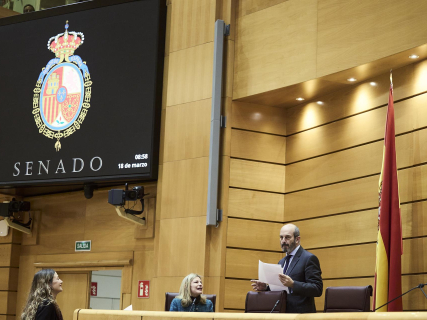
This is how the left and the right try to control the Senate: joint candidacies come into play

The election system of the Senate favors the concentration of the vote: in the majority of the provinces, four senators are elected and each voter can mark up to three candidates.

fotonoticia 20261013124416 1920

fotonoticia 20261013124416 1920

Add DEMÓCRATA to Google

Ask FREN

Published

Last updated

3 minutes

Most read

Elecciones 29N · Encuestas

La media de las encuestas

Media a 13 de noviembre de 2026 · 15 institutos

  • PP31,4 %
  • PSOE26,8 %
  • Vox19,1 %
  • Frente Amplio6,3 %
  • ERC2,4 %
01020304050ene 2024jul 2024ene 2025jul 2025ene 2026jul 2026

Media del último estudio de cada instituto en 30 días y su evolución semanal desde el 23J. Partidos con al menos un 2 %.

Todas las encuestas

Elecciones generales del 29 de noviembre · Demócrata

It is the Upper House, but, when it comes to reaching the electoral college, the importance that the voter gives to the Senate is significantly lower than that received by the Congress. This is not the case among the parties, which know what is at stake. Therefore, the dispute to gain control has opened a new negotiation avenue ahead of the general elections on November 29. The left has begun to explore joint candidacies to concentrate the vote and challenge the Popular Party for the majority of this Chamber. In parallel, PP and Vox could study a similar strategy in certain provinces if their rivals run united.

Vozpópuli publishes this Wednesday that the national leaderships of PP and Vox are exploring the possibility of presenting joint lists to the Senate in the constituencies where coordination could facilitate the obtaining of seats. According to this media, the option would be conditioned on the left closing its own unitary candidacies and would not necessarily imply a generalized agreement for the entire territory.

The left is already negotiating joint candidacies to the Senate

PSOE and the parties that make up the Broad Front met on Sunday, October 11, to study the possibility of running together for the Senate. The meeting served to open conversations, although the formations have not announced a definitive agreement nor detailed in which provinces the formula could be applied.

The socialists have acknowledged that they are studying different alternatives for the elections on November 29, with the intention of preventing the PP from maintaining its absolute majority in the Upper House. The PSOE leadership believes that the fragmentation of the progressive vote could facilitate the right obtaining more seats than it would achieve if the candidacies were coordinated.

The negotiation occurs while the Broad Front, formed by United Left, Sumar Movement, Más Madrid, and Comuns, finishes defining its structure and its lists for Congress. The possibility of sharing candidacies to the Senate opens a cooperation avenue distinct from the composition of the lists for Congress, where each organization maintains its own priorities and negotiations.

The electoral calendar adds pressure to the conversations. Friday, October 16 is the deadline to inform the Electoral Board of the intention to run in coalition. Until then, the parties must determine whether the agreement is limited to certain constituencies or if it reaches a broader territorial scope.

How the Senate is elected and why joint lists matter

The Senate is the Chamber of territorial representation and combines senators elected directly at the polls with others appointed by the autonomous parliaments. In most provinces, four senators are elected; the island constituencies, Ceuta, and Melilla have specific rules. The current total composition is 266 members.

Unlike the elections to the Congress, in which the distribution of seats is carried out through closed lists and a proportional system by constituencies, in the Senate elections, the vote is individual for each candidate. In the mainland provinces, each voter can mark up to three names, and the most voted candidates are elected until the four assigned positions are filled.

This system can favor candidacies capable of concentrating support. If several ideologically close parties present candidates separately, their votes can be split among different lists, while a coordinated candidacy can gather more support for its candidates. The alliance does not guarantee obtaining more seats, but it allows for designing a common strategy to compete for them.

Coordination also has a political component. The Senate participates in the legislative process, can veto or introduce amendments to bills —although the Congress can lift the veto under the terms provided by the Constitution— and performs specific functions in territorial matters. A broad majority allows a party or bloc to lead the Table, promote initiatives, and control the parliamentary activity of the Chamber.

The composition of the Senate is especially relevant for the renewal of the Constitutional Court. Four of its twelve magistrates are proposed by the Upper House, and the election requires a three-fifths majority. With the 266 senators that currently make up the Chamber, that proportion amounts to 160 votes. Achieving it would give the block that gathered that majority the ability to approve those proposals without needing external support, although the renewal procedure is subject to the corresponding legal requirements.

The struggle for the Senate is therefore not limited to adding seats to obtain an absolute majority. Joint candidacies can be a tool to improve the representation of each block and condition institutional decisions that require reinforced majorities. The unknown now is whether the confirmed negotiations of the left will translate into concrete agreements and whether PP and Vox will end up responding with their own electoral coordination.

More key points, information and questions with FREN

AI-GENERATED CONTENT

What is the current status of the processing of joint candidacy agreements between left-wing parties for the Senate?

At this moment, the joint candidacy agreements of the left for the Senate ahead of the general elections on November 29, 2026, are clearly in a political and negotiating phase, but they are still not formalized and registered coalitions before the Electoral Board at the national level between PSOE, Frente Amplio (Sumar–IU–Comuns–Más Madrid), Podemos, and other forces.

The available information allows us to outline this scenario:

1. What exactly is being negotiated
  • PSOE is exploring joint lists for the Senate with forces to its left to try to take the absolute majority in the Upper House from the PP. This is reflected in various reports and detailed in a piece by Demócrata explaining that the socialist leadership is considering running in shared candidacies in provinces where the Senate's majoritarian system penalizes progressive fragmentation.
    See, for example, this analysis by Demócrata.
  • In parallel, the new space Frente Amplio (coalition promoted by Movimiento Sumar, IU, Comuns, and Más Madrid) is positioning itself as the main reference of the alternative left and extends a hand to Podemos and ERC to run together on November 29, although there is no closed agreement to date on a single list with all these forces.
  • There is also a civil society initiative, “Senators for Democracy,” which explicitly demands joint progressive candidacies for the Senate in all constituencies. Demócrata describes how this platform urges PSOE, Sumar, IU, Podemos, Más Madrid, Compromís, and other forces to agree on common lists, but this is a political proposal, not a legally formalized electoral agreement.
2. Agreements that are more advanced
  • In the realm of the sovereignist left, ERC and EH Bildu have announced they will run together again for the Senate in Catalonia and the Basque Country, as they did in 2023. This is a concrete and territorially limited agreement, separate from the negotiation between PSOE and Frente Amplio.
  • In the national progressive space, one reference is the precedent of Ibiza and Formentera in 2023, where PSOE, Sumar, Esquerra Unida, and Ara Eivissa already secured a senator with a joint list. This example is now cited as a model that could be replicated in other provinces, but its extension to the entire territory is still pending formal decisions.
3. Schedule and status of processing before electoral bodies
  • The Royal Decree calling the elections to the Congress and Senate on November 29 has already been published, and the Senate and Congress have released the basic electoral calendar (start and end of the campaign, constitution of the Chambers, etc.).
  • For these joint candidacies to have legal effects, parties must:
    • Register, if applicable, the electoral coalitions within the legal deadline before the competent electoral board (generally, the Central Electoral Board for coalition registration and then the provincial and local boards for specific candidacies).
    • Submit the Senate lists for each provincial constituency, respecting electoral legislation (name of the candidacy, symbols, documentation, parity, acceptance of candidates, etc.).
    • Pass the candidacy proclamation phase, which includes official publication, possible challenges, and final proclamation.
  • According to collected journalistic information, the deadline to register electoral coalitions ends this very week (around October 16, 2026), so the talks are under strong time pressure. Several reports explicitly mention negotiations “against the clock.”
4. Conclusion: advanced negotiation, but no closed unitary list
  • It is not recorded, as of October 14, 2026, that a statewide joint candidacy for the Senate grouping PSOE, Frente Amplio (Sumar–IU–Comuns–Más Madrid), Podemos, and the other mentioned forces has been formalized and registered before the Electoral Board.
  • What is underway is:
    • A territorialized political negotiation between PSOE and the Frente Amplio space to agree on joint lists in certain provinces.
    • An already announced agreement between ERC and EH Bildu to run together for the Senate, based on their 2023 experience.
    • A strong social and union pressure (citizen platform, positions of UGT and CCOO) for the left to close a “broad front” and formulate a unitary strategy, including the Upper House.

In summary, the current status is one of pre-agreement and exploration: parties have publicly acknowledged that the key to the Senate lies in joint candidacy formulas, but these formulas still need to be translated, in the coming days, into registered coalitions and proclaimed candidacies to have effects in the formal electoral processing.

Can you detail the specific deadlines set by the electoral calendar to register coalitions and submit candidacies for the Senate on November 29? In which provinces could a joint left-wing candidacy for the Senate have the greatest impact according to published examples and simulations? What differences exist between the ERC–Bildu agreement for the Senate and the PSOE negotiations with Frente Amplio in political and electoral terms?

What specific powers does the president of the Senate have according to Spanish legislation?

The president of the Senate is the highest authority of the Upper House and concentrates a set of powers derived, on the one hand, from the Constitution itself (which recognizes the organizational autonomy of the Chambers and the existence of their Presidents) and, on the other hand, from the Senate Regulations, which specify and detail those functions. In practice, most of the “specific powers” are in the Regulations; the Constitution mainly acts as an enabling and institutional guarantee framework.

1. Powers of constitutional origin

The Spanish Constitution does not dedicate a specific article to the president of the Senate, but it does establish several principles from which his basic powers derive:

  • Organizational autonomy of the Senate: the Constitution recognizes that each Chamber approves its own Regulations, elects its President and the other members of the Board, and organizes its internal functioning. This authorization allows the Senate Regulations to assign the President functions of direction, order, and representation.
  • Role as governing body of the Board: the Constitution provides that each Chamber has a Board as its governing body. The Regulations specify that this Board “acts under the authority and direction of its President,” which directly links the governing function of the Chamber to the Presidency.
  • Guarantee of internal order and parliamentary discipline: constitutional provisions on the functioning of the Chambers (order of debates, publicity of sessions, discipline, and internal regime) are developed in the Regulations, which entrust the President with a central role in maintaining order and applying disciplinary measures consistent with those principles.
  • Institutional role in the system of powers: as president of one of the State's constitutional bodies, the president of the Senate is one of the high authorities who, in certain cases, is politically consulted (for example, before a possible dissolution of the Chambers). He does not have decision-making power in these matters but does have a constitutionally recognized interlocutor role.

In summary, the Constitution recognizes the figure and autonomy of the body, but it is the Regulations that detail the specific powers of the president of the Senate.

2. Powers according to the Senate Regulations

2.1. Relationship with the Board and the Spokespersons' Committee
  • Direction of the Board: the Regulations define the Board as the governing body of the Senate that “acts under the authority and direction of its President.” This means that the President frames, drives, and coordinates all internal government activity adopted by the Board (session calendar, qualification of documents, organization of services, Chamber budget, etc.).
  • Convocation and presidency of the Board: it is the President's responsibility to convene and preside over the Board meetings, order its work, and ensure the execution of its agreements.
  • Spokespersons' Committee: although regulated in other provisions, the scheme is similar: the President convenes and presides over the Spokespersons' Committee, which is the political coordination body among parliamentary groups. Through it, he articulates the participation of groups in setting the agenda and organizing debates.
2.2. Direction of debates and internal order of the Chamber

Article 37 of the Regulations concentrates many of the President's specific powers:

  • Convoking and presiding over plenary sessions: he is the one who convenes and presides over the Senate Plenary.
  • Maintaining order in discussions and directing debates: organizes the development of interventions, grants and withdraws the right to speak, orders votes, and ensures respect for the Regulations, courtesy, and parliamentary customs.
  • Parliamentary disciplinary measures: he is responsible for applying the disciplinary measures provided in the Regulations (calls to order, withdrawal of the floor, expulsion of a Senator from the chamber in the most serious cases, etc.), within the framework allowed by the rules and without prejudice to decisions the Chamber must adopt.
  • Announcement of the agenda: the President announces the agenda of the Plenary, once it has been prepared in accordance with the Board and the Spokespersons' Committee.
2.3. Institutional representation and external relations
  • Natural spokesperson and representative of the Chamber: the Regulations establish that he is the “Spokesperson of the Chamber and its natural representative in all official acts.” He represents the Senate before the King, the Government, the Congress of Deputies, other State institutions, and international organizations.
  • Communications with the Government and authorities: he is responsible for maintaining the Senate's official communications with the Government and other public authorities.
  • Signing messages and resolutions: he signs, together with one of the Secretaries, the messages and formal communications that the Senate directs to other State powers, including those related to the approval of laws, agreements, motions, or requests.
2.4. Interpretation of the Regulations and residual powers
  • Interpretation of the Regulations: the President is expressly empowered to interpret the Senate Regulations during debates and in organizing work, resolving doubts about specific applications.
  • Filling regulatory gaps: in agreement with the Board of the Rules Committee, he can fill gaps in the regulatory text, that is, decide how to proceed when there is no explicit regulation for a specific case.
  • Convocation of Committees: he can convene and preside over any Senate Committee when he deems it convenient, reinforcing his general coordination function of parliamentary activity.
  • General clause: finally, the Regulations include a broad clause according to which the President has “other powers provided in the Constitution, laws, and these Regulations,” which acts as a channel to assign him other specific functions in sectoral norms (for example, receipt of reports, formal transfers, etc.).
2.5. Exceptional situations

In exceptional situations —such as dissolution of the Chambers, periods between legislatures, or constitutional crises— the President of the Senate generally does not acquire extraordinary powers of his own, but he does perform key functions:

  • Guarantees the institutional continuity of the Chamber, presiding over the Permanent Deputation when appropriate or ensuring the Senate's representation while it is not convened in Plenary.
  • Acts as interlocutor of the Senate before the King and the Government in procedures affecting the Chamber (for example, communications about dissolution, electoral calls, or extensions of exceptional situations), always within the limits set by the Constitution and without decision-making power over those decisions of the Head of State and Government.

Overall, the president of the Senate is simultaneously the arbiter of debates, head of the internal governing body (the Board), immediate interpreter of the Regulations, and main representative of the Senate before other public powers and society.

Could you detail what specific disciplinary measures the president of the Senate can apply according to the Regulations? How is the president of the Senate elected and, if applicable, how can he be removed according to the Regulations and the Constitution? What differences exist between the powers of the president of the Senate and those of the president of the Congress of Deputies?

What legal requirements must be met to form an electoral coalition and present it before the Central Electoral Board?

In Spain, electoral coalitions are mainly regulated by the Organic Law of the General Electoral Regime (LOREG). Properly forming a coalition and presenting it before the competent Electoral Board (in general elections, the Central Electoral Board) requires meeting material, formal, and deadline requirements that should be planned in advance.

1. Legal framework and scope of application

The figure of the electoral coalition is established in the LOREG, especially in its article 44 (candidacies) and related provisions on parties, federations, and groups of electors. The Central Electoral Board (JEC) develops and specifies this regime through interpretative instructions, detailing deadlines and documentation.

Coalitions can be formed for any electoral process regulated by the LOREG (elections to the Congress and Senate, the European Parliament, local elections, and, where applicable, regional elections when governed by LOREG itself or by rules referring to it). For general and European elections, the competent authority to receive the coalition communication is the JEC.

2. Who can form a coalition and internal agreement

Only the following can constitute electoral coalitions:

  • Political parties validly registered in the Register of Political Parties.
  • Federations of parties also registered.

Groups of electors do not technically “coalition” but present their own candidacies through signature collection. Therefore, a coalition is an agreement between already constituted parties and/or federations.

Within each party or federation, the agreement to join the coalition must be adopted by the competent body according to its statutes (usually the executive committee, political council, national leadership, or equivalent). For the JEC, it must be possible to prove:

  • That the body was competent to decide the coalition.
  • That the agreement was validly adopted (quorum, majority, etc.).

3. Deadline and competent electoral body

LOREG requires that parties and federations intending to run in coalition:

  • Communicate the formation of the coalition to the competent Electoral Board within ten days following the election call.

For elections to the Congress, Senate, and European Parliament, the communication is addressed to the Central Electoral Board. In other processes (local or certain regional elections), the competence may fall to provincial or regional electoral boards, according to specific regulations, but the deadline and content regime is analogous.

4. Minimum content of the communication

The communication to the JEC must include, at minimum:

  • Identification of the parties and/or federations that make up the coalition (full official name).
  • Name of the coalition and, if applicable, acronyms and symbol with which it will run in the elections.
  • The scope for which the coalition is formed (which specific elections and, if applicable, which constituencies).
  • Designation of general representatives and alternates of the coalition for electoral purposes.

Internally, the coalition agreement usually also details aspects that, although not always formally required by the JEC, are essential in practice (distribution of list positions, use of branding, distribution of financing, spokespersons, etc.).

5. Usual documentation

Although LOREG sets the general framework and electoral boards specify requirements, it is usually required to provide or have available:

  • Deed or registration certificate proving the registration of each party/federation.
  • Certification of the agreement of the competent body of each party approving the coalition and designating representative(s), issued by its secretary with the approval of the presidency.
  • Proof of identity and powers of the persons signing the communication before the JEC (ID/passport, notarized powers, or sufficient internal certifications according to the Board's practice).
  • If applicable, graphic file of the symbol or logo of the coalition for reproduction on ballots and official documentation.

6. Legal effects and limits

Once validly communicated and admitted, the coalition:

  • Becomes the electoral subject that presents joint candidacies under its name and acronyms.
  • Has the votes of all candidacies presented under that coalition counted jointly for seat allocation and electoral financing.
  • Does not by itself alter the possibility of constituting its own parliamentary group: this is governed by the Regulations of each Chamber and by the number of seats and vote percentage obtained.
  • Is subject to the financing and accounting control regime of LOREG, applicable to the coalition as a whole without prejudice to internal distribution agreements.

The name, acronyms, and symbol of the coalition cannot cause confusion with other existing formations; if a conflict is detected, the Board may require modification.

7. Non-compliance and late submission

If the coalition:

  • Is not communicated to the competent Electoral Board, or
  • Is communicated after the ten-day deadline from the call, or
  • The communication lacks essential requirements (parties, name, valid signatures)…

…the normal consequence is that the coalition is not considered validly constituted for electoral purposes. This means it cannot present candidacies as such a coalition; only separate candidacies of each party would be admissible if they meet their own requirements and deadlines.

Against inadmission decisions or requests for correction, the appeals provided in LOREG can be used (complaint before the Board itself and, if applicable, contentious-electoral appeal), but time margins are very tight, so it is crucial to strictly respect deadlines and forms from the start.

Could you detail point by point what a good internal coalition agreement between parties wanting to run together should contain? What practical differences exist between running as an electoral coalition and doing so through a single party that integrates the others? How does forming an electoral coalition affect financing and the distribution of expenses and income among the parties that compose it?

Play

Test your knowledge with FREN!

How much do you know about this topic? Answer the following 3 questions.

What do the left and right seek to achieve by exploring joint candidacies for the Senate?

Question 1 of 3

How many senators currently make up the Spanish Senate?

Question 2 of 3

What proportion of votes is needed in the Senate to propose magistrates to the Constitutional Court?

Question 3 of 3