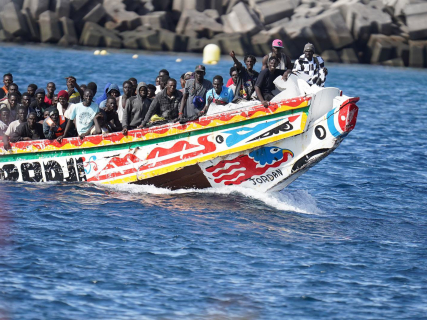

Canarias registered this Saturday, November 14, the largest day of migrant rescues in the 32 years of history of the Atlantic route, with a total of 1,488 people assisted onboard 14 cayucos in just 24 hours. The device deployed by Salvamento Marítimo and the Guardia Civil, made up of eight vessels, has worked throughout the day to respond to the arrival of people coming mainly from Senegal, Gambia and Mauritania, on crossings that, according to the testimonies collected by the assistance teams, lasted between four and seven days. Most of the landings have been concentrated in El Hierro, an island that is once again becoming the main entry point for irregular migration to the archipelago and whose health, assistance and reception resources are facing extraordinary pressure.
The balance, still provisional, exceeds the previous maximum recorded on November 7, 2020, when 1,461 people were rescued and the port of Arguineguín, in Gran Canaria, became the epicenter of a migration crisis that ended with thousands of people concentrated in improvised facilities. This time, 12 of the 14 cayucos arrived in El Hierro, with 1,235 people onboard, while another vessel with 203 occupants was transferred to Gran Canaria and a final one, with 50 people, landed in Tenerife. Among those rescued on Saturday were 108 women and 167 minors, according to the first counts. The scale of the day is reflected in the cumulative figures from Friday and Saturday, when 2,331 people arrived in 22 vessels at the archipelago, a succession of operations that has required maintaining intense coordination between the maritime teams and the emergency services.
El Hierro, at the limit: Torres visits La Restinga after the record of arrivals
The situation has led the Minister of Territorial Policy and Democratic Memory, Ángel Víctor Torres, to schedule a visit this Sunday to El Hierro, where he plans to travel starting at the 13.00 hours, Canary Island time, to the port of La Restinga. This small fishing and tourist enclave, located in the municipality of El Pinar, has become over the past few weeks the setting for virtually continuous landings and for protests by some residents, who denounce the consequences that migratory pressure is having on daily life and the town’s services. The minister’s visit takes place after the central Government and the Canary Islands Executive reached an agreement to expand the resources available in response to an emergency that has intensified again during the autumn.
Last Tuesday, the Executive of Pedro Sánchez announced the declaration of a migratory emergency in the Canary Islands and the mobilization of an additional 15.18 million euros, according to the official figure communicated by the Ministry of Territorial Policy, to expand the state reception places and speed up the transfers of migrants between islands and to the mainland. To this allocation is added one million euros to reinforce healthcare support and the first-aid services provided by the Red Cross, which raises the announced funding to 16.18 million. The agreement also includes the addition of a new Salvage Maritime vessel, the Guardamar Calíope, as well as reinforcements from the National Police, the Guardia Civil, and staff responsible for processing the relocation case files. The Government and the autonomous community also agreed to study compensations to ease the economic and social impact of the arrivals on the affected municipalities.
The Canary president, Fernando Clavijo, has been warning about the need to speed up these measures in the face of overcrowding of the services in El Hierro. The pressure is reflected especially in the port of La Restinga and in the Temporary Attention Center for Foreigners, from where the migrants are sent to other facilities on the archipelago or to the Peninsula. Medical assistance has also been subjected to growing demand, with people arriving after several days of navigation in precarious conditions, some of them dehydrated, exhausted, or needing hospital care. During Saturday, one of the more numerous cayucos transported 240 people, including 36 minors, after six days of crossing from Gunjur, in Gambia. Other rescues forced the coordination of the disembarkation of its occupants between the ports of La Restinga and La Estaca, while the teams tried to maintain reception capacity.
The Canary route surges in autumn: Senegal is again the main point of departure
The record from this weekend confirms the shift in migration patterns recorded since October, after a first half marked by a decline in arrivals. According to data from the Ministry of the Interior, between January and June 2026, 3,708 people reached the Canary Islands by sea, 67% fewer than in the same period the previous year. However, the situation began to change with the arrival of autumn and intensified especially during October, when 6,194 migrants disembarked, compared with the 1,251 recorded in the same month of 2025. The acceleration has continued during November, to the point that the arrivals counted in its first days already surpassed those of the entire previous month.
One of the keys to this upturn is found in Senegal, which has regained prominence as the starting point of the cayucos that try to reach the Canary Islands. To the more favorable weather conditions for sailing in the months after summer are added the economic and political difficulties the African country is going through, especially among young people and communities linked to artisanal fishing. The loss of job opportunities, the pressure on fishing resources, and the lack of economic prospects are some of the factors cited by the organizations working on the ground to explain the increase in departures.
Also influenced was the celebration of the Dakar Youth Olympic Games, held between 31 October and 13 November, which concentrated a significant police and security deployment. Senegalese authorities have recognized that the mobilization of personnel for this event temporarily reduced surveillance of certain points along the coast, a circumstance that could have been taken advantage of by networks dedicated to human trafficking. The Minister of the Interior, Fernando Grande-Marlaska, already addressed this situation during his visit to Dakar on 6 November, when he called on the authorities of the country to strengthen cooperation and prevention mechanisms to prevent new departures toward the archipelago.
The challenge for Spanish administrations is now to meet the immediate needs of those who arrive and to prevent the pressure from falling in a disproportionate way on an island with limited resources. Saturday’s day has left a figure without precedent in the recent history of the Canary route, but it has also highlighted the need to guarantee rescues, speed up transfers, and strengthen healthcare attention. Torres’s visit to El Hierro takes place precisely in that scenario, with the central and Canary governments forced to carry out the measures announced while weather conditions and the situation in the countries of origin keep open the possibility of new arrivals.