Pedro Sánchez asks Feijóo to accept the results of the 29N because "the PSOE is going to win"

The prime minister of the Government vindicates from Palma "good politics in the face of bad education" and takes aim at the leader of the PP for his remarks about English: "Failing in English, failing in chemistry, failing in economics." Before about 5,000 Socialist supporters, Sánchez assures that his party will form the government again for four more years and presents the election as a choice between progress and the "regression" that he attributes to the PP and Vox

EuropaPress 7915067 secretario general psoe presidente gobierno candidato presidencia gobierno

EuropaPress 7915067 secretario general psoe presidente gobierno candidato presidencia gobierno

Add DEMÓCRATA to Google

Ask FREN

Published

Last updated

6 minutes

Most read

Elecciones 29N · Encuestas

La media de las encuestas

Media a 14 de noviembre de 2026 · 15 institutos

  • PP31,4 %
  • PSOE26,9 %
  • Vox19,1 %
  • Frente Amplio6,4 %
  • ERC2,5 %
01020304050ene 2024jul 2024ene 2025jul 2025ene 2026jul 2026

Media del último estudio de cada instituto en 30 días y su evolución semanal desde el 23J. Partidos con al menos un 2 %.

Todas las encuestas

Elecciones generales del 29 de noviembre · Demócrata

ELECCIONES 29N

¿Cuál es tu pronóstico? 29N

Reparte los 350 escaños del Congreso como creas que quedarán el 29 de noviembre. Puedes cambiar tu pronóstico hasta que cierren los colegios.

0 de 350 escaños

PP
PSOE
Vox
Frente Amplio
ERC
Junts
EH Bildu
PNV
Más partidos
Podemos
BNG
SALF
CC
UPN
Adelante
Aliança
Otros

Protegido por reCAPTCHA de Google: privacidad y condiciones

Pronóstico de DemócrataParticipación abierta, no es una encuesta

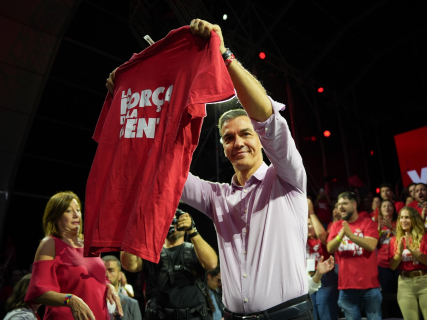
From Palma de Mallorca, in the middle of an election campaign.- Pedro Sánchez has chosen this Saturday school grades to launch one of his most direct attacks against Alberto Núñez Feijóo. Before some 5,000 socialist activists and supporters gathered in Son Fusteret, the president of the Government reviewed the alleged failed grades of the leader of the Partido Popular in English, chemistry and economics before setting him a final subject ahead of the general elections of next November 29: "Civic Education". The test, according to the PSOE secretary general, will consist of accepting the result at the ballot box, which he has assured will give victory back to the socialists.

"What I hope is that at least he passes next November 29 in Civic Education, accepting the election result," Sánchez proclaimed, before adding that "the Partido Socialista is going to win the elections and will continue governing for four more years". The statement constituted one of the central moments of a rally in which the candidate for reelection sought to convey confidence to his supporters and turn the mobilization of the progressive electorate into the axis of his speech.

The event, held on the second official day of the campaign, brought together a large part of the socialist leadership of the Balearic Islands. Francina Armengol, president of the Congress and head of list of the PSIB-PSOE for the islands, has spoken before Sánchez, along with other regional leaders. Among the attendees, a poster with the message "La Peter lo peta", a reference to the nickname with which the actress Candela Peña addressed the president on the program La Revuelta and that has found its place among the winks of the socialist campaign, also stood out.

Sánchez turns Feijóo’s statements about English into an election exam

The socialist leader took advantage of the interview that Feijóo granted this week to content creator Jordi Wild to ironize about the preparation of the popular candidate. During that conversation, the PP president acknowledged that he does not speak English and that he had also not made a special effort to learn it, although he considered that a president of the Government should master that language.

Sánchez has recovered those statements to question the leader of the opposition. "They’ve had four years even to, I don’t know, to learn a little English", he said, referring to the time that has passed since the start of the legislature. Immediately afterward, he broadened his criticism to other matters in which he believes Feijóo has shown a lack of knowledge.

"Failing English, failing chemistry", he said, before reproaching him for not knowing how to tell hydrogen from nitrogen. He also attributed to him a "failing in economics", recalling a confusion between the risk premium and interest rates. The president has used this succession of examples to argue that the PP has had enough time to prepare an alternative Government and that, in his view, it has not presented a convincing project.

The clash over English had been preceded by a response from Feijóo himself. The Popular candidate defended this Friday that his lack of knowledge of the language does not prevent him from carrying out political responsibilities: "I don’t know English, but I know how to govern and I don’t insult in any language", he said. The discussion has thus become a new episode in the confrontation between the two candidates, who are scheduled to face each other in an electoral debate next Thursday, 19 November.

Sánchez’s demand that Feijóo accept the result of the ballot boxes does not, for the time being, respond to an announcement by the Popular leader that he will disregard it. It is a political challenge from the Socialist candidate, which he has linked that acceptance to his own prediction of victory.

"An ultra who wrinkles"

Sánchez has also directed his attacks against Santiago Abascal, whom he has claimed "does not represent the Spain that gets up early, but the ultra that cringes". From Palma, the president of the Government has questioned the international support received by the leader of Vox and has reminded that Giorgia Meloni, Matteo Salvini, Viktor Orbán and other leaders of the European far right have conveyed their backing to him ahead of the elections on 29 November. The messages, broadcast in video form at the start of Vox’s campaign in Madrid, have served Sánchez to link Abascal to the forces he considers opposed to the project of European integration. Against those alliances, the general secretary of the PSOE has asked for the vote from those who "love Europe", asserting Spain’s membership in the European Union and presenting the election as a choice between strengthening the community project or moving toward the nationalist positions that he attributes to the far right.

"Good politics in the face of bad manners," the PSOE message from Palma

Before turning his focus to Feijóo, Sánchez devoted the first minutes of his intervention to asserting the institutional role of Francina Armengol. The president has recognized her work leading the Congress over the last three years and has denounced the atmosphere of confrontation that, in his view, has taken hold in the lower house.

The socialist general secretary has argued that insults, noise and shouts have taken up too much space in parliamentary debate, to the detriment of proposals aimed at solving citizens’ problems. In light of that situation, he has presented Armengol as an example of institutional calm.

"You have been a president who has kept her composure and has defended good manners in public debate," Sánchez said, who has extended that assertion to the entire campaign. "That’s also what these elections are about. Whether we assert good politics in the face of bad manners", he argued.

For the head of the Executive, good politics consists of putting forward solutions and managing institutions, while bad manners are expressed through personal attacks and put-downs. "That’s what the citizens pay us for: to propose solutions and not to hurl insults", he summed up.

The speech has maintained, however, a marked tone of confrontation with the opposition, especially during references to Feijóo's knowledge. Sánchez has also directed his criticisms against Santiago Abascal, whom he has reproached for considering gender equality policies a superfluous expense—a position that the president has placed among the examples of what he calls "bad education".

In that context, the PSOE leader has stated that 29N will mean a new confrontation between two models of country. "We are going to defeat the involution of Feijóo and of Abascal", he said, presenting a possible majority of PP and Vox as a threat to the social policies promoted during his years in government.

Armengol asserts the co-official languages and the PSOE seeks to mobilize the vote in the Balearic Islands

Sánchez's intervention was preceded by that of Francina Armengol, who has asserted her management at the head of the Congress and, especially, the reform of the Rules of Procedure that allowed the use of Catalan, Basque, and Galician in parliamentary debates alongside Castilian.

The Balearic leader, who delivered much of her speech in Catalan, has defended this measure as a recognition of Spain's linguistic diversity. She has also placed housing among the priorities of the socialist campaign, a problem especially relevant in the Balearic Islands due to the difficulties of accessing rentals and pressure on the residential market.

The rally also featured Rosario Sánchez Grau, socialist candidate for the presidency of the Balearic Government; Amanda Fernández, candidate for the Consell de Mallorca; and Iago Negueruela, candidate for Mayor of Palma. The call thus brought together the state campaign with the territorial aspirations of PSIB-PSOE, which seeks to strengthen its institutional presence on the islands.

The choice of Palma is part of Sánchez's intense election agenda, which officially kicked off the campaign on Thursday in Seville and took part on Friday in events held in Arnedo, La Rioja, and Pamplona. Meanwhile, Feijóo has headlined this Saturday a rally in Santiago de Compostela, while Santiago Abascal has scheduled interventions in Almería and Murcia.

Sánchez again proclaims his victory despite an open campaign

The President of the Government has closed his address in Palma with a new appeal to socialist mobilization. Sánchez argues that the PSOE can make a comeback and secure another four years in La Moncloa, despite the fact that several opinion polls published over the past few days place the Partido Popular ahead of the socialists in voting intention. The CIS, by contrast, places the PSOE as the leading force, reflecting the differences between the available polling estimates.

The confidence expressed by Sánchez constitutes a campaign forecast, not an anticipated result. With the ballot boxes still to be opened and two weeks of electoral activity still ahead, the makeup of the next Congress will continue to depend on citizens’ vote and on any subsequent parliamentary agreements.

The Son Fusteret rally has left one of the day’s political images: Sánchez putting Feijóo through an imaginary exam and saving the final test for November 29. In a campaign marked by reproaches between the main parties, the socialist leader has sought to combine his defense of “good politics” with a verbal offensive against PP and Vox.

The conclusion of his speech was unequivocal: Sánchez asks Feijóo to accept the verdict of the ballot boxes because he is convinced that the PSOE will win again. The result of that exam, however, will not be known until election night.

More key points, information and questions with FREN

AI-GENERATED CONTENT

What is the parliamentary status of the reform of the Congress Regulations that allows the use of co-official languages?

The reform of the Congress Regulations that allows the use of co-official languages has already been approved and its parliamentary processing has concluded. The Plenary definitively approved it on September 21, 2023, and the text was published on September 25 of that year, the date it came into force. Therefore, it is not pending debate, approval, or a subsequent vote in the Senate.

What the reform is and how it was processed

It is the Proposal to reform the Regulations of the Congress of Deputies, file 410/000001. The proposal is dated September 6, 2023; the Board agreed to admit it for processing on September 13, and its initial publication took place on the 14th. The initial document allows identifying both its linguistic purpose and the start of its parliamentary journey (initial publication).

The main subsequent milestones were as follows:

  • September 19, 2023: the Plenary agreed to take it into consideration, that is, to start processing the proposal. It also approved processing it directly and in a single reading, a procedure that concentrates deliberation and decision in the Plenary.
  • That same day: the Board arranged for urgent processing and set the deadline for amendments for September 20 at 6:00 p.m. Both agreements were published in the September 20 bulletin.
  • September 21, 2023: the Plenary definitively approved the reform. The approval agreement invokes Article 72.1 of the Constitution and the second final provision of the Regulations.
  • September 25, 2023: the approved text was published in the Official Bulletin of the General Courts. It also appeared in the Official State Gazette.
Entry into force and situation in the Senate

The final provision is explicit: "This amendment to the Regulations of the Congress shall enter into force on the day of its publication in the Official Bulletin of the General Courts." Therefore, the relevant date is September 25, 2023; it was not subject to subsequent authorization.

In the Senate, there is a communication of approval, dated September 22, 2023, with reference 740/000002. This communication does not constitute a second phase of approval: what is communicated is precisely the agreement that the Congress had already adopted the previous day.

What was authorized

The reform is not limited to interventions in the chamber. Its scope includes the Plenary, committees, and the Permanent Deputation, as well as parliamentary writings and publications:

  • Article 6.3: recognizes the right to use, in all areas of parliamentary activity, the official languages in some autonomous community.
  • Articles 60.1 and 70.2: provide translation and interpretation services and allow speeches to be delivered in those languages.
  • Article 92.1: allows documents and writings to be submitted in them.
  • Articles 96 and 97.1: regulate their reproduction and publication, alongside Spanish, in the corresponding journals and bulletins.

The transitional provision contemplated a maximum of six months to adapt the services related to the submission of writings, meanwhile requiring an accompanying translation into Spanish. This adaptation period was not a pending parliamentary procedure nor did it postpone the general entry into force of the reform.

What are the powers and functions of Francina Armengol as president of the Congress according to Spanish legislation?

Francina Armengol, as president of the Congress, has functions of institutional representation, direction of parliamentary work, and guarantee of the Regulations. Her powers correspond to the position: they do not allow her to override the decisions of the Plenary nor to individually assume the powers of the Board or the Board of Spokespersons. The main framework is the Constitution and the Congress Regulations.

1. Represent the Chamber and apply the Regulations

Article 32 of the Regulations establishes that the Presidency "holds the representation of the Chamber, ensures the smooth running of the work, directs debates, maintains order in them, and orders payments." She must also comply with and enforce the Regulations, interpret them when there are doubts, and fill in omissions. To issue a supplementary resolution of a general nature, she needs the favorable opinion of the Board and the Board of Spokespersons.

2. Convene sessions and organize work

She convenes the Plenary on her own initiative or at the request of two parliamentary groups or one-fifth of the deputies. She convenes and presides over the Board of Spokespersons and directs and coordinates the Board. She sets the agenda of the Plenary in agreement with the Board of Spokespersons, not unilaterally; its modification corresponds to the Plenary under regulatory terms. She can also convene and preside over any committee, although she only votes in those of which she is a member (Articles 30, 35, 39, 42, 54, and 67-68).

3. Direct debates, votes, and discipline

She grants the floor, controls times, resolves regulatory issues, and decides on interventions by allusion. She can adjust turns and their duration, after hearing the Board of Spokespersons, and order votes. If she wishes to intervene in a debate, she must leave the Presidency until the discussion ends (Articles 70-77).

She can also call to order or to the point of order, withdraw the floor, and apply disciplinary measures provided. These include expulsion from a session in regulatory cases. Articles 105-107 assign her the maintenance of order in the parliamentary premises and dependencies, including spaces intended for the public.

4. Channel laws and government control

In the legislative procedure, she organizes debates and votes, can admit certain technical corrections and transactional amendments under conditions, and sends approved projects to the Senate (Articles 118 and 120). After a decree-law is ratified, she asks if any group requests to process it as a bill; the Chamber decides (Article 151).

In executive control, she channels requests for information and appearances, organizes Plenary questions with the Board of Spokespersons, and can group related matters. If a written question remains unanswered, at the request of its author, she orders its oral treatment in committee (Articles 44, 188, 190, and 192).

5. Intervene in investiture and institutional relations

Upon receiving the proposed candidacy for the Presidency of the Government, she convenes the investiture, directs the debate, sets the voting time, and communicates to the King the confidence granted. If no candidacy obtains confidence within two months following the first vote, she submits the royal decree of dissolution and election call for royal signature. She also communicates the results of confidence matters and the approval of motions of censure (Articles 170-178).

6. Preside over the Permanent Deputation and respect limits

She presides over and convenes the Permanent Deputation, which protects the powers of the Chamber when it is not in session and assumes certain powers after its dissolution, especially regarding decree-laws and exceptional states (Articles 56-59). These are powers of the body, not personal decisions of its president.

Finally, the admission of initiatives, the general calendar, and budget approval correspond to the Board. The Presidency must protect parliamentary rights, especially those of minorities, as recalled by Judgment 165/2023.

What results did the PSOE obtain in the last general elections in the Balearic Islands?

In the last general elections held, those of July 23, 2023, the PSOE obtained in the Balearic Islands 151,134 votes, 30.14%, and 3 deputies in the Congress. The socialist candidacy, identified as PSIB-PSOE, was the second most voted in the archipelago, behind the PP, although both obtained the same number of seats. These data correspond to the Congress results, according to the Balearic count.

Main figures
  • Votes: 151,134 ballots for the socialist candidacy throughout the Balearic Islands. This is the absolute number of supports recorded in the consulted result. (23J Results).
  • Percentage: 30.14% of the valid vote, that is, approximately three out of every ten valid votes cast in the constituency. This percentage expresses its electoral weight, not the percentage of the entire Balearic population. (23J Results).
  • Representation: 3 deputies elected by the Balearic Islands for the Congress. That was the translation of their votes into parliamentary representation in this election. (23J Results).
  • Position: second candidacy in number of votes, although tied with the PP in deputies obtained by the constituency. (23J Results).
Comparison with the most voted candidacy

The PP obtained 178,715 votes and 3 deputies in the Balearic Islands. Therefore, it surpassed the PSOE by 27,581 votes, but that difference did not translate into a difference in seats between the two candidacies: each obtained three representatives. The vote difference is obtained by subtracting the 151,134 socialist supports from the 178,715 of the PP. (Count by candidacies).

The distinction is important to describe the result accurately: the PSOE was not the most voted force in the Balearic Islands, but it also did not obtain fewer deputies than the PP. There was a difference in electoral support and a tie in representation between the two candidacies. These are two different ways to read the same election, and it is advisable to keep them separate. (Balearic Results).

What election and territory these data reflect

The reference used is the vote for the Congress of Deputies on July 23, 2023 in the entire Balearic Islands. It is not a result of regional or municipal elections. Nor is it a breakdown by Mallorca, Menorca, Ibiza, or Formentera: the cited figures correspond to the total Balearic constituency. You can consult that territorial scope on the RTVE results page.

Likewise, the three seats mentioned are Congress deputies. They should not be interpreted as a number of senators nor as the total socialist representatives in both chambers. Similarly, the 30.14% describes the vote for the candidacy in that election and territory: it is not a participation percentage nor an estimate of voting intention. (Congress Results).

In short, the brief answer is: 151,134 votes, 30.14%, and three deputies. The PSOE was second in votes in the Balearic Islands and obtained as many seats as the PP. These are the figures that summarize its result in the 23J general elections, without confusing the electoral order with the distribution of representatives. (Consulted result).

Play

Test your knowledge with FREN!

How much do you know about this topic? Answer the following 3 questions.

What election result did Pedro Sánchez assure the PSOE would achieve on November 29?

Question 1 of 3

What reform of the Congress did Francina Armengol claim during the rally?

Question 2 of 3

What argument did Feijóo give regarding his lack of English knowledge?

Question 3 of 3