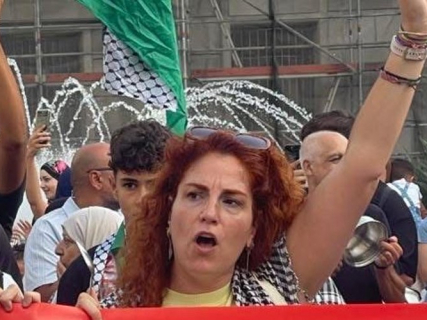

Julia Ferreras has become this Monday one of the prominent names in the news after a group of protesters attacked and destroyed the car she was driving in the port of Ceuta. The deputy of Ceuta Ya! was inside the vehicle along with two other people when it was surrounded during a gathering called in front of the arrival in the city of members of the Negu Gorriak/Derecho a Techo collective.
The protesters blocked the car's path, threw eggs and stones, shook it, and caused damage to the vehicle. Ferreras later went to the National Police headquarters to report the events. This Monday she recounted that she came to fear that they would not be able to leave the place and that she recognized among the participants people from her own city.
Psychologist and specialized in gender violence
Julia Alejandra Ferreras Guerra was born in Ceuta in 1985. She is a psychologist and has postgraduate training in intervention and treatment of women victims of gender violence, an area that would later also mark a good part of her political activity.
Her professional trajectory has developed especially in the social field. Before becoming a deputy, she had dedicated her career to psychological intervention with groups in situations of social exclusion, in addition to working in training and awareness-raising on equality issues. She has also developed her professional activity with the Association of Disabled People with Neurological Diseases.
Although she was born in Ceuta, she spent her early years in a small town in Málaga, from where her father's family comes. Her connection to the autonomous city, however, remained during her childhood through her maternal family and the summers she spent in Ceuta.
Her relationship with politics did not begin with Ceuta Ya!. Ferreras has explained that she grew up in an environment where politics was very present and that she began to take an interest in it when she was only 14 years old.
From Nuevas Generaciones to leftist localism
One of the most striking elements of her trajectory is precisely where she began her activism. Ferreras joined Nuevas Generaciones in her adolescence, the youth organization of the Popular Party. Years later, she would explain that at that time she was looking for a space to channel her interest in politics and would acknowledge that that option did not correspond to the ideology she would end up developing.
Her training as a psychologist, her professional experience in the social field, and her approach to feminism were modifying her political position. After returning to Ceuta, she approached the space of leftist localism and ended up joining Caballas, the coalition that for years constituted one of the main local political references of the city.
Feminism played a particularly important role in that transition. Ferreras herself has placed her first steps in Caballas around her work and training in this area. With the subsequent reorganization of that political space, she ended up joining Ceuta Ya!, a formation that emerged in 2021 and is led by Mohamed Mustafa.
Ferreras then assumed the Secretariat of Equality of the party, a responsibility from which she has focused much of her activity on issues related to macho violence, social policies, disability, and the existing inequalities within the city itself.
Number two of Ceuta Ya! and deputy since 2023
Her definitive leap to the front line of institutions came in the municipal and autonomous elections of May 2023. Ceuta Ya! positioned Ferreras as number two of its candidacy, immediately after Mohamed Mustafa.
The formation obtained sufficient representation for both to enter the Assembly, so Ferreras became part for the first time of the highest representative body of the autonomous city.
Currently, Mohamed Mustafa and Julia Ferreras are the two deputies that make up the Ceuta Ya! Group in the Assembly, according to the official list of members of the institution.
From her seat, Ferreras has brought to the Plenary issues particularly linked to social policies. Among them are proposals on child poverty, equality, accessibility, and care for the most vulnerable groups. In 2024, for example, she defended the development of a plan against child poverty that included actions on taxation, housing, and access to public services, education, health, culture, and sports.
She has also maintained a particularly active profile in equality policies. In March 2026, she criticized the IV Equality Plan developed by the City for considering that it used outdated information and called for more rigorous planning and evaluation of these policies.
A family with political roots
The interest of Ferreras in politics also has a family component. His grandfather, Miguel Guerra Sánchez, was one of the founders of the PSOE in Ceuta and a councilor in the first socialist corporation of the city, while his grandmother, Flora Paredes, was also linked to the socialist organization of Ceuta.
The deputy herself has said that politics was a common conversation in her family and that practically all its members had participated in one way or another in political life. Her personal journey, however, ended up distancing her from both the PP, where she took her first youthful steps, and the PSOE linked to her family tradition, to place her in the local leftist space.
Outside the Assembly, Ferreras has maintained her profession as a psychologist and another less known vocation: basketball. For years she has been related to this sport through refereeing, an activity she has described as a way to disconnect from her professional and political responsibilities.
The attack at the port of Ceuta
The episode this Sunday now places Ferreras at the center of a crisis that transcends her own political profile. The protest at the port had been called in anticipation of the announced arrival of members of Negu Gorriak/Derecho a Techo, a group that had communicated its intention to travel to Ceuta with humanitarian aid.
According to the information published about the events, Ferreras' vehicle was identified by some protesters as linked to the group they were expecting. Despite the intervention of the agents and the fact that the deputy identified herself, the car was hit and various objects were thrown at it before it could leave the place under police protection.
Ferreras has assured this Monday that she felt "very scared" during the episode and has defended that the fear that exists among part of the Ceuta population cannot lead to violence. The attack has thus brought to the national forefront a deputy who, until now, had developed practically her entire political and professional career within the Ceuta sphere.