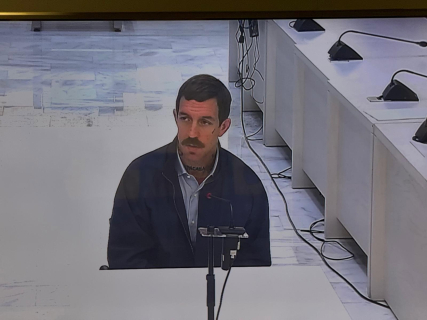

The pro-Palestinian American philanthropist Fergie Chambers has acknowledged this Friday that he channeled funds toward Palestinian humanitarian organizations and that he contributed several million dollars to a football club in Tunisia, but he has insisted that those operations have nothing to do with terrorism. "I am uncomfortable for the United States," he said, after reiterating his refusal to be handed over to the North American country.
Chambers has stated before a court of the National Court (AN), which will have to decide in the coming days whether to grant the extradition request filed by the United States. U.S. authorities attribute to him an alleged offense of conspiracy to promote unrest, international money laundering, and a purported case of terrorist financing.
"A whole narrative has been built about me having participated in terrorist activity. I have never been linked to terrorist activity and not even violent activity, I have never financed any terrorist activity, the United States has not even managed to accuse me of it. All of this because I raised my voice with more money than the rest of the people who were protesting. I only ask for justice, reason, and compassion," he said during his turn for final words.
The requested person arrived at the headquarters of the National Court in a police van coming from the Aranjuez prison (Madrid), where he has been in pretrial detention since his arrest last July in Ibiza, after an international arrest warrant issued by Washington was activated.
At the doors of the court, despite the rain, a group of supporters gathered showing their support for the philanthropist behind a banner with the message "Free Fergie" --'Libertad para Fergie'-- and waving flags of Palestine and the Basque Country.
Accusations of terrorist financing and defense of the transfers
In the initial phase of the hearing, devoted to the preliminary issues, one of Chambers's lawyers defended the legality of the banking operations questioned by the U.S. Department of Justice, denying that they were intended to feed terrorist organizations.
The attorney specified that the money from those transfers was directed to entities such as a Tunisian football club and to humanitarian organizations, rejecting that it was used to fund terrorist activities, as the U.S. Government claims.
Chambers has detailed that, through his foundation, he made financial contributions to Palestinian associations dedicated to the medical treatment of minors, transportation to safe areas, and the provision of food and potable water.
"We were aware that our activities could be subject to political persecution and that our positions conflicted with those of the United States, and that is why we made sure that the organizations to which the money was going would not be sanctioned," he explained during the hearing.
The philanthropist has also admitted that he took part in two protests against the premises of Elbit Systems, an Israeli arms company, in Cambridge and New Hampshire, in U.S. territory. He has said that he chained himself to the main door and blocked access alongside thousands of demonstrators, stressing that he did not cause material damage, and he has acknowledged that he paid bail for several detainees in those mobilizations.
The Department of Justice incorporates Chambers’ presence at these protests as part of the factual basis to bring alleged charges of rioting and conspiracy to promote rioting against him.
Move to Tunisia and support for Club Africain
In his statement, Chambers has confirmed that he decided to settle in Tunisia with his family "for political reasons," as he did not share the "participation in the genocide of Palestine" by the United States and in light of the "increase in political repression." He has indicated that he chose that country because he had a friend there and because he had an "interest" in "approaching Islam from an intellectual and traditional perspective."
The millionaire has denied that his departure responded to "legal issues." "I had no charges against me. I used my passport, my credit cards, my social media accounts; I moved door to door with the U.S. ambassador in Tunisia. I was an inconvenience in the United States, but I had no causes," he has emphasized.
Once in Tunisian territory, the philanthropist became the "main sponsor" of Club Africain, one of the most prominent teams in the country. He has admitted that he transferred around four million dollars to the entity—funds, according to his account, that were used "for the club’s debt servicing," for youth academy programs, and "for the re-floating" of the women’s section.
Chambers has added that he never held conversations with Iranian representatives and that he only went once to the Iranian embassy in Tunisia. "I made a visit to the Iranian embassy. I went in and told the person who was there, who was Tunisian, that I was curious to know whether I could obtain a visa to visit Iran. He told me that at that time there was nobody and that I had to come back later. I never returned. I never spoke with any official of the Embassy of Iran," he said.
The prosecutor has rejected that there is a "political persecution" and has reiterated the arguments already put forward in his favorable report on the handover of Chambers, in which he argues that the person sought would have made money transfers with the purpose of "promoting illicit" and "violent" activities that would have "benefited" the terrorist group Hamas.