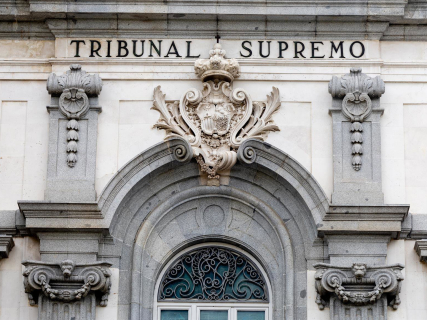

The Government has rejected the request by Vox and Iustitia Europa for the Supreme Court to extend the suspension of the right to vote in the general elections of next November 29 to the descendants of those naturalized by the so-called 'grandchildren's law', warning that a decision in that sense would generate "insecurity" both for these people and for the electoral count itself.
In the statement of arguments to which Europa Press has had access, the State Attorney's Office "shows its opposition to the issuance of the precautionary measures requested" for "not being in accordance with and adjusted to law". It acts in representation of the Ministry of the Presidency, Justice and Relations with the Cortes and requests that the Contentious-Administrative Chamber, "as a prior step" to resolving this precautionary incident, agree to the "summons of the affected third parties".
Within the period granted to the Supreme Court to rule, the State's legal services warn that the measure could entail a "notorious" and "undoubted" "affectation" on "the fundamental right to active suffrage of the persons who could be affected by it". They add, moreover, that the requested suspension "would also have a notorious and direct impact on the development of the ongoing electoral process, which would be affected by the insecurity and uncertainty that its adoption would entail".
It would affect the development of the electoral process
The statement underscores that "all its development in its legally established proceedings would remain conditioned by the impact that would be produced in it as a consequence of the adoption of the precautionary measure that is now being requested and that could even affect the final count that must be carried out and proclaimed insofar as there could exist votes cast but pending to be counted according to what has already been decided".
The State Attorney's Office stresses that the new petition of the appellants, who have already managed for the Supreme Court to suspend the vote of naturalized persons who do not prove the exile of their ascendants, "is in itself indeterminate and impossible to comply with at the moment in which it is requested". It notes that "the nominal list requested does not exist, and moreover with the added 'plus', and which for these precautionary purposes is essential, that it must be linked --'chain'-- with those who in turn had an acquisition of the first clause without consular certification".
According to the data handled by the State legal services, the number of potential affected persons would rise to 189,678, according to the registrations made in the consular offices under the Protection of Democratic Memory Law. This law contemplates, through the so-called 'grandchildren law', the possibility of obtaining nationality for those who prove ancestors who suffered exile and request it.
The document adds that "the material and human means that would allow reaching that result are not identified" and emphasizes "the extraordinary effort already deployed by the Administration" through the Spanish consulates "to comply with the previous precautionary rulings", warning that a "repetition regarding new groups, in a time horizon of barely a few weeks and in the midst of the development of the electoral process, is materially incompatible with the available resources".