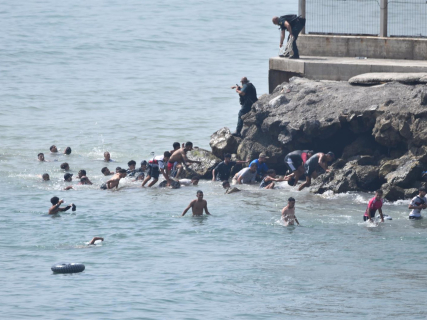

The recent ruling of the Supreme Court that vetoed the rejection at the border of migrants who reach Ceuta or Melilla by swimming specifies that "nothing would prevent" the application of the so-called 'hot returns' if "containment elements were placed in the sea to protect the border line".
The ruling, issued by the Administrative Litigation Chamber on July 8 and disseminated by Europa Press, determines that those who access in this way must be subjected to the ordinary return procedure, discarding the border rejection mechanism.
The president of Ceuta, Juan Jesús Vivas, reiterated this Thursday his request to change the law "by all means" because, in his opinion, this ruling of the Supreme generates a "gap" that "must be remedied", after the entry of hundreds of people from Morocco through the border of the autonomous city, where there have also been accesses by swimming and by the pier.
The high court emphasized the cassational interest in "determining whether the tenth additional provision of the Immigration Law is applicable regarding people who are intercepted at sea, intending to enter by swimming in the cities of Ceuta and Melilla and for that reason it is possible to apply the border rejection procedure to them".
This additional provision establishes that "Foreigners who are detected at the border line of the territorial demarcation of Ceuta or Melilla while attempting to overcome the border containment elements to cross the border irregularly may be rejected in order to prevent their illegal entry into Spain".
The Supreme Court recalls that the Superior Court of Justice of Andalusia considered that those who access by swimming "do not overcome a border containment element", so the application of the tenth additional provision was not appropriate, a reasoning that the Chamber itself shares.
In this line, it emphasizes that the border rejection in Ceuta and Melilla "is not generally contemplated" in the tenth additional provision of the Immigration Law "for all foreigners attempting to cross the border irregularly, whether land or maritime, but only for those who attempt to do so by overcoming the established border containment elements, such as fences".
The court clarifies next that the norm refers to border containment elements "and not exclusively to land ones nor, specifically, to fences".
For this reason, it concludes that "nothing would prevent that, if containment elements were established at sea to protect the border line, the aforementioned tenth additional provision could be applied to those who intended to cross the border irregularly by overcoming those maritime containment elements."
Legal sources consulted by Europa Press have acknowledged the convenience of adopting measures in the face of this type of migratory pressure episodes, although they warn that it would be a "mistake" to ignore the rest of the factors --social, political, humanitarian, and economic-- that surround these crises and to focus attention solely on judicial resolutions that, precisely, "serve to guarantee human rights."