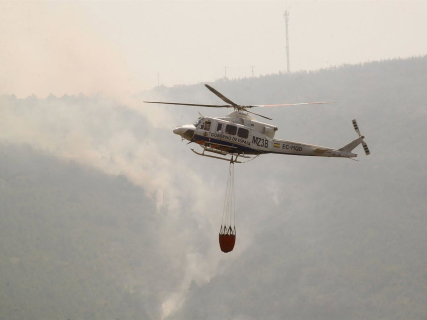

The municipality of Cenicientos, in the southwest of the Community of Madrid, will be evacuated due to the evolution of the forest fire that keeps several localities in the area in a critical situation and has forced the expansion of protective measures over the population.
The evacuation represents a new leap in the emergency, because Cenicientos has been one of the key points of the operation during these days and one of the localities closest to the coordination area of the firefighting efforts. The decision indicates that the risk to the urban environment or access routes has increased enough for the authorities to prioritize the orderly exit of residents, workers, and non-essential personnel.
The command post will likely move to Navalcarnero
The evacuation of Cenicientos also requires relocating the advanced command post, from which a large part of the operation deployed against the fire is coordinated. According to the forecast provided, that coordination center will probably move to Navalcarnero, a municipality located further away from the front and with better conditions to organize resources, communications, and emergency movements.
The relocation of a command post is not a minor decision. It involves moving technical teams, operational managers, communications, health coordination, institutional links, and support personnel, all without losing response capacity in an emergency that remains active and can change in a few hours due to wind, smoke, or the emergence of new hotspots.
A measure to ensure the safety of the operation
The relocation aims to ensure that those directing the emergency can continue working from a safe, stable point connected to the main communication routes. In large-scale fires, the command post must be close enough to the ground to receive updated information, but also far enough from the front to avoid being compromised by smoke, flames, roadblocks, or the massive arrival of emergency vehicles.
Navalcarnero offers a more protected position and greater logistical capacity to concentrate command, coordinate resources from different administrations, and maintain communication with the affected municipalities. From there, the deployment of forest firefighters, aerial resources, Guardia Civil, Civil Protection, health services, UME, and municipal teams can continue to be organized.
Ordered evacuation of neighbors and non-essential personnel
The evacuation of Cenicientos must be carried out in an orderly manner and following the instructions of the emergency services, especially because the roads near the fire may be affected by smoke, by preventive closures, or by the constant transit of firefighting vehicles.
Neighbors must leave the area via the indicated routes, bring documentation, medication, mobile phone, charger, water, and basic items, and avoid delaying the departure to collect belongings that are not essential. Authorities insist that the route should not be improvised nor should secondary roads be used without authorization, as they may be compromised or interfere with the movements of the operation.
A critical point in the emergency of Madrid and Ávila
Cenicientos is located in a particularly sensitive area due to its proximity to the fronts affecting the southwest of Madrid and the southern surroundings of Ávila. The emergency has forced the coordination of measures between nearby territories, with evacuations, confinements, road closures, and deployment of land and air resources in a very wide perimeter.
The possible relocation of the command post to Navalcarnero reflects that the emergency is no longer managed only from the closest point to the fire, but from a logic of safety and operational continuity. In a crisis of this magnitude, keeping the coordination center active is essential to decide on new evacuations, distribute resources, order roads, and protect inhabited areas.