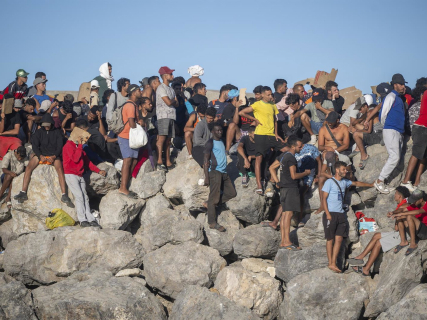
Ceuta in front of the mirror of Lesbos: what happened when another border of Europe overflowed

The massive arrival of thousands of people in Ceuta recalls the collapse experienced by the Greek islands during the refugee crisis of 2015, when overcrowding and the lack of sanitation also worsened the health emergency.

7 minutes

fotonoticia 20260824113528 1920

fotonoticia 20260824113528 1920

Add DEMÓCRATA to Google

Ask FREN

Published

7 minutes

Most read

The migratory and humanitarian crisis of Ceuta is not the first occasion in which a small external border of the European Union has been overwhelmed by the arrival of thousands of people. Eleven years ago, during the great refugee crisis of 2015, the Greek islands of the Aegean Sea, and especially Lesbos, became the main entry point to Europe for hundreds of thousands of people coming from Turkey.

The comparison allows understanding the exceptional nature of what happened in Ceuta, although the figures and circumstances are different. The massive entry produced an immediate shock in a city of barely 20 square kilometers and about 84,000 inhabitants, while thousands of people have subsequently remained pending accommodation, identification, assistance, or the determination of their administrative situation.

Lesbos faced a much more prolonged pressure. During 2015, Greece received hundreds of thousands of refugees and migrants by sea, mainly through the Aegean islands. The accumulated volume was much higher than that recorded in Ceuta, but it was distributed over months. The difference allows summarizing both episodes in a simple way: Lesbos suffered a sustained crisis of enormous magnitude; Ceuta experienced a border shock much more concentrated in time.

Lesbos came to receive thousands of people in a single day

The Aegean route connected the coasts of Turkey with Greek islands such as Lesbos, Chios, Samos, Kos, and Leros. Thousands of refugees and migrants made the crossing in small boats, often managed by human trafficking networks and without adequate safety conditions.

The pace increased extraordinarily during 2015. By the end of July, UNHCR had already counted about 124,000 arrivals by sea to Greece, compared to approximately 15,000 recorded during the same period in 2014. Only during July, about 50,000 people arrived.

Lesbos bore a good part of that pressure. The available centers did not have the capacity to accommodate such a volume of arrivals, and thousands of people ended up housed in improvised facilities or waiting outdoors while trying to register and continue to mainland Greece and other European countries.

Ceuta concentrated the crisis in an extraordinarily reduced space and period

The differential characteristic of Ceuta in 2026 has been precisely the speed with which the entry occurred and the subsequent impact on a very small territory. Once the most critical moment at the border was overcome, the problem quickly shifted from controlling access to attending to those who had remained inside the city.

The size of Ceuta multiplies the impact of any massive arrival. With an approximate population of 84,000 inhabitants distributed over about 20 square kilometers, thousands of additional people without stable accommodation represent an immediate pressure on public services, assistance resources, and urban spaces.

Part of those who remained in the city ended up sleeping on beaches, hills, and improvised settlements until temporary facilities began to be set up and expanded. That evolution is precisely one of the elements that most closely aligns the situation in Ceuta with what happened in the Greek islands during 2015.

Two humanitarian crises, but with different migratory profiles

The main difference between Lesbos and Ceuta appears when observing who were the protagonists of the displacements. The Greek crisis of 2015 was closely related to wars and persecutions in the Middle East and Asia.

UNHCR pointed out that summer that the vast majority of those arriving in Greece came from countries affected by conflicts or serious human rights violations, mainly Syria, Afghanistan, and Iraq. For that reason, the situation of 2015 was fundamentally characterized as a European refugee crisis.

Ceuta presents a more heterogeneous flow. In the currently established facilities, there are also people from Sudan, Somalia, Ethiopia, Chad, and the Central African Republic, several of them countries affected by conflicts or serious humanitarian crises, so some may meet the necessary conditions to apply for international protection.

Ceuta now faces the problem that Lesbos suffered after the arrivals

Once the initial moment was overcome, both crises present a particularly relevant similarity: what to do with thousands of people who remain within a small territory while their situation is determined.

In Lesbos, the Moria center became completely overwhelmed. In July 2015, Médecins Sans Frontières estimated that around 5,000 people had arrived on the island in just a few days, while Moria had a capacity for about 700. The result was overcrowding, poor hygienic conditions, and thousands of people forced to settle outside.

Ceuta has had to face a comparable situation in terms of capacity. Thousands of people were initially outside the ordinary devices and the response has required enabling new spaces, reinforcing assistance, and starting identification and triage processes. In Loma Margarita, for example, the device managed by Accem housed about 1,100 people this Monday and already has health assistance with Médicos del Mundo and Cruz Roja.

From Lesbos to Ceuta: overcrowding turns a migration crisis into a health problem

The experience of Lesbos shows that a reception crisis can end up generating significant health problems when thousands of people remain overcrowded without enough water, bathrooms, accommodation, or medical care. In July 2015, UNHCR warned that there were more than 3,000 refugees in difficult conditions in Kara Tepe and another 1,000 people were camping outside Moria, with a shortage of medical assistance, running water, sanitation, and protection from the heat.

Médecins Sans Frontières then described saturated facilities and serious hygienic deficiencies. The organization had to open medical consultations in Moria and Kara Tepe, install water points and chemical toilets, improve sanitation, and manage waste. Between July and December 2015, it carried out more than 16,100 medical consultations in Lesbos, in addition to providing mental health support to about 3,000 people.

Ceuta now faces a risk arising from similar conditions. The Medical College of Ceuta has warned that overcrowding and unsanitary conditions can favor the emergence and transmission of diseases, while the Nursing College has called for reinforcements in light of the increased pressure on assistance. In some improvised settlements, situations of extreme precariousness and a clearly insufficient availability of bathrooms have been documented.

However, there is currently no evidence of a general epidemic threat to the Ceuta population. Health authorities have confirmed only three cases of tuberculosis and none were contagious, while issues such as scabies, gastroenteritis, or other infections are being treated through the corresponding health protocols. The priority is to provide adequate accommodation, hygiene, and medical care.

The precedent of Lesbos points precisely in that direction. The WHO warned during the European crisis of 2015 that refugees and migrants should not be automatically considered a health threat. The main health problems were related to travel conditions, injuries, hypothermia, neglected chronic diseases, and reception conditions.

Lesbos was above all a refugee crisis

Completely equating both episodes would, however, lead to an incorrect conclusion. Lesbos became one of the main symbols of the European refugee crisis of 2015 because a huge proportion of those arriving were fleeing armed conflicts and persecutions.

In August of that year, UNHCR already classified what was happening in Greece as a "humanitarian emergency" that required an urgent response both from Greece and Europe. Arrivals by sea had increased by more than 750% compared to the same period the previous year.

The status of refugee is not automatically obtained by crossing a border from a certain country. Applications for international protection must be analyzed individually. However, the enormous weight of Syrians, Afghans, and Iraqis explains why international institutions described that situation fundamentally as a humanitarian and refugee emergency.

Morocco and Turkey, two decisive countries on the other side of the European border

Geography also places Morocco and Turkey in comparable positions as countries located immediately on the other side of two external borders of the European Union, although their political and migratory circumstances are different.

During the Lesbos crisis, Turkey became an indispensable actor for the European strategy. Most of the vessels reaching the Greek islands departed from its coast, and Brussels ultimately concluded that reducing arrivals required intensifying cooperation with Ankara.

That strategy led to the EU-Turkey statement of March 18, 2016, aimed at reducing irregular crossings in the Aegean and reorganizing the management of refugees. The European response combined border control, asylum procedures, reception, returns, and cooperation with the country located on the other side of the border.

Europe reinforced borders, reception, and cooperation with Turkey

The European response to that crisis did not consist solely of preventing arrivals. The EU promoted the so-called "hotspots", centers aimed at registering, identifying, and taking the fingerprints of those arriving, while also trying to strengthen the Greek asylum system and increase its reception capacity.

The Union also launched relocation and resettlement mechanisms, although their operation generated strong tensions among the Member States. At the same time, cooperation with Turkey took on a central role in reducing irregular crossings in the Aegean and combating human trafficking networks.

The experience also left a health lesson. Registering and quickly accommodating those who arrive is not only a migratory or security issue, but also a public health tool: it allows knowing where people are, conducting triage, detecting diseases, ensuring treatments, and preventing overcrowding and lack of hygiene from generating problems that did not initially exist.

Ceuta in front of the mirror of Lesbos: two different ways to overflow a European border

The comparison ultimately leaves two different photographs of a similar problem. Lesbos received a much larger volume of people over a prolonged period, within an international refugee crisis closely linked to the wars in Syria, Afghanistan, and Iraq.

Ceuta has suffered, on the other hand, an extraordinary concentration of entries in a very short period. Once the initial emergency at the border was overcome, the priority has shifted towards accommodation, identification, the protection of minors, and healthcare for those remaining in the city.

Fifteen years after Lesbos, Europe thus faces a familiar question: what happens when one of its external borders receives in a very short time more people than it can identify, accommodate, and attend to with its usual resources. The Greek precedent showed that a border crisis that does not quickly receive sufficient capacity for reception can also transform into a humanitarian and health crisis, precisely because of the conditions in which the people trapped in the territory end up living.

More key points, information and questions with FREN

AI-GENERATED CONTENT

What is the current status of the processing of international protection procedures for migrants arriving in Ceuta?

The international protection procedures for migrants arriving in Ceuta are governed by the same Asylum Law and immigration regulations as in the rest of Spain, but today they operate in a context of extraordinary pressure following the massive arrivals at the end of July 2026. Legally, the framework of guarantees has been strengthened, while in practice the processing capacity is far behind the volume of arrivals, generating a considerable backlog despite reinforcement measures and contingency plans.

Recent legal framework affecting processing

At the state level, asylum policy at the border and in Ceuta is marked by several recent elements:

  • Jurisprudence on border returns: the Superior Court of Justice of Andalusia and later the Supreme Court have made it clear that immediate returns (“border rejection”) cannot be applied to those arriving by swimming or by sea to Ceuta and Melilla. These people must undergo the ordinary procedure, with identification, legal assistance, and the possibility to apply for international protection, and cannot be sent back without individual examination and without a lawyer.
  • EU border asylum procedure: on August 12, 2026, a resolution from the Ministry of the Interior was published in the BOE formalizing a management assignment to the Directorate General for Humanitarian Assistance and the International Protection Reception System to notify acts and resolutions issued under the new Regulations (EU) 2024/1348 and 2024/1351 on border asylum procedures (BOE 12/08/2026). This strengthens coordination between Interior and Migration in border asylum decisions.
  • Unaccompanied minors and “migration contingency”: Royal Decree-law 2/2025 and its development allow declaring an “extraordinary migration contingency” when territories such as the Canary Islands, Ceuta, or Melilla triple their ordinary capacity to host minors. The declaration for these territories was made in August 2025 (note of 29/08/2025) and activates a protocol to relocate minors to other communities with maximum deadlines of 15 days from registration and 5 days to execute the transfer once resolved, according to details collected by Demócrata.

Operational situation in Ceuta after the 2026 crisis

The massive arrival at the end of July 2026 (Interior has spoken of about 72,000 people, while the Ceuta president raised the figure to 75,000 or 80,000 at different times) has overwhelmed all devices:

  • The CETI of Ceuta, with about 512 places, was already saturated by mid-July; after the influx it hosted around a thousand people and as many were waiting outside, according to Demócrata’s coverage.
  • In response, the Government has deployed a CATE (Temporary Foreigners Care Center) and, through the Ministry of Inclusion, four new temporary devices with about 1,500 additional places (Loma Colmenar parking, La Hípica, former Cavalry Barracks field, and the “Guano”) to alleviate the situation in streets and beaches (note of 17/08/2026).
  • For unaccompanied minors, the city has tutored around a thousand boys and girls at different times, and both the migration contingency mechanism and punctual relocations to the peninsula are being used, combining residential centers and, according to Youth and Childhood, family foster care arrangements.

Processing pace and backlog of files

In strict terms of “processing status,” available data show a huge gap between the flow of arrivals and the capacity to resolve files:

  • The president of Ceuta, Juan Vivas, has estimated 25–30 asylum files daily as the volume managed by the National Police after the massive entry (Demócrata, 20/08/2026). He himself warned that, at that pace, “the people who have arrived would not leave Ceuta for at least a year.”
  • Meanwhile, Interior emphasizes that the priority is to identify and, if applicable, return with guarantees those who do not meet residence requirements. Extraordinary asylum commissions and reinforcements of Immigration have been launched to speed up both returns and application analysis, but without official figures showing a significant reduction in the backlog.
  • The Government insists that no one can be expelled without individual examination nor can collective returns be made, and that international protection applications suspend return procedures while they are resolved. Organizations such as Amnesty International demand precisely that effective access to asylum, legal assistance, and referral of protection applicants to the peninsula once inside the system be guaranteed.

Referrals to the peninsula and prospects for acceleration

Referrals to the peninsula remain limited and selective:

  • Before the influx, periodic transfers from the CETI to the peninsula were already being made; during the crisis itself, the Government has mentioned sending small groups (for example, 39 people from the CETI in the last transfer detailed by Interior) and is preparing the urgent transfer of about 500 migrant girls from Ceuta to specialized resources on the peninsula.
  • For newly arrived adults, the official position focuses more on rapid repatriation than on internal redistribution. Vivas and PP leaders demand “that they all return as soon as possible,” while the Executive recalls that those applying for asylum or minors must go through specific procedures with guarantees.

In summary, the current state is that of a legally guarantee-based but operationally congested system: the rules and jurisprudence require processing international protection applications of those arriving in Ceuta, especially by sea and among minors, with guarantees, but the real capacity (25–30 files/day, overwhelmed reception resources) makes the backlog very significant and the political priority has shifted to reinforcing returns and relocations rather than structurally expanding asylum capacity in the city.

What are the competences and functions of the health authorities in Ceuta in the migratory field according to Spanish legislation?

In Ceuta, the competences and functions of the health authorities in the migratory field are structured around a clear division between the State (external health, immigration, and border security), the City of Ceuta ("internal" public health), and the National Institute of Health Management (INGESA), which manages healthcare of the National Health System in the city.

1. General framework of public health and immigration

  • Law 33/2011, General Public Health Law establishes that health protection is a responsibility of all public authorities and that health is safeguarded through surveillance, prevention, and promotion actions in all sectors, including migratory flows and international entry points.
  • Organic Law 4/2000 on the rights and freedoms of foreigners configures immigration policy as a state competence but foresees cooperation with Autonomous Communities, the Cities of Ceuta and Melilla, and municipalities in the integration and care of migrants, including unaccompanied minors.
  • The International Health Regulations (IHR-2005), incorporated into Spanish law via the BOE, require having surveillance and response capacities at “points of entry” and for public health emergencies of international concern, which conditions the health organization at borders, ports, and other crossings.

2. Competences of the City of Ceuta in health and public health

The Royal Decree 32/1999, on the transfer of functions and services to the City of Ceuta in health matters, develops the Statute of Autonomy and details which functions the city assumes in its territory. The annex of the decree lists, among others, the following functions that are key in the migratory context:

  • Organization and control of environmental health: sanitary control of drinking and bathing water, wastewater, solid waste, air pollution, housing and urban planning, public or collective coexistence premises and buildings, etc. This includes reception centers, shelters, and other devices where migrants concentrate.
  • Technical health inspection and power of surveillance, guardianship, and sanction over health activities and services within its competence, also when affecting migrant populations.
  • Mortuary health police (transfers, burials, hygienic-sanitary conditions) without prejudice to state external health, relevant in cases of deaths on migratory routes.
  • Authorization, opening, modification, and closure of health centers, services, and establishments in Ceuta (including devices that mainly serve migrant populations), as well as control of medical-health advertising.
  • Epidemiological surveillance and analysis of processes affecting human health and health protection and promotion programs. This includes outbreak detection and implementation of vaccination campaigns or screenings in migrant groups, in coordination with the State.

3. State competences: external health and border health control

The State, under article 149.1.16ª of the Constitution, is responsible for external health, bases, and general coordination of health. On this basis, several regulations specify functions with direct impact in Ceuta:

  • Legislation on external health and Order SPI/2136/2011 (and its amendments) define health controls at borders, especially on goods but also on international traveler traffic. In practice, the State’s external health services:
    • Carry out surveillance and control of health risks associated with the entry of people through border posts (e.g., detection of symptoms in travelers from outbreak areas).
    • Apply the requirements of the IHR-2005 in coordination with the Ministry of Health and other involved departments.
  • Immigration regulations (Organic Law 4/2000 and its regulatory development) maintain at the State level:
    • Ownership of the Temporary Stay Centers for Immigrants (CETI), dependent on the Ministry of the Interior, and general responsibility over entry flows, return, and stay.
    • Obligations to guarantee basic dignified living conditions in these devices, which include coverage of health needs through agreements with INGESA and coordination with health authorities.

4. Functions of INGESA in Ceuta regarding the migrant population

Royal Decree 118/2023 regulates the organization and functioning of the National Institute of Health Management (INGESA). According to its articles, INGESA is a Social Security managing entity responsible, among other functions, for:

  • Management of health benefits in the cities of Ceuta and Melilla, which includes:
    • Primary and specialized care in public centers and hospitals.
    • Health emergencies and urgencies.
    • Pharmaceutical and public health benefits entrusted to it.
  • Administration of its human and material resources and participation in centralized purchases of medicines and health products, which affects care capacity in the face of massive migrant arrivals.

In practice, this means that migrants present in Ceuta (including those housed in the CETI and other state or contracted devices) are attended to in the National Health System managed by INGESA, according to the general rules of access to healthcare (Royal Decree-law 7/2018 and amendments to Law 16/2003), with particular protection for emergencies, minors, and pregnant women, and for vulnerable situations.

5. Inter-administrative coordination in the migratory field

Public health and immigration legislation require close coordination among:

  • Ministry of Health and its external health services.
  • INGESA, as manager of the health system in Ceuta.
  • Autonomous City of Ceuta, competent in public health and internal epidemiological surveillance.
  • Ministry of the Interior, responsible for migration control and CETIs.

In the migratory field, this translates into the health authority of Ceuta carrying out surveillance and response against internal health risks (outbreaks in reception centers, vaccination campaigns, inspection of hygienic conditions), while the State controls risks associated with entry into the territory (external health and immigration policy) and INGESA provides ordinary and specialized healthcare to the population, whether migrant or not.

What legal requirements must migrants in Ceuta meet to apply for international protection in Spain?

For migrants in Ceuta, the legal requirements to apply for international protection (asylum or subsidiary protection) are essentially the same as in the rest of Spain. The autonomous city does not have a different legal regime, although it does present practical particularities (application points, presence of CETI and CATE, etc.). Below is a summary of the key aspects you should know.

1. Is it necessary to have entered regularly?

No. Irregular entry into Spain, including entry over the fence or by sea, does not prevent applying for international protection.

  • Spanish asylum regulations follow the principle of no penalization for irregular entry for those who present themselves to the authorities and request protection.
  • What matters is to express your intention to seek asylum before the National Police, Civil Guard at the border, at the CATE, at the CETI, at police stations, or before the Asylum and Refuge Office when appropriate.
  • The form of entry may be analyzed in the assessment of your account, but it is not a requirement to have entered with a valid visa or passport to be able to apply for asylum.
2. Documentation and identification

It is not mandatory to have a passport or identity documents to submit the application, although it always helps.

  • If you have a passport, national identity document, birth certificate, or other documents (yours or your family’s), it is advisable to provide or show them.
  • In any case, your fingerprints and photograph (biometric registration) will be taken. This serves to:
    • Verify your identity as much as possible.
    • Check if you have applied for asylum before in another EU country (Eurodac system).
  • You must provide your personal data and explain your account of persecution or serious risk. Not presenting documents does not block your application but may make proving your case more difficult.
3. Is it necessary to be in a CATE or CETI to apply for asylum?

It is not a legal requirement to be in a specific resource, although in practice in Ceuta many applications are channeled through:

  • Border (Tarajal) or port: when you arrive through a border post.
  • CATE (Temporary Foreigners Care Center): in arrivals by sea or police operations.
  • CETI (Temporary Stay Center for Immigrants): once referred there, you can request that your protection application be formalized.

You can also apply at a police station. Being in a CATE or CETI facilitates access to procedures but is not a legal requirement to have the right to apply for asylum.

4. Deadlines to submit the application

Regulations establish that the application must be made without unjustified delay from entry into Spain or from when protection reasons arise. At the border, it is usually required to express the intention to seek asylum at the time of entry or shortly after.

  • If you delay too long in applying for asylum, authorities may consider that delay as a factor against credibility, but it does not automatically mean you cannot apply.
  • It is most advisable to request protection as soon as possible and explain any delay (for example, fear, lack of knowledge, health problems, etc.).
5. Admission for processing and typical causes of inadmissibility

First, it is decided whether the application is admitted for processing (studied in detail) or inadmissible quickly.

  • Dublin/another responsible country: if another EU State is competent because you entered there first or applied for asylum there.
  • Repeated application without new facts: if you already had a firm negative decision and do not provide relevant new elements.
  • Protection in a safe third country: if you already have effective protection in another country considered safe for you.
  • Lack of Spain’s competence: for example, if you have never really been on Spanish territory.

If admitted for processing, your case moves to an in-depth examination phase, with a detailed interview and country of origin analysis.

6. Effects of submitting the application
  • Non-refoulement principle: you cannot be returned to your country of origin nor expelled while your application is pending, except in very exceptional situations.
  • Suspension of return or expulsion procedures that were initiated, insofar as they relate to the country of risk.
  • Issuance of a receipt of submission and later a asylum seeker card (the so-called “red card”) that certifies your legal status in Spain.
  • Right to remain in Spain while the application is processed and, generally, access to the reception system (accommodation, subsistence, social and legal support), which in Ceuta usually begins at the CETI and may continue on the peninsula according to administrative decisions.
  • After a certain time from admission for processing, you may obtain work authorization, provided the application is still ongoing.
  • In return, you have the obligation to cooperate with the authorities, attend summons, inform of changes of address, and respect the rules of the reception resource.

In summary, any migrant in Ceuta who fears persecution or serious harm in their country has the right to apply for international protection in Spain, even if they have entered irregularly, provided they identify themselves as much as possible, cooperate with the procedure, and present their case in good faith.

Play

Test your knowledge with FREN!

How much do you know about this topic? Answer the following 3 questions.

What was the main difference between the Lesbos migration crisis in 2015 and the one in Ceuta?

Question 1 of 3

What did the Ceuta Medical Association warn about after the massive arrival of migrants?

Question 2 of 3

How many tuberculosis cases have health authorities confirmed in Ceuta after the migration crisis and what was their level of contagion?

Question 3 of 3

Hola, soy Fren. ¿Cómo te ayudo?