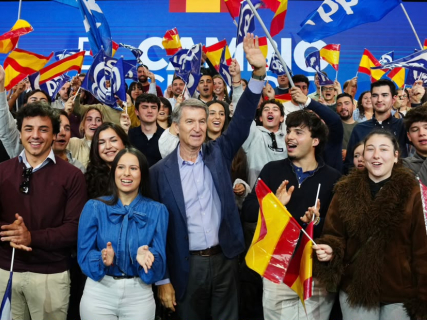
Feijóo turns youth emancipation into one of the pillars of his alternative to Sánchez

The leader of the PP places young people, the elderly and families who cannot make ends meet among the priorities of his alternative to the Government. During a rally in Valladolid, he relates the meeting with a victim of the Urda accident who asked him to put "people who know in key positions" and pledges to restore hope after eight years of Sánchez

WhatsApp Image 2026 11 07 at 13.07.52

WhatsApp Image 2026 11 07 at 13.07.52

Add DEMÓCRATA to Google

Ask FREN

Published

4 minutes

Most read

Elecciones 29N · Encuestas

La media de las encuestas

Media a 7 de noviembre de 2026 · 11 institutos

  • PP31,0 %
  • PSOE26,2 %
  • Vox19,5 %
  • Frente Amplio6,6 %
  • ERC2,4 %
  • SALF2,2 %
  • Podemos2,1 %
01020304050ene 2024jul 2024ene 2025jul 2025ene 2026jul 2026

Media del último estudio de cada instituto en 30 días y su evolución semanal desde el 23J. Partidos con al menos un 2 %.

Todas las encuestas

Elecciones generales del 29 de noviembre · Demócrata

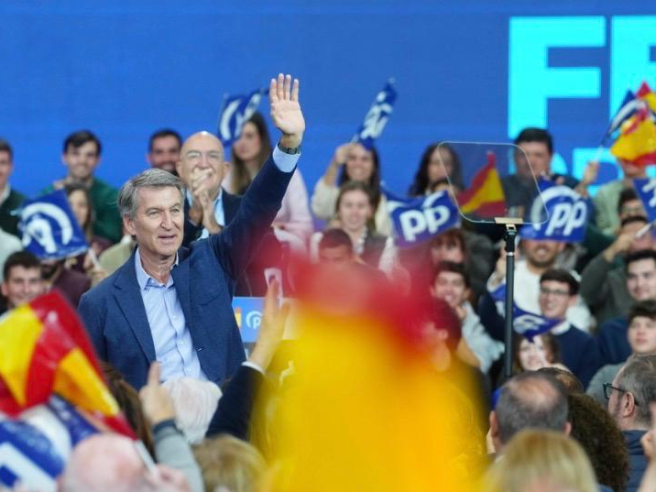
The president of Partido Popular, Alberto Núñez Feijóo, has placed the revaluation of pensions among the commitments of his political project and has claimed the general elections of next 29 November as an opportunity to open a new stage in Spain. During a rally held this Saturday in Valladolid, the popular leader appealed to the everyday concerns of citizens and has focused on the purchasing power of families, the difficulties young people face in accessing housing, and the living conditions of older people.

Feijóo has argued that politics must abandon permanent confrontation and return to focusing on the problems of citizens. "It's time for politics to talk about people again," he said to those attending, in a speech in which he set his Government proposal against what he considers years of "show, of scandal, of arrest after arrest, of case file after case file."

The popular leader said that his party wants to move on from that dynamic and focus on management. "The show is over, the networks are over, the shamelessness is over, now it's time to work," he proclaimed. In that context, he claimed 29N as the date to begin a new political cycle. "The 29th of November is the date. That day we will put an end to the torment and we will finally say that a new stage starts," he said.

The request of a victim from Urda: "Put people who know in key positions"

One of the central moments of the speech was the account of a meeting that Feijóo held this week with one of the victims of the railway accident in Urda. As he explained, the person affected asked to meet with him privately in order to convey a request related to safety and responsibility in the management of infrastructure.

The president of the PP has said that the man came accompanied by his wife and still had visible injuries on his forehead. During the conversation, he conveyed the deep pain he was going through and made a specific request: "I just want to ask you to put people who know in key positions because our safety depends on it." Feijóo has used that testimony to question the situation of public services and citizens' trust in institutions. "What country have we become so that a citizen who has gone through something so tragic feels the need to ask for something so basic?" he asked.
David Mudarra
David Mudarra -

The Popular Party leader has added that the victim also conveyed to him the despair that, in his opinion, exists among part of the citizenry and the need for politics to offer an alternative. Feijóo has taken on that commitment and has ensured that his party has the obligation to demonstrate that there is a political way out. "Sadness is not at odds with hope," he has argued, before insisting that the PP must offer an alternative that makes it possible to recover trust in institutions.

The leader wanted to distance the Valladolid event from a call focused exclusively on the railway accident. He explained that the rally had been planned for some time and noted that, if the objective had been only to point to the political person responsible for the situation of the infrastructure, the PP would have held the event in front of the Palacio de la Moncloa. However, he blamed Sánchez’s government for the infrastructure situation and for the security problems that his party denounces.

Young people, pensions, and families that don’t make ends meet

Feijóo devoted a good part of his speech to the economic difficulties of households and to the problems affecting different generations. The PP president has pointed out that the main economic problem for many families is the loss of purchasing power and the difficulty of maintaining conditions of dignified living.

"The main economic problem today is that most families don’t make ends meet," he said. The leader mentioned the cost of the grocery basket and the price of fuel as two of the concerns that condition household economics.

The Popular Party leader has also placed young people among the priority groups of his speech. Feijóo denounced the difficulties in becoming independent and accessing housing, and argued that the new generations must have opportunities to develop their life projects without depending economically on their families. "Young people, you have the right to eat the world, but it is not possible to eat the world from the room in your parents’ house," he said.

At this point, he has taken the opportunity to praise the Government of Castilla y León’s housing policy and has highlighted the commitment to deliver one thousand homes in Valladolid. Housing is thus added to one of the axes of the popular discourse for 29N, in a context marked by difficulties in accessing the real estate market and youth emancipation. At the same time, Feijóo has asserted the need to look after older people and has introduced the revaluation of pensions among the commitments of his political alternative. The leader has argued that the protection of those who have reached retirement age must be part of the priorities of any Government project.

Ceuta and the criticisms of the Executive’s foreign policy

The speech also reserved space for the situation in Ceuta and relations with Morocco. Feijóo has recalled the events recorded at the border and has denounced that, months later, there are still issues which, as he has said, the Government has not clarified sufficiently.

The PP leader has assured that more than 100,000 people entered during those events and has accused Moroccan agents of organizing the movements at the border. He has also criticized the attitude of the Spanish Executive toward Morocco and has questioned that the Government congratulates the neighboring country while, in his view, issues related to border security are still pending. "I’m not going to forget a single day, and I won’t stop until that part of Spain and that part of Europe recovers normality," he has assured.

With these references, Feijóo has expanded the framework of his speech beyond infrastructure and domestic economy, also incorporating foreign policy and territorial security among the matters he intends to place in the electoral debate. In this way, the PP president has closed an intervention structured around the need to recover trust in institutions, improve living conditions for families, and offer an alternative Government on next November 29.

More key points, information and questions with FREN

AI-GENERATED CONTENT

What is the parliamentary status of the Popular Party's proposal on youth emancipation and access to housing?

The Popular Party's initiative linking access to housing with youth emancipation has already been approved in committee in the Congress: it is not pending becoming law, as it is a non-legislative proposal, that is, a political request to the Government. The clearly identified official reference is 161/000292, titled "Non-Legislative Proposal to address the challenge of young people's access to housing in Spain." It is important to distinguish it from other subsequent PP proposals on the same subject.

What procedure has been completed

The Popular Parliamentary Group presented this initiative for debate in the Housing and Urban Agenda Committee. Its text was published on February 27, 2024 in the Official Bulletin of the General Courts. Therefore, it was not proposed as a legislative bill intended to directly modify legislation, but as a resolution to demand actions from the Executive. (Original text, 02/27/2024).

The committee approved it on March 19, 2024 in its own terms, as expressly recorded in the parliamentary bulletin. The approved agreement was published on March 27, 2024. That is the decisive milestone to describe its status: its processing as a non-legislative proposal ended with the approval and publication of the resolution. It should not be described as pending a report, a legislative opinion, or referral to the Senate. (Approved agreement, 03/27/2024).

What exactly was approved

The resolution contains six lines of action directed at the Government, which allow specifying what this parliamentary support means:

  • Expand the housing supply, especially affordable rental housing for young people and young families.
  • Adapt taxation to facilitate purchase, rental, and savings aimed at emancipation, through deductions and tax reductions.
  • Promote public-private collaboration and legal security for owners and the construction sector.
  • Incorporate youth housing into urban planning, architecture, urban agenda, and rural development policies.
  • Revert rules and policies that generate negative effects on prices, supply, uncertainty, or occupation.
  • Improve information on housing policies for young people, coordinating the competent administrations. (Resolution, 03/27/2024).

The same bulletin includes an amendment from Vox proposing to expressly add the repeal of Housing Law 12/2023. However, the certification indicates that the original PP text was approved: that addition is not part of the approved resolution. (Published amendment, 03/27/2024).

Other proposals that may explain the reference

There is also a subsequent initiative, 161/002130, to launch an urgent plan for young people's access to housing, published on May 20, 2025. Demócrata reported on May 22 its approval in the Housing Committee, with measures on savings deductions, extension of guarantees up to 40 years old, and affordable housing. It is another non-legislative proposal, not an approved law. (Demócrata, 05/22/2025).

The practical consequence is the same: parliamentary support alone does not create claimable aids, applicable deductions, or new guarantees available. To materialize these requests, the corresponding normative, budgetary, or administrative decisions are necessary. Therefore, the precise answer is approved non-legislative proposal, not a youth emancipation law in force.

What are the competencies and functions of the president of the Popular Party according to the party's statutes?

The national president of the Popular Party exercises the political and legal representation of the party, directs its political action, and presides over its main executive bodies. The Statutes approved at the XXI National Congress, in July 2025, concentrate these powers mainly in Article 44. His position combines powers of direction, coordination, and proposal, but must be exercised respecting the competencies of collegiate bodies.

Representation and political direction

The Presidency represents the PP before institutions, other parties, social organizations, and third parties. This representation includes both the political and legal dimensions: the president acts on behalf of the organization and leads its external interlocution.

He also directs and coordinates the general political action at the national level. He is responsible for maintaining a common orientation of the party's activity and coordinating its various actions. The Statutes reinforce this responsibility by requiring his authorization for statements made on behalf of the PP or that politically affect or commit the organization. This provision refers to statements that commit the party, not simply any personal expression of a member.

Presidency of national bodies

The president heads the National Board of Directors and the National Executive Committee. From that position, he participates in the management of the work and decisions of both bodies. He also has a casting vote when there is a tie in the bodies he presides over: his vote resolves a tied vote.

He is responsible for adopting the necessary measures to execute and develop the agreements of the National Congress and the bodies with superior statutory competence. Therefore, his function is not only to set a political orientation: he must also comply with the decisions adopted according to the Statutes.

Proposal of officials and internal organization

An important part of his powers consists of proposing appointments to the National Executive Committee. Among the positions included are:

  • The Secretary General.
  • The coordinators and deputy secretaries general.
  • The secretaries.
  • The Director General of Finance and Organization.

The Presidency also makes proposals on positions of internal bodies, including those related to the Electoral, Rights and Guarantees, and Membership committees. The distinction is relevant: proposing does not mean unilaterally appointing. When the Statutes assign the decision to the National Executive Committee, the presidential intervention consists of presenting the proposal for that body to decide.

Relationship with parliamentary groups

The national president presides over the PP parliamentary groups in the Congress of Deputies, the Senate, and the European Parliament, according to the respective regulations of those groups. This power connects the national leadership of the party with its parliamentary activity. Its exercise must comply with the specific operating rules of each group.

Exceptional decisions and limits

The Statutes contemplate that he may exceptionally adopt decisions corresponding to collegiate bodies in situations that justify urgent, necessary, and proportionate action. This power entails the obligation to subsequently inform the competent body for its control. Therefore, it does not constitute an ordinary substitution of collective bodies.

Overall, the Presidency concentrates the leadership and representation of the PP, but does not absorb all the competencies of its structure. To consult the complete regulation, the main reference is the 2025 statutory text, also published by the party in this version of the Statutes.

What legal requirements currently exist for the revaluation of pensions in Spain?

Currently, the law requires annual revaluation of contributory pensions according to the average CPI, without reducing them when that average is negative. It also establishes specific rules for non-contributory pensions, minimum amounts, and supplements. It is important to distinguish between the legal obligation to update and the annual rule that specifies its application.

1. Constitutional and legal basis

Article 50 of the Constitution requires adequate and periodically updated pensions. It does not set a percentage nor impose a specific indicator: these correspond to the legislator.

The main rule is in Article 58 of the General Social Security Law, amended by Law 21/2021. For Civil Servants, Article 27 of its consolidated text establishes an equivalent update.

2. Periodicity, calculation, and protection against decreases

Contributory pensions, including their minimum amounts, are revalued at the beginning of each year. The percentage equals the average of the twelve year-on-year CPI rates corresponding to the months prior to December of the previous year.

For example, for January 2027, data from December 2025 to November 2026 are taken. The twelve rates are summed and divided by twelve: only the November CPI or the inflation accumulated since January is not used. As of November 7, 2026, that period has not yet ended.

Article 58 expressly states: "If the average value [...] were negative, the amount of pensions will not vary at the beginning of the year." Therefore, negative inflation does not allow a nominal reduction through this formula.

3. Annual specification and budget

Application requires specifying percentages, amounts, and particularities through the corresponding annual regulation. This can be done through the Budgets and their development or through another legal rank norm. It is not essential to approve new Budgets, but their extension does not by itself incorporate all updates, as explained by Demócrata.

In 2026, Royal Decree-law 3/2026 set a general increase of 2.7% for contributory and Civil Servants' pensions, effective from January 1. The text published in the BOE contains its regulation.

4. Maximums, minimums, and supplements
  • Maximum pension: Article 57 regulates the initial limit and the concurrence of pensions. The 2023 reform differentiates between updating an already recognized pension and setting the maximum for new pensions: for the latter, the CPI is increased by 0.115 percentage points annually until 2050.
  • Minimum pensions: in addition to the CPI, they have specific sufficiency improvements. From 2027, the minimum retirement pension for those over 65 with a dependent spouse cannot fall below the poverty threshold of a two-adult household.
  • Minimum supplements: Article 59 requires compliance with income limits and applicable residency conditions. These requirements should not be confused with those of the general revaluation.
5. Non-contributory pensions and review of the mechanism

Non-contributory pensions must be updated at least by the same general percentage established for contributory pensions; they may receive higher increases. Their individual amount remains conditioned by income and cohabitation.

Finally, Additional Provision 39 of the General Social Security Law requires evaluating the effects of revaluation every five years within social dialogue. If deviations are observed, a proposal must be incorporated to preserve purchasing power.

Play

Test your knowledge with FREN!

How much do you know about this topic? Answer the following 3 questions.

What issue has Feijóo positioned as one of the main pillars of his political alternative?

Question 1 of 3

What specific request did a victim of the Urda train accident convey to Feijóo?

Question 2 of 3

What commitment has Feijóo defended regarding pensions?

Question 3 of 3