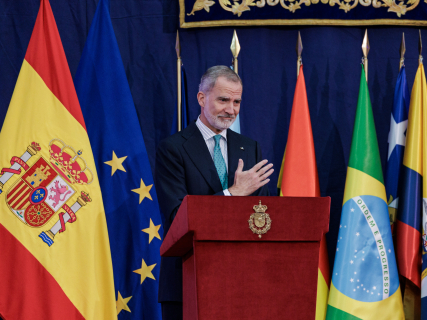
Felipe VI reasserts the future of Ibero-America after the Madrid Summit: "I am every day more proud of what it is and what it means"

The King takes stock of the agreements reached by the 22 Ibero-American countries during the delivery of the Fórum Europa Award to the Ibero-American General Secretariat. He defends a greater international influence for the community and warns of the difficulties in keeping multilateralism alive.

EuropaPress 7896224 rey felipe vi entrega premio forum europa 2026 noviembre 2026 madrid espana

EuropaPress 7896224 rey felipe vi entrega premio forum europa 2026 noviembre 2026 madrid espana

Add DEMÓCRATA to Google

Ask FREN

Published

Last updated

6 minutes

Most read

Elecciones 29N · Encuestas

La media de las encuestas

Media a 6 de noviembre de 2026 · 14 institutos

  • PP31,0 %
  • PSOE26,2 %
  • Vox19,5 %
  • Frente Amplio6,6 %
  • ERC2,4 %
  • SALF2,2 %
  • Podemos2,1 %
01020304050ene 2024jul 2024ene 2025jul 2025ene 2026jul 2026

Media del último estudio de cada instituto en 30 días y su evolución semanal desde el 23J. Partidos con al menos un 2 %.

Todas las encuestas

Elecciones generales del 29 de noviembre · Demócrata

One day after closing the XXX Ibero-American Summit, Felipe VI has on Friday vindicated the future of the community of Ibero-American countries and has expressed his satisfaction with the agreements reached in Madrid. The King presided at the Palace of El Pardo over the awarding of the Fórum Europa 2026 Prize to the Ibero-American General Secretariat (SEGIB), a ceremony that has served to take stock of the diplomatic event and defend the continuity of a summit system that has been in place for 35 years.

"We can reach even greater levels of cohesion and political agreement. We can have even more of a voice on major global issues, as befits our population, our resources, and our cultural wealth," the monarch said, convinced that cooperation between the countries on both sides of the Atlantic still has room to grow.

Felipe VI also recognized his personal connection to the Ibero-American community. In praising the work of the SEGIB, he has used an expression that he has defined as "the fervor of Ibero-America," an enthusiasm he said he shares.

"I recognize that enthusiasm because it is also mine and I am every day more proud of what it is and what it means", he said.

The event brought together institutional and diplomatic representatives to recognize the track record of the three general secretaries that the organization has had: Enrique V. Iglesias, Rebeca Grynspan and Andrés Allamand. The first was not able to attend in person and intervened through a video.

The King vindicates the Madrid agreements and calls for keeping cooperation alive

Felipe VI’s speech came after a summit that brought together delegations of the 22 Ibero-American countries, although with uneven participation from their top leaders. The meeting made it possible to approve a joint declaration and several cooperation agreements, after the previous edition, held in Cuenca (Ecuador) in 2024, ended without a communiqué agreed upon by all countries.

The monarch highlighted that the commitments reached in Madrid will have concrete consequences for citizens.

"We have reached consensus on issues that will have a direct impact on our citizens," he said, before citing the recognition of academic degrees, care, the joint response to natural catastrophes, and the new design of Ibero-American cooperation.

Among the main results of the summit are the Ibero-American Alliance for Artificial Intelligence, the Ibero-American Charter for Academic Mobility, the Ibero-American Charter for Care and Support, and the Ibero-American Network for Disaster Risk Reduction and Civil Protection. A new cooperation strategy for the coming years is added to these initiatives.

The alliance on artificial intelligence seeks to improve technological collaboration among countries, while the academic mobility charter aims to facilitate student exchanges and the recognition of university studies.

For its part, the care charter establishes a common framework for advancing care policies for dependent persons and for those who perform caregiving tasks. The civil protection network will make it possible to strengthen coordination in the face of emergencies and natural disasters.

The King has defended that these agreements show that the summit system can continue to offer results, although he has warned that maintaining cooperation requires a sustained effort.

"Sharing Ibero-America's fervor also leads us to be very aware of what it costs, in times like the current ones, to keep that flame alive", he said.

A common declaration despite differences between the countries

The Madrid summit concluded with the approval of the Madrid Declaration, a document that sets out the political commitments shared by the Ibero-American community.

The consensus has not eliminated differences among governments. Argentina, Colombia, Costa Rica and Paraguay have dissociated themselves from certain sections of the text, without preventing its approval.

Argentina has also expressed reservations about some of the cooperation initiatives, including those related to artificial intelligence, academic mobility, and care.

This mechanism has made it possible to maintain a joint declaration despite the political disagreements among the participating countries, which include governments with different ideological orientations.

The meeting had the presence of about a dozen heads of State and Government, as well as ministerial delegations from the 22 countries. The participation of top leaders exceeded that of Cuenca in 2024, although it fell far short of that reached in other editions.

During Thursday’s closing ceremony, the President of the Government, Pedro Sánchez, defended that ideological differences do not prevent reaching agreements in defense of peace and international law.

Felipe VI has resumed this Friday that defense of cooperation and has insisted that Ibero-American countries can acquire greater influence in international debates if they work in a coordinated manner.

"We must learn to be Ibero-Americans"

The King has devoted part of his address to the shared identity of Ibero-American countries, which he has described as a reality in permanent construction.

"Ibero-America is not a static or acquired identity; we must learn to be Ibero-Americans", he stated.

Felipe VI added that mutual knowledge requires a continuous effort and that advancing in that learning makes it possible to understand more clearly both the common bonds and the differences among Ibero-American societies.

"Many of those present, like the three Secretary Generals, have devoted, a lifetime to this learning. I trust that, like them, we are on the right path", he said.

The monarch also highlighted the work of the Ibero-American General Secretariat, which he had already defined during the summit’s opening as "the backbone of the summit system".

This Friday he has recovered that expression to stress that the institution should not be limited to preserving existing ties, but should help to expand the possibilities for cooperation.

The SEGIB, he has defended, is "a constant and determined commitment to our future: not to what Ibero-America is, but to what it can come to be".

An award for the three Secretary Generals of the SEGIB

The El Pardo ceremony has served to recognize the work of those who have directed the Ibero-American General Secretariat since its creation.

The Premio Fórum Europa 2026, awarded by Nueva Economía Fórum, honors Enrique V. Iglesias, Secretary General from 2005 to 2014; Rebeca Grynspan, who held the post between 2014 and 2021; and Andrés Allamand, currently responsible for the institution.

Felipe VI has praised their career and highlighted three common characteristics: the vocation to serve, political experience, and the defense of multilateralism.

The King has opened his address with a quote by Baltasar Gracián: "No matter how great the position, it must show that the person is greater".

With her, it has sought to recognize the work of the three leaders and their contribution to the continuity of the Ibero-American community over the past two decades.

During the ceremony, Rebeca Grynspan, current Secretary-General of UN Trade and Development (UNCTAD), has warned of the difficulties that multilateralism is going through and has argued that a world with several centers of power needs effective cooperation mechanisms.

Grynspan also called for the United Nations to incorporate organized crime into international debates on peace and security.

For his part, Andrés Allamand has defended the role of Ibero-America as a space for dialogue in the face of tensions between the major powers.

The interventions have extended the debate opened during the summit on the ability of international organizations to reach agreements in a context of growing geopolitical rivalry.

Honduras takes up the baton for the 2028 Summit

The XXX Ibero-American Summit has concluded with the handover of the Pro Tempore Secretariat to Honduras, which will organize the next meeting of heads of State and Government in 2028.

The Honduran president, Nasry Asfura, has invited the leaders to take part in the next edition, which will provide continuity to the agreements reached in Madrid.

Felipe VI has recalled that the approval of declarations and commitments does not exhaust the work of the community. Its progress will depend on the SEGIB and on collaboration between governments over the next two years.

"The credit for the fact that, with the spotlight of the summit turned off, the agreements and instruments continue to be developed corresponds, to a large extent, to the commitment of those who make up the SEGIB," he has explained.

The monarch closed his address with a call to prepare from now for the next meeting in Honduras and to take advantage of the experience accumulated during the 35 years since the first summit, held in Guadalajara (Mexico) in 1991.

"Let’s all work, starting today, so that it is a new step forward, a new success of consensus", he concluded.

Thus, the awarding of the Fórum Europa Prize has provided the institutional closing of three days of diplomatic activity in Madrid. After the joint declaration and the cooperation agreements, the main challenge will be to translate commitments into concrete measures before the Ibero-American countries meet again in Honduras.

More key points, information and questions with FREN

AI-GENERATED CONTENT

What is the status of the implementation of the agreements reached at the XXX Ibero-American Summit in Madrid?

As of November 6, 2026, the implementation of the agreements from the XXX Ibero-American Summit in Madrid is in an initial phase of institutional and technical development, not yet in consolidated compliance. The meeting ended on November 5: the Madrid Declaration and several sectoral instruments were approved, but there is still no complete execution report nor published schedules, financing, and indicators for all commitments.

Status of the main agreements
  • Ibero-American Cooperation Strategy 2027-2030. It is approved as a framework to guide cooperation over the next four years. Its execution requires specifying programs, resources, and operational plans. Therefore, strategic approval does not yet equate to material results.
  • Ibero-American Network for Disaster Risk Reduction and Civil Protection. It was unanimously approved to strengthen prevention, early warnings, and coordination in emergencies. Political support is secured; its structure, resources, and national protocols remain to be specified.
  • Ibero-American Artificial Intelligence Alliance. It is approved as an instrument for technological collaboration and digital governance. Its application is incipient and not fully common, as Argentina withdrew from the agreement.
  • Ibero-American Charter on Academic Mobility. It has been adopted to facilitate university exchanges and cooperation between institutions. It has a monitoring mechanism planned: the Organization of Ibero-American States (OEI) will assume the technical secretariat of its commission. It does not imply automatic recognition of degrees.
  • Ibero-American Charter on Care and Support. It is approved as a shared framework to promote care policies. Its application requires national measures, financing, and evaluation; Argentina also withdrew from this instrument and the mobility charter.
  • Ibero-American Charter of the Artist and Cultural Worker. It has been adopted to strengthen labor and social rights in the sector. The consulted sources do not yet show concrete national development.
  • Ibero-American Education Strategy. It is under technical development. The OEI identifies four lines: inclusion and equity, artificial intelligence, educational emergencies, and vocational training.

The OEI information details its participation in educational and cultural instruments. The Demócrata report covers the main agreements and institutional succession.

Who must turn them into actions

The Ibero-American General Secretariat (SEGIB) is the continuity axis, along with governments and sectoral bodies. Honduras has received the Pro Tempore Secretariat and will organize the next summit in 2028. This succession provides political continuity but does not replace execution plans for each commitment.

The institutional framework explained by Moncloa indicates that agreements are materialized through action programs and four-year plans. The accumulated preparation during ministerial meetings allows starting from prior technical work, although it must be distinguished from execution after Madrid.

What is missing to certify compliance

The consulted sources do not show, for all commitments, a complete publication of national responsible parties, budget allocations, execution dates, comparable indicators, and periodic result reports. This absence prevents assigning compliance percentages or presenting the approved instruments as already operational services.

Moreover, political scope is not uniform: Argentina, Colombia, Costa Rica, and Paraguay distanced themselves from certain paragraphs of the declaration without blocking its approval. These reservations must be distinguished from effective participation in each sectoral initiative.

In conclusion, Madrid has completed political approval and initiated the organization of monitoring. The next verifiable milestone will be the publication and execution of financed plans, with responsible parties and deadlines; for now, it is appropriate to speak of startup, not fulfilled agreements or demonstrated delays.

What are the competencies and powers of Felipe VI as head of State according to the Spanish Constitution?

According to the 1978 Spanish Constitution, the competencies and powers of Felipe VI as head of State are mainly set out in articles 56 to 65. The Crown is essentially a representative, arbitral, and symbolic institution, without its own political power in the governmental sense: its acts must be subject to countersignature by the Government or the Cortes.

General function of the King

Article 56 CE defines the King as the Head of State, symbol of its unity and permanence. It attributes three basic roles:

  • Arbitrate and moderate the regular functioning of institutions.
  • Assume the highest representation of the State in international relations, especially with the nations of its historical community.
  • Perform his functions according to the Constitution and laws, without direct political responsibility.

Additionally, the King is inviolable and not subject to responsibility. Responsibility for his acts falls on those who countersign them (Government, Prime Minister, ministers, or, where appropriate, the President of the Congress).

Main constitutional powers

The central catalog of competencies is found in article 62 CE. Among the most relevant are:

  • Promulgation and sanction of laws: the King sanctions and promulgates laws approved by the Cortes Generales and orders their publication. He cannot veto or modify them; his intervention is necessary but formal.
  • Call and dissolve the Cortes Generales: he does so at the proposal of the Prime Minister, according to the Constitution. Likewise, he calls general elections.
  • Call referendums: it corresponds to the King to call referendums provided for in the Constitution, always by prior decision of the Cortes Generales according to the regulating law.
  • Proposal and appointment of the Prime Minister: after elections or in case of vacancy, he proposes to the Congress a candidate for the Presidency of the Government, after consulting political force representatives, and appoints him if he obtains the confidence of the Chamber.
  • Dismissal of the Government and appointment of its members: he appoints and removes other Government members at the proposal of the Prime Minister.
  • Supreme command of the Armed Forces: he holds supreme command, essentially symbolic and institutional, since political and operational direction corresponds to the Government.
  • Issue decrees agreed in the Council of Ministers and confer civil and military positions according to the law, that is, formally sign appointments and provisions already decided by the Government.
  • Exercise the right of grace: he can grant individual pardons according to the law. The Constitution expressly excludes general pardons.
  • High Patronage of the Royal Academies: he holds honorary leadership of these scientific and cultural corporations.

International and diplomatic relations

The King has a prominent role in Spain's external projection:

  • Accredits ambassadors and other diplomatic representatives of Spain and receives credentials from foreign ambassadors.
  • Exercises the international representation of the State in official visits and high-level acts, in agreement with the Government.

Acts of the King, countersignature and countersign

The Constitution establishes that all acts of the King must be countersigned by the Prime Minister, competent ministers, or, where appropriate, the President of the Congress. Without such countersignature, the act is invalid and the King assumes no political responsibility.

Thus, the King's powers are constitutionally limited and are always exercised within a parliamentary system: the Government emanates from the Congress and is politically responsible to it, while the Crown fulfills a function of institutional continuity, representation, and formalization of decisions adopted by elected powers.

Other related functions

The Constitution also links the King with other institutional situations:

  • Succession to the Crown and oath before the Cortes (art. 61 CE).
  • Possible Regency and guardianship of a minor or incapacitated King (arts. 59 and 60 CE).
  • Oath to respect the Constitution and laws and loyalty to the King by the Prime Minister and other high officials, an act he also presides over.

In summary, Felipe VI, as head of State, has a set of formally relevant powers but subject to the principle of parliamentary monarchy: he represents the State, guarantees institutional continuity, and formalizes main political decisions, which actually correspond to the Government and the Cortes Generales.

What have been the results of the latest legislative elections in any of the participating Ibero-American countries?

I do not have systematic information or specific tools about electoral results in Ibero-American countries: I specialize in the politics and institutions of Spain (Congress, Senate, Government, regional parliaments, regulations, Spanish political actors, etc.).

This means I cannot rigorously provide you with an updated and detailed summary of “the latest legislative elections” in the different Ibero-American countries (dates, seat distribution, winning parties, governing coalitions, thresholds, turnout, etc.), because such data is not part of my scope nor the databases I have access to.

What I can do is help you with anything directly connected to:

  • Legislation and legislative process in Spain (laws, royal decree-laws, bill proposals and projects, ministerial orders, parliamentary regulations).
  • Parliamentary processing in Congress, Senate, and regional parliaments: initiative phases, amendments, votes, validations of decree-laws, etc.
  • Spanish political actors: parties, parliamentary groups, Government and chamber officials, what they have said or done on certain topics within the Spanish institutional scope.
  • Political and regulatory news in Spain: what has been published in the BOE or regional bulletins, what has been debated or voted in Parliament, public consultations, and regulatory agendas.
  • Context and analysis on public policies in Spain (energy, housing, taxation, health, education, etc.) as long as it is supported by Spanish norms, initiatives, debates, or actors.

If you are interested in relating those processes with Ibero-America, I could support you, for example:

  • Explain how a parliamentary system like Spain's works (government formation, motions of no confidence, investitures, dissolution of chambers…), so you can compare it with any Ibero-American country.
  • Clarify general institutional concepts (what is a lower and upper chamber, proportional system, constituencies, open/closed lists, etc.) as long as they do not enter into details specific to a country outside Spain.
  • Help you read and interpret electoral results institutionally (what it means for a party to have an absolute or relative majority, what parliamentary coalitions mean, how they affect law approval), taking Spanish experience as reference.

If you reformulate your question focusing on Spain or conceptual comparisons (for example, “how are parliamentary majorities formed in Spain and how does that condition governability?”), I can give you a detailed and structured answer in the format you indicate.

However, for concrete country-by-country data on the latest legislative elections in Ibero-America (number of seats per party, exact dates, names of recent coalitions, etc.), I would recommend consulting directly the official and specialized sources of each country (electoral courts, national statistics institutes, regional electoral observatories, or academic databases), which compile and update those results.

Play

Test your knowledge with FREN!

How much do you know about this topic? Answer the following 3 questions.

What initiative approved at the XXX Ibero-American Summit aims to improve technological collaboration among countries?

Question 1 of 3

Who have been recognized with the Fórum Europa 2026 Award for their work leading the Ibero-American General Secretariat?

Question 2 of 3

Which country expressed reservations about several cooperation initiatives, including those on artificial intelligence and care, during the Madrid summit?

Question 3 of 3