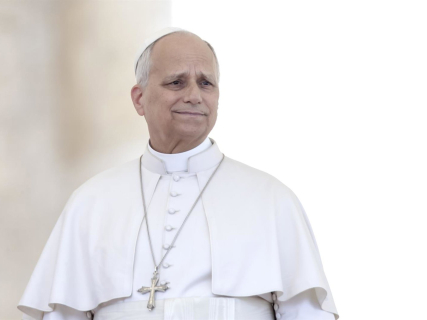

Pope Leo XIV will present next Monday, May 25, at the Vatican his first encyclical, titled Magnifica humanitas, a text that places artificial intelligence at the center of the doctrinal and ethical debate of the Church. The document, whose content is still unpublished, aims to become one of the key pieces of his pontificate by addressing the impact of the technological revolution on human dignity.
The presentation will take place in the Synod Hall, in an unusual format for this type of text, with a conference in which cardinals, theologians, and representatives from the technological field will participate. Among them, the presence of Christopher Olah, co-founder of Anthropic, one of the leading companies in the advanced artificial intelligence sector and a reference in the debate on the ethical limits of this technology, stands out.
An encyclical to position the human being in the face of the algorithmic revolution
The content of the document, according to initial information, revolves around the defense of human dignity in the face of the accelerated development of artificial intelligence, as well as the effects of automation on employment, the concentration of power in large technology corporations, and the manipulation of information in digital environments.
The text will also address what the Vatican defines as a possible "ecology of truth," referring to the proliferation of systems capable of generating synthetic content, false identities, or large-scale disinformation, as well as a critique of transhumanism from an anthropological and ethical perspective.
A gesture of openness to the global debate on technology
The presence of a director from one of the main AI companies at the presentation underscores the pontiff's desire to place the Church at the center of a debate that is no longer limited to the academic or religious sphere, but cuts across politics, economics, and the structure of global technological power.
The Vatican has wished to frame this initiative within the continuity of the Church's social doctrine, drawing a historical parallel with Leo XIII's encyclical Rerum novarum, published in the context of the industrial revolution. In this new stage, Leo XIV intends to intervene in what some analysts already define as the "algorithmic revolution."
The Church in the face of technological transformation
The pontiff has also promoted the creation of a specific commission on artificial intelligence within the Holy See, made up of different Vatican bodies linked to doctrine, culture, and communication. The objective is to continuously analyze the impact of these technologies on work, information, and social life.
With Magnifica humanitas, the Vatican seeks to reinforce an already traditional line in its social thought: placing the human person at the center of structural changes. In this case, in the face of technology that advances at great speed and poses ethical challenges of global scope, from job displacement to the redefinition of the human condition itself.