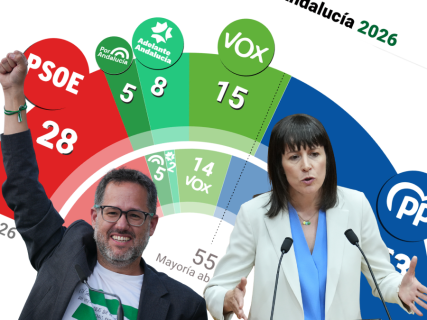

The surprising advance of Adelante Andalucía in the 17M elections and the debacle of the PSOE-A pose a dire scenario for those of María Jesús Montero: a possible 'sorpraso' in what has been until now a historic socialist stronghold.
The formation of José Ignacio García emerged on Sunday as the party that gained the most votes compared to the previous 2022 elections, around 231,000, translating into 6 more deputies in Parliament. In this list, the Andalusian PSOE appears precisely as the party with the least growth (55,000 votes), just ahead of Por Andalucía, which lost 22,000 voters along the way.
Podemos and Ciudadanos were responsible in 2015 for closing the door on bipartisanship in Congress. But at the regional level, the hegemony of PP and PSOE had already been questioned long before. In communities like Catalonia or the Basque Country, nationalist forces have historically been the ones with the greatest electoral weight.
In others like Galicia, despite the PP always being the favorite, a nationalist party has long occupied the space that once belonged to the PSOE. Ana Pontón's Bloque Nacionalista Galego (BNG) has managed, after much effort, to consolidate itself in the Galician Parliament, offering an alternative to Galician socialism on the left.
Its programmatic similarity with Adelante Andalucía is evident. But will it achieve the same results?
Adelante Andalucía bursts onto the scene with force
Adelante Andalucía has been one of the main protagonists of these elections. It goes from 6 to 8 seats with more than 401,000 votes, positioning itself ahead of Vox in provinces like Cádiz and Seville and consolidating itself as the main left-wing force to the left of the PSOE.
Its leader, José Ignacio García, has claimed that Adelante Andalucía is "the main left-wing force in Andalusia" and has assured that the project "is here to stay." Thus, the comparison with Ana Pontón's party is not accidental. The BNG has managed in Galicia to consolidate itself as a force with its own identity, nationalist discourse, and stable social base, combining institutional representation with presence in the social movement.
Adelante's discourse is based on three pillars: political Andalusianism, the defense of public services, and a narrative of social and territorial sovereignty. In this regard, its strategy moves away from the logic of coalitions with state-wide parties and seeks to consolidate its own space.
The Galician mirror: similarities and limits
The comparison with the BNG is mainly based on the attempt by both spaces to articulate a strong territorial identity within the Spanish State. Both BNG and Adelante Andalucía share elements such as the defense of self-government, emphasis on social issues, and a discourse of cultural roots.
However, the differences remain relevant. The BNG has a much more consolidated historical structure, decades of territorial presence, and a more stable electoral base. Under the leadership of Ana Pontón, the Bloque has managed to combine an identity discourse with social, feminist proposals, and the defense of public services.
Adelante Andalucía, on the other hand, is a more recent project, emerging from previous fragmentations in the Andalusian left and still in the process of organizational definition. Its origin dates back to 2018 and it emerged as a coalition between Podemos Andalucía, Izquierda Unida, and other progressive formations
The Bloque also emerged as a coalition, although it was founded in 1982 as a formation that would support various organizations of Galician nationalism, including Unión do Povo Galego (UPG), which is today the majority force. Its origin is framed within the consolidation of left-wing nationalism in Galicia after the Transition, with the aim of articulating its own political alternative for the autonomous community.
In 1996, it was constituted as a party, beginning a trajectory of institutional growth that has made it the main force of Galician nationalism today. And although in its struggle with the PSdeG it suffered significant setbacks, especially in that decade, since 2020 it has managed to consolidate itself as the great political alternative to Alfonso Rueda's Partido Popular.
Adelante Andalucía, without a defined electorate
With 25 deputies in the Parliament, Ana Pontón's party stands out in Galicia above a PSdeG that only obtained 9 representatives in the previous 2024 elections.
Its vote is particularly young, with high levels of education, and is concentrated in large cities, ceding rural areas to the Partido Popular. In contrast, Adelante Andalucía has not yet found a defined profile for its electorate.
In cities like Seville, it does not stand out in terms of representation, except in very specific areas on the outskirts, and, pending post-election data, it has not yet managed to stand out in any sociodemographic category.
Is Adelante Andalucía the Andalusian BNG?
Despite the electoral advance, the formation still faces key challenges: its unequal territorial implementation, internal competition on the left, and the difficulty of translating its sovereignist discourse to broad majorities in Andalusia.
The territorial differences between Andalusia and Galicia are also evident. While the PP has managed to consolidate a rural vote for over 40 years, likely influenced by a long tradition of small landholdings in Galicia, among other factors, the Andalusian countryside, traditionally characterized by large estates, has finally ceded ground in the last two legislatures to the PP, despite historically belonging to the PSOE.
The comparison with the BNG is useful as a reference, but still premature as a political equivalence. Adelante Andalucía shares with the Galician bloc the commitment to left-wing sovereignism with territorial identity, but still lacks its historical trajectory and electoral stability.
More than a "new BNG," Adelante Andalucía appears today as a project under construction, with the potential for consolidation, but still in a phase of strategic definition within the Andalusian political map.
If it manages to consolidate its electoral base, expand its municipal presence, and make the leap to Congress – where Ana Pontón's party has one deputy – the comparison with the BNG will cease to be a hypothesis and become a political reality.