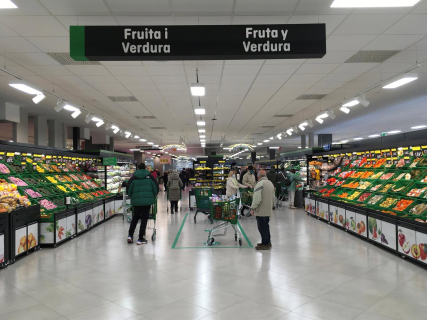
Mercadona and the grocery bill price: Roig explains when products go down in price

Juan Roig links the price drops at Mercadona to the lowering cost of raw materials and gives as an example olive oil. In statements recovered by ABC, the head of the chain explains how he passes those changes on to the products his customers buy

fotonoticia 20260915133206 1920

fotonoticia 20260915133206 1920

Add DEMÓCRATA to Google

Ask FREN

Published

Last updated

3 minutes

Most read

Elecciones 29N · Encuestas

La media de las encuestas

Media a 15 de noviembre de 2026 · 16 institutos

  • PP31,4 %
  • PSOE27,0 %
  • Vox19,0 %
  • Frente Amplio6,2 %
  • ERC2,5 %
01020304050ene 2024jul 2024ene 2025jul 2025ene 2026jul 2026

Media del último estudio de cada instituto en 30 días y su evolución semanal desde el 23J. Partidos con al menos un 2 %.

Todas las encuestas

Elecciones generales del 29 de noviembre · Demócrata

ELECCIONES 29N

¿Cuál es tu pronóstico? 29N

Reparte los 350 escaños del Congreso como creas que quedarán el 29 de noviembre. Puedes cambiar tu pronóstico hasta que cierren los colegios.

0 de 350 escaños

PP
PSOE
Vox
Frente Amplio
ERC
Junts
EH Bildu
PNV
Más partidos
Podemos
BNG
SALF
CC
UPN
Adelante
Aliança
Otros

Protegido por reCAPTCHA de Google: privacidad y condiciones

Pronóstico de DemócrataParticipación abierta, no es una encuesta

The purchase price at Mercadona depends, as Juan Roig explains, on the evolution of raw materials. The chain’s president argues that their rise forces prices to be revised upward and uses olive oil to illustrate the opposite movement: when the product’s cost goes down, the company can pass that reduction on to the consumer.

The statements come from a press conference held in March and have been retrieved by ABC in an information piece published this November 15. They do not include the announcement of a new general discount or a schedule of discounts for the coming weeks.

Roig’s explanation responds to a question that directly affects the household budget: why the same product costs more than before and what has to change for it to become cheaper again.

What Juan Roig says about Mercadona’s prices

The businessman attributes the increases to the costs of raw materials. "We never raise them, only if raw materials become more expensive," he said, according to ABC.

Roig argues that distribution is exposed to international events that it cannot control. In his explanation, that dependence affects the entire sector, even though each chain uses its own offers and commercial policies.

This is Mercadona’s president’s interpretation of the evolution of its prices. The statements collected do not include a breakdown by product that would make it possible to check how much corresponds to raw materials, transport, other costs, or commercial margin.

They also do not specify how much time passes between a change in the cost at origin and its transfer to the supermarket. Therefore, their words do not allow an immediate drop in the entire shopping basket to be anticipated.

Olive oil, the example of an increase and a decrease

The case that Roig uses to explain his approach is olive oil. As he related at that appearance, the chain raised its price when the product became more expensive and reduced it afterward, when the evolution of costs changed.

The reference serves to describe the behavior of a specific food. It does not equate to claiming that all supermarket products have gone down at the same time or in the same proportion.

For the buyer, that distinction is relevant: a price cut in olive oil can reduce spending on that item, but its effect on the total receipt will also depend on the rest of the products purchased and on their quantities.

The statements recovered by ABC do not specify brands, formats, amounts per liter, or percentages of reduction. They also do not offer a comparison of current prices with those recorded in March.

Lower prices to attract the customer

Roig argues that merchants are interested in offering lower prices because the cost of the purchase influences the consumer’s choice. From that perspective, he presents the price reduction as a tool to attract customers.

His argument places the chain’s commercial interest alongside households’ concern about spending. But expressing that preference does not mean committing to a specific reduction: to know it, the product, the new price, and the date of application are needed.

That is the scope of the published statements. They explain the position of Mercadona’s president on increases and decreases, without detailing a new commercial campaign.

What the consumer can check when shopping

To compare a product between supermarkets, it is useful to look at the price per unit of measurement: euros per liter in oil or euros per kilogram in other foods. The amount of the package, by itself, may be insufficient if the quantities are different.

It also makes it easier to assess a discount by comparing the same format and the same variety. In olive oil, for example, a comparison between different categories does not necessarily show how much an equivalent product has become cheaper.

More key points, information and questions with FREN

AI-GENERATED CONTENT

What is the parliamentary procedure for approving measures that regulate the prices of basic products in Spain?

In Spain, there is no single parliamentary procedure to regulate the prices of basic products. The route depends on the content of the measure: it can be approved through a law, by means of a royal decree-law if there is an extraordinary and urgent need, or by regulation when there is sufficient legal coverage.

1. Approval through a law

The legislative route allows debating and modifying the regulation before approving it. The general procedure is set out in articles 108 to 132 of the Congress Regulations:

  • Initiative. The Government presents a bill. Law proposals can also be promoted by authorized subjects, including parliamentary groups. These generally require consideration: an initial vote to decide whether to start processing.
  • Publication and amendments. The Congress Board orders the publication of the text and sends it to the competent committee. The ordinary period to submit amendments is fifteen working days, subject to modification. Amendments allow deleting, adding, or changing provisions; total amendments may request the return of the bill or propose an alternative text.
  • Presentation and committee. A presentation, formed within the committee, studies the text and amendments and drafts a report. Then, the committee debates and votes on the articles and issues an opinion.
  • Approval in Congress. The Plenary debates the opinion and the maintained amendments. When full legislative competence applies, the committee can approve the text without that final Plenary vote, unless the Plenary recovers the decision.
  • Senate intervention. The text goes to the Senate. If it introduces amendments, Congress decides whether to accept them by simple majority. If it vetoes, Congress can lift the veto by absolute majority or, after two months from its imposition, by simple majority.

The general rule is a simple majority: more favorable votes than opposing, with the required quorum. Price regulation does not require an organic law merely because it affects essential goods. If the content falls within a matter reserved for an organic law, an absolute majority of Congress will be necessary in a final vote on the whole.

2. Urgent approval by royal decree-law

This route reverses the order: first, the Government approves a norm with the force of law and then Congress intervenes. It requires justifying the extraordinary and urgent need and respecting the constitutional limits of this instrument.

  • A Government member explains the reasons for approval and the groups debate the text.
  • Congress must decide on its validation or repeal within the constitutional period of thirty days following its promulgation.
  • Validation, which maintains the norm, is decided by simple majority. The whole is voted on: its articles are not modified in that vote.
  • Once validated, it can be agreed to process it as a bill by urgency. Then the possibility of introducing amendments opens and the Senate participates.

If Congress is dissolved or its term has expired, the Permanent Deputation assumes its powers over royal decree-laws. The Senate does not intervene in validation.

3. Regulatory development and control

When the law allows specifying certain aspects, the Government can develop them through regulations. A regulatory royal decree is not equivalent to a royal decree-law: it cannot modify what is established by a law and does not follow its validation procedure.

Parliament can demand information, formulate questions and interpellations, and request appearances. Motions and non-law proposals express a political position but do not replace the necessary norm to impose prices. Additionally, initiatives and amendments that increase credits or reduce budget revenues may require Government approval to be processed.

What are the competencies of the president of a large supermarket chain like Mercadona according to Spanish legislation?

In Spanish legislation, there is no closed and specific list of “competencies of the president of a large supermarket chain” like Mercadona. What does exist is a general framework of commercial law (mainly the Capital Companies Act, LSC) that regulates the functions of directors of companies (board of directors, directors, CEO) and leaves the specific distribution of competencies to the bylaws and internal board agreements.

Therefore, the first thing is to distinguish the exact position that person holds:

  • Chairman of the board of directors: leads and coordinates the board itself, but is not always the top executive.
  • Executive chairman / CEO (or chairman and CEO): concentrates both the direction of the board and the daily management of the company.

The LSC establishes that the management and representation of the company correspond to its directors, who can be organized as sole director, several joint or several several directors, or a board of directors. In large retail chains, a board is usual, and in that context, the typical competencies of the chairman (on a common legal basis) are:

1. Organic competencies vis-à-vis the board of directors
  • Call and preside over board meetings, set the agenda (according to the bylaws and board regulations) and direct debates.
  • Promote the proper functioning of the board: ensure that directors receive sufficient and timely information, that internal procedures are respected, and that supervision obligations over executive management are fulfilled.
  • In many companies, the chairman proposes to the board the creation and composition of committees (audit, appointments and remuneration, sustainability, etc.), although legally these competencies can be nuanced in bylaws or regulations.
2. Management competencies when he is executive chairman

If the chairman is also the main executive (executive chairman or CEO), his functions approach those of a general manager, based on the powers delegated by the board itself:

  • Ordinary business management: direct the daily activity of the supermarket chain (purchasing, sales, expansion, logistics, human resources, marketing), according to the strategy approved by the board.
  • Representation of the company in its relations with third parties: sign relevant contracts, negotiate with key suppliers, financial entities, unions, public administrations, etc., within the limits set by the board and bylaws.
  • Execution of board and general meeting agreements: implement decisions on investments, divestments, store openings or closures, corporate changes, financial policies, etc.
  • Management of the executive team: appoint, coordinate and, if applicable, dismiss area directors (operations, finance, legal, commercial), again according to the powers recognized by the board and bylaws.
3. Legal duties rather than sector “powers”

Rather than detailing specific tasks for the supermarket sector, the LSC imposes on the chairman–director a series of very strict legal duties:

  • Duty of diligence: act with the care of an orderly entrepreneur, adequately inform before deciding, supervise risks and the company’s solvency.
  • Duty of loyalty: put the company’s interest before personal interest, avoid conflicts of interest, not take advantage of business opportunities of the company for personal benefit, and maintain confidentiality.
  • Liability towards the company, shareholders, and third parties: respond with personal assets if, violating the law or bylaws, he causes damage to the company or third parties (for example, in serious cases of mismanagement, falsification of accounts, very serious infringements of competition or consumer regulations).
4. Complementary framework: sectoral and competition regulations

Although the law does not define “special” competencies for being a supermarket chain, the chairman must ensure that the company complies with:

  • Competition defense regulations and prohibition of collusive or abusive practices in the food chain.
  • Consumer and user protection legislation, labeling, product safety and quality, commercial hours, etc.
  • Financial information and corporate governance obligations if the company is listed or issues securities in regulated markets.

In summary, Spanish legislation does not define a specific catalog of competencies for the “president of Mercadona,” but a general framework for directors of capital companies. Within that framework, the specific powers of the chairman are set in the company’s bylaws and the board of directors agreements, and are complemented by his legal duties of diligence, loyalty, business supervision, and regulatory compliance.

What regulations govern the transparency of price formation in the food distribution sector in Spain?

The central regulation is Law 12/2013, of August 2, on measures to improve the functioning of the food chain, known as the Food Chain Law. It regulates the transparency of commercial relations from production to distribution, but does not generally require publishing the profit margin of each supermarket. It is important to distinguish between contractual transparency, market information, and competition protection.

1. Food Chain Law: documented and verifiable prices

The consolidated Law 12/2013 is the starting point. Its articles 3 and 4 set transparency, balance between operators, and respect for free competition as objectives and principles of commercial relations.

  • Contracting and price: requires written contracts in legally foreseen cases. They must include the price, payments, and applicable discounts and, when there is a variable part, the factors to calculate it. These must be objective, verifiable, transparent, and not manipulable.
  • Costs and value destruction: each operator must pay the immediately previous one a price equal to or higher than the effective production cost. For the primary producer, the contractual price must exceed production costs. The final sale of food cannot be below the real acquisition price under the terms established by law.
  • Changes and promotions: unilateral modifications of prices and contractual conditions are prohibited. Certain payments for display, marketing, or promotions require a prior, clear, and unambiguous agreement.
  • Confidential information: information required between operators must be proportionate and justified by the contract. Transparency does not allow freely obtaining or disclosing trade secrets.
2. Reforms explaining the current framework

Law 8/2020, of December 16, reinforced the consideration of production costs and the prohibition of value destruction. Law 16/2021, of December 14, expanded contractual protection and prohibited practices, and incorporated into Spanish law the Directive (EU) 2019/633 on unfair commercial practices between businesses in the agricultural and food supply chain.

These reforms must be read integrated into Law 12/2013, not as independent regimes. The directive establishes a minimum European protection and allows stricter national measures compatible with the internal market.

3. Regulatory development and market information

Royal Decree 64/2015, of February 6, partially develops the law. The Code of Good Commercial Practices in Food Contracting, published by Resolution of December 10, 2015, adds commitments for its adherents without replacing legal obligations.

The Food Chain Observatory helps explain price and cost evolution through value chain studies. It is an advisory body: it does not inspect or sanction. The indicators serve as reference but do not equate to a mandatory price nor publication of individual margins.

4. Competition and compliance control

Law 15/2007, on Competition Defense, prohibits price-fixing agreements and abuses of dominant position. Therefore, increasing transparency does not authorize distributors to coordinate their prices.

Supervision of the Food Chain Law corresponds to AICA and regional authorities, according to their competencies. Its control regime is articulated through Royal Decree 66/2015, amended by Royal Decree 368/2023. In practice, the main obligation is to be able to prove how the price was agreed and that the operation respects legal limits.

Play

Test your knowledge with FREN!

How much do you know about this topic? Answer the following 3 questions.

According to Juan Roig, what does the price of shopping at Mercadona depend on?

Question 1 of 3

What example does Roig use to illustrate how prices vary at Mercadona?

Question 2 of 3

What does the news recommend for correctly comparing prices between supermarkets?

Question 3 of 3