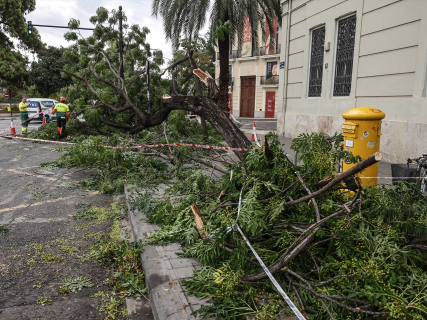
Red alert in Murcia for rains: up to 60 liters in one hour in Cartagena and Mazarrón

The Region of Murcia also keeps classes suspended in 15 municipalities while the episode of instability continues.

2 minutes

murcia alerta roja lluvias

murcia alerta roja lluvias

Add DEMÓCRATA to Google

Ask FREN

Published

Last updated

2 minutes

Most read

The State Meteorological Agency (AEMET) has activated this Thursday the red alert for rains in the Region of Murcia, the maximum level of meteorological risk, due to the possibility of very intense precipitation in the Campo de Cartagena and Mazarrón. According to the alert disseminated at 10:12 hours, the episode lasts between 10:00 and 11:59 hours, with up to 60 liters per square meter. 

The alert specifically affects that area of the Murcian coast and also contemplates the possibility of overflowing streams and local flooding. The rest of the Region maintains lower alert levels, within an episode that is particularly affecting the southeast and the Mediterranean arc.

The Region of Murcia has suspended educational activities until 15:00 hours in 15 municipalities and certain districts of Murcia due to the meteorological episode. The measure affects localities such as Cartagena, Lorca, Águilas, Mazarrón, San Javier, San Pedro del Pinatar, Torre Pacheco, and Totana.

The situation adds to the measures adopted since Wednesday by the regional Government in anticipation of intense rains. During the early morning, Emergencies managed several incidents related to the storms, although initially none were considered of special severity.

The storm has already caused hundreds of incidents

The Valencian Community faced one of the most intense episodes during the night. Emergencies managed 478 incidents between 14:00 and 23:00 hours on Wednesday, mainly due to water accumulation, leaks, circulation problems, and material damage. In some points of the province, more than 100 liters per square meter were exceeded. The rains also caused cuts and disruptions in transportation. Valencia airport had to close temporarily and diverted 12 flights, while Metrovalencia resumed service this Thursday with initial problems in ensuring regularity.

In Catalonia, the precipitation caused road closures and problems in Rodalies. The B-20 remained closed in Santa Coloma de Gramenet due to flooding, and rail traffic was interrupted between Fabra i Puig and Montcada Bifurcació. Rodalies also warned of delays exceeding 20 minutes on average across practically the entire network. The episode also had fatal consequences in Olivella, where emergency services located the body of a man whose vehicle had been dragged by the water while crossing a stream.

The instability remains this Thursday in a good part of the eastern and southeastern peninsula. AEMET forecasts showers and strong or very strong storms in the Balearic Islands, the Valencian Community, Murcia, and Almería, while Andalusia, Castilla-La Mancha, and the Balearic Islands also maintain various weather warnings.

More key points, information and questions with FREN

AI-GENERATED CONTENT

What is the procedure for issuing and modifying official weather warnings in Spain?

In Spain, the procedure for issuing and modifying official weather warnings is highly standardized because decisions regarding civil protection, traffic, maritime safety, or emergency management depend on them. The state reference body is the AEMET (State Meteorological Agency), although some autonomous communities (for example Catalonia, Basque Country, Navarre, Galicia, Valencian Community, Balearic Islands, Canary Islands) also have their own meteorological services that issue warnings within their territorial scope, always coordinated with civil protection.

1. Competent body and general framework

At the national level, AEMET is the official meteorological service and Spain's contact point in the Meteoalarm / EUMETNET warning system. Within the framework of civil protection plans (for example, the State General Emergency Plan and special plans against floods, forest fire risk, heat waves, coastal phenomena, etc.), the issuance of weather warnings by AEMET is the technical reference on which authorities (state, regional, and local civil protection) decide whether to declare pre-emergency, alert, or emergency situations.

2. Forecast generation and thresholds

The ordinary process begins with numerical weather prediction. AEMET integrates:

  • Observation data (network of stations, radars, satellites, buoys, radiosondes).
  • Results from its own numerical models and international centers (for example, the European Centre for Medium-Range Weather Forecasts).
  • Information from forecasters at Territorial Meteorological Centers, who refine the forecast for each province or maritime zone.

Based on this, it is evaluated whether the forecasted phenomena (precipitation, wind, snow, storms, extreme temperatures, coastal phenomena, etc.) will exceed predefined thresholds, which vary according to:

  • The type of phenomenon (mm of rain in 1 or 12 hours, wind gusts in km/h, wave height, maximum/minimum temperature, snow depth, etc.).
  • The geographical area (the rain threshold is not the same in a semi-arid area as in a very rainy one).
  • The time window (usually working with horizons of 12, 24, 48, and up to 72 hours).

When models and forecaster analysis indicate these thresholds will be exceeded, a weather warning is generated for the corresponding area and time interval.

3. Classification by warning levels

Spain uses a scale harmonized with the European system:

  • Green: no significant phenomena. No warning is issued; this is the reference situation.
  • Yellow: potentially dangerous but common meteorological phenomena. They may cause isolated incidents, especially in exposed activities.
  • Orange: meteorological phenomenon of significant risk. Material damage and dangerous situations for the general population are likely.
  • Red: phenomenon of exceptional intensity and extreme risk. Severe damage and very dangerous situations for physical integrity are expected.

Each level is associated with specific threshold ranges for each type of phenomenon and area, defined in internal tables that are periodically reviewed.

4. Updating and modifying warnings

Once issued, the warning is kept under continuous review. The standard procedure includes:

  • Constant monitoring of actual observations against the forecast.
  • Periodic review of numerical models (update cycles every few hours).
  • Communication between the National Prediction Center and territorial centers.

If new information indicates that:

  • The phenomenon will be more intense or affect more areas, the warning is updated by raising the level (for example, from yellow to orange) or expanding the area or time.
  • It will be less intense or will move, the level is lowered, the area reduced, or its end anticipated.
  • It does not materialize, the warning can be canceled before its expiration.

Every modification generates a new version of the warning, with clearly indicated issuance and validity times.

5. Coordination with civil protection and administrations

Warnings are integrated into a formal coordination circuit:

  • AEMET communicates warnings and their changes to the Directorate General of Civil Protection and Emergencies and to regional and local coordination centers (CECOES, CECOPI, regional 112, etc.).
  • In special plans (floods, cold/heat waves, maritime storms), certain warning levels are triggers for activating pre-emergency or alert phases.
  • Regional meteorological services, when they exist, maintain direct channels with their community's civil protection and exchange information with AEMET to ensure coherence.
6. Communication to the public and media

Dissemination to the public is carried out through multiple channels:

  • Web portals and near real-time warning maps.
  • Own applications and channels (bulletins, social networks, information notes).
  • Joint press releases and briefings with civil protection in high or extreme risk situations.

These products aim to accompany the warning level with understandable messages about what may happen and what types of self-protection behaviors are advisable, so that citizens and authorities can make informed decisions.

What specific thresholds (mm of rain, km/h of wind, etc.) apply at each warning level for my province? How are weather warnings coordinated with civil protection plans against floods or heat waves in a specific autonomous community? What are the differences between AEMET warnings and those from regional meteorological services like Meteocat or Euskalmet?

What competencies and functions does the State Meteorological Agency (AEMET) have according to current legislation?

The State Meteorological Agency (AEMET) is, according to current legislation, the State's meteorological service and the state meteorological authority. Its statute was approved by Royal Decree 186/2008, of February 8, whose consolidated text —updated, among others, by Royal Decree 895/2017— defines its competencies and functions. In 2026, a new statute adapted to Law 40/2015 was approved, but the main lines of mission and functions remain substantially the same: to provide the state meteorological and climatological service, support security and public policies, and exercise international representation in the field.

General framework of competencies

According to its Statute, AEMET's purpose is to develop, implement, and provide the State meteorological services, linked to the exclusive competence of the State over the “meteorological service” of article 149.1.20.ª of the Constitution. Within this framework, the article on competencies and functions (art. 8 of RD 186/2008, in its consolidated version) attributes to it, among others, the following:

  • Public service of general meteorological information: to prepare, supply, and disseminate meteorological information and forecasts of general interest to the public throughout the territory, as well as to issue warnings and forecasts of phenomena that may affect the safety of people and material goods.
  • Support for the safety of air and maritime navigation: to provide the necessary meteorological services to contribute to the safety, regularity, and efficiency of air traffic and to the safety of maritime traffic, in coordination with the competent aviation and maritime authorities.
  • Support for defense and internal security: to supply the necessary meteorological information and provide appropriate meteorological support to the Armed Forces, national defense, and the State Security Forces and Corps for the fulfillment of their missions.
  • Climatology, climate change, and environment:
    • To provide administrations with scientific advice on variability and climate change.
    • To prepare and update climate change scenarios and support environmental policies.
    • To contribute to international development cooperation in meteorology and climatology.
  • Support for public policies and other bodies:
    • To provide Public Administrations, institutions, and public and private entities with meteorological and climatological advice and value-added services, adapted to the needs of each sector (agriculture, energy, transport, civil protection, etc.).
    • To collaborate in the planning and execution of the State's policy on international development cooperation in its field.
Observation, networks, and data management
  • Continuous meteorological and climatic monitoring: to maintain effective and sustainable monitoring of meteorological and climatic conditions, as well as the structure and composition of the atmosphere over the national territory.
  • Observation networks and infrastructures: to establish, develop, manage, and maintain observation networks, systems, and necessary technical infrastructures (stations, radars, remote sensing systems, telecommunications, prediction centers, etc.).
  • Historical data archive: to preserve and update the historical archive of meteorological and climatological data of Spain, which serves as a basis for climate studies, sectoral planning, and risk assessment.
Research, training, and dissemination
  • Research and development: to conduct studies and research in atmospheric sciences and develop techniques and applications that improve knowledge of weather and climate and the quality of services.
  • Scientific-technical cooperation: to collaborate with other national and international organizations in R&D projects and global observation and prediction programs.
  • Training, documentation, and communication: to carry out training, documentation, and dissemination activities in meteorology and climatology to meet national and international needs, including managing centers such as the Izaña Atmospheric Research Center.
International representation and cooperation
  • State representation in international, supranational, and intergovernmental organizations related to observation, meteorological prediction, and climate study and modeling, such as:
    • World Meteorological Organization (WMO).
    • European Organization for the Exploitation of Meteorological Satellites (EUMETSAT).
    • European Centre for Medium-Range Weather Forecasts.
    • Networks such as EUMETNET, ECOMET, or the Group on Earth Observations (GEO).
  • Compliance with Spain's international commitments regarding the exchange of essential meteorological and climatological data and products.
Other functions and value-added activities
  • Commercial and consulting services: carrying out consultancy and technical assistance work within its competencies, as well as providing value-added services and setting public prices for certain specialized products and services.
  • Supervision of Agency construction projects, expressly incorporated in the latest update of the Statute.
  • Any other competence assigned by regulations within its object and scope of action.

Overall, current legislation configures AEMET as a specialized technical body that combines functions of an essential public service (information and warnings), operational support for security and public policies, management of critical observation infrastructures, and international representation in meteorology and climatology.

What are the legal requirements to suspend teaching activities in municipalities due to meteorological causes?

In Spain, there is no single rule that states “when classes are suspended due to snow or heat,” but rather a framework of civil protection and educational regulations. In practice, suspending teaching activities due to meteorological causes requires two major blocks of requirements: that there is an accredited risk situation within the civil protection framework and that the competent educational authority adopts (or assumes) the decision to suspend activities for safety reasons.

1. General civil protection framework

The Law 17/2015, of July 9, on the National Civil Protection System and the Basic Civil Protection Standard approved by Royal Decree 524/2023 are the state basis:

  • They configure civil protection as a public service integrated into public safety, with a distribution of functions among the State, autonomous communities, and local entities.
  • They foresee the existence of territorial and special civil protection plans and self-protection plans for centers, establishments, and facilities, including educational ones.
  • They explicitly include adverse meteorological phenomena as one of the risks to be planned for (catalog annexed to the Basic Standard).
  • They establish the principle of single command in emergencies: when a civil protection plan is activated, the actions of intervening services (including measures such as closing facilities or mobility restrictions) are subject to the direction of the competent civil protection authority.

Within this framework, regional emergency laws (for example, Law 5/2007, on emergencies in Galicia) require educational centers to have self-protection plans, with evacuation drills and specific measures for emergency situations. These plans are part of the material requirements: they must foresee what to do in episodes of snowfall, floods, storms, etc., including when activity cessation is appropriate.

2. State educational bases and regional competencies

The Organic Law 2/2006, on Education (LOE), amended by LO 3/2020 (LOMLOE), sets the bases for the organization of the educational system but does not detail “class suspension due to weather.” What is relevant is:

  • It recognizes education as an essential public service, which must be provided regularly but also with guarantees of safety and protection of students.
  • It assigns to regional educational administrations the competence to organize centers, their operation, and calendar within the state bases.
  • It refers to regional and center regulations for internal organization aspects, including exceptional situations.

On this common trunk, each autonomous community approves its own educational and center organization regulations. For example, in Andalusia, the Organic Regulation of infant and primary schools (Decree 328/2010) regulates in detail the competencies of management and educational administration; other regional emergency or school organization regulations include references to self-protection plans and coordination with civil protection.

3. Who can suspend teaching activities?

Generally, the decision is not made “at the class level” nor by each teacher, but by authorities with competence:

  • Regional educational administration: usually competent to agree on the generalized suspension of teaching activities in one or more municipalities or areas (education ministry, territorial delegations, provincial directorates).
  • School management: can adopt immediate protection measures (evacuation, not starting the day, temporary closure), especially when foreseen in the self-protection plan or upon instructions from civil protection or educational administration.
  • Civil protection authorities: do not “suspend classes” in the educational sense but can declare emergency situations and order facility closures, circulation restrictions, etc., which de facto prevent in-person educational service.
  • Municipalities: as owners of buildings and municipal services, can close facilities and activate municipal emergency plans; in many cases, the effective suspension of teaching activities is later formalized by the regional educational authority.
4. Common material requirements

Although details vary by community, several criteria repeat:

  • Existence of accredited adverse meteorological phenomena (AEMET or regional agency alerts) that endanger safety at the center or its access (snowfalls, ice patches, floods, very strong winds, extreme temperatures).
  • Activation of a civil protection plan (territorial or special) at a certain level (for example, orange or red alert, or operational situation 2 or 3 according to the Basic Standard).
  • Report or recommendation from civil protection or emergency services, assessing the impossibility or serious difficulty of safe access for students and staff to the center.
  • Consideration of the measure as proportional and temporary: limited to the strictly necessary time and reviewed as the episode evolves.
5. Formal requirements and coordination

Besides objective risk, there are minimum formal requirements:

  • The decision must be adopted by the competent authority (ministry, territorial delegation, center management within their powers) and recorded in a resolution, instruction, or agreement, at least internally.
  • Immediate communication to the educational community (families, students, staff) and coordination with municipalities and school transport services must be guaranteed.
  • Eventual recovery of activities (calendar adaptation) and, when possible, non-presential educational continuity are articulated, as reinforced by regulations issued during COVID-19 (for example, Royal Decree-law 31/2020 at the state level).

In summary, legally the suspension of teaching activities in a municipality due to meteorological causes rests on: the basic civil protection framework (Law 17/2015 and Basic Standard 2023), the state educational bases of LOE/LOMLOE, the regional development in emergencies and center organization, and the civil protection and self-protection plans of each territory and center. Based on this, educational authorities, in coordination with civil protection and local entities, assess case by case whether risk conditions justify suspension.

Can you detail how some specific autonomous communities (for example, Galicia, Andalusia, or Catalonia) regulate class suspension due to adverse meteorological phenomena? What exact role do educational centers' self-protection plans play when deciding to suspend teaching activities? What obligations do municipalities and school management have to inform families when classes are suspended due to bad weather?

Play

Test your knowledge with FREN!

How much do you know about this topic? Answer the following 3 questions.

What level of rain alert has AEMET currently declared in the Region of Murcia?

Question 1 of 3

What was the consequence of the storm in Olivella?

Question 2 of 3

Which transport infrastructures were affected in the Valencian Community and Catalonia during the storm?

Question 3 of 3

Hola, soy Fren. ¿Cómo te ayudo?