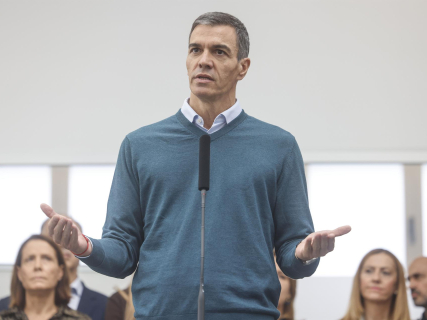
Sánchez suspends his schedule after the Toledo railway accident

The Prime Minister cancels his participation in an event of the Ministry of Health to follow the evolution of the emergency after the collision of an Iryo and an AVE in Urda

fotonoticia 20261026144640 1920

fotonoticia 20261026144640 1920

Add DEMÓCRATA to Google

Ask FREN

Published

Last updated

2 minutes

Most read

Elecciones 29N · Encuestas

La media de las encuestas

Media a 27 de octubre de 2026 · 15 institutos

  • PP31,0 %
  • PSOE27,3 %
  • Vox18,9 %
  • Sumar6,3 %
  • Podemos2,9 %
  • ERC2,3 %
010203040ene 2024jul 2024ene 2025jul 2025ene 2026jul 2026

Media del último estudio de cada instituto en 30 días y su evolución semanal desde el 23J. Partidos con al menos un 2 %.

Todas las encuestas

Elecciones generales del 29 de noviembre · Demócrata

The President of the Government, Pedro Sánchez, has suspended his participation in the closing of an event scheduled for the morning of this Wednesday, October 28, at the Ministry of Health to closely follow the evolution of the serious train accident registered in Urda (Toledo), where at least 39 people have died, according to the report communicated by Emergencias Castilla-La Mancha.

The decision of the head of the Executive comes after the magnitude of the collision between a Iryo train and an AVE was known, which has left numerous injured and has caused two carriages to fall down an embankment. The accident has also forced Adif to suspend high-speed traffic between Madrid and Andalucía, while emergency services work at the scene of the accident.

Sánchez cancels his participation in an event at the Ministry of Health

The President of the Government had planned to participate this morning in the closing of the World Obesity Summit 2026, held at the Ministry of Health. However, he has canceled his attendance to follow in detail the information about the train accident, while the authorities continue evaluating its consequences and the emergency teams attend to those affected.

The suspension of his participation is added to the decision of the Minister of Transport, Óscar Puente, who has also interrupted his schedule when he was participating in an event of the World Infrastructure Forum.

At least 39 dead in the Toledo train accident

The accident occurred this Wednesday in the municipal area of Urda, in the province of Toledo, where two high-speed trains have collided under circumstances that are still being investigated.

According to the report communicated by Emergencias Castilla-La Mancha, at least 39 people have lost their lives, while many others have been injured. Two carriages have fallen down an embankment, which has complicated the intervention work of the emergency services.

Adif has communicated the suspension of railway traffic between Madrid and Andalucía due to "a collision between two trains", without it having yet been specified when the service can be restored.

The seriousness of the incident has also caused the suspension of the campaign schedules of the political parties, a little more than a month before the general elections of next November 29.

More key points, information and questions with FREN

AI-GENERATED CONTENT

What are the competencies and functions of the Prime Minister in emergency situations according to Spanish legislation?

The Prime Minister leads the political response and coordinates the ministers in an emergency, but does not automatically concentrate all powers. The legislation distinguishes his personal powers from those of the Council of Ministers, the ministers, and the regional and local authorities. The available powers depend on the legal regime activated.

1. General Government Leadership

Article 2 of the Law 50/1997, of the Government establishes that the Prime Minister "directs the action of the Government and coordinates the functions of the other members thereof," respecting the direct competence and responsibility of each minister.

In a crisis, he can convene and preside over the Council of Ministers, set its agenda, give instructions to the ministers, resolve conflicts of competence between departments, and determine political guidelines. He also directs defense policy. These functions allow organizing the governmental response but do not replace the powers that laws assign to other authorities.

2. National Security Crisis

The Law 36/2015, on National Security, especially its articles 15 and 20, expressly assigns to the Prime Minister:

  • To direct the policy and the National Security System.
  • To propose the National Security Strategy and its revisions, whose approval corresponds to the Government.
  • To declare a situation of interest for National Security.

The National Security Council assists him in this direction. The system allows evaluating threats, gathering information, and coordinating the response and resources. However, this route does not allow exercising the powers typical of states of alarm or exception: when necessary, their specific regulations must be applied.

3. Disasters and Civil Protection

The Law 17/2015, on Civil Protection does not make the Prime Minister the operational director of any disaster. Its articles 33 to 37 distribute responsibilities:

  • The Government approves state plans and declares areas severely affected by an emergency.
  • The Minister of the Interior declares the emergency of national interest and its end, and assumes the corresponding direction and coordination.
  • The intervention of the Military Emergency Unit is requested by Interior and ordered by Defense. In emergencies of national interest, the UME assumes operational direction under Interior's leadership.

Therefore, presidential political leadership and operational command are not equivalent.

4. States of Alarm, Exception, and Siege

The Constitution and the Organic Law 4/1981 reserve the main decisions to the Government and the Congress, not to the Prime Minister individually:

  • Alarm: the Council of Ministers declares it for an initial maximum of fifteen days; its extension requires authorization from Congress. It allows, among other measures, limiting movement, carrying out temporary requisitions, or ensuring supplies. The competent authority is the Government or, by legally provided delegation, the regional president.
  • Exception: requires prior authorization from Congress and declaration by decree of the Council of Ministers. Its initial maximum duration is thirty days, extendable by another thirty with parliamentary authorization. Measures must conform to what is authorized.
  • Siege: the Government proposes its declaration to Congress, which decides.
5. Limits and Responsibility

Extraordinary measures must be indispensable, temporary, and proportionate. They do not interrupt the functioning of constitutional powers. The Government must inform Congress about the state of alarm; administrative acts are subject to judicial challenge and may generate compensation under legal terms. The emergency alone does not grant unlimited powers to the Prime Minister.

What legal requirements must be met to resume railway traffic after an accident of this magnitude?

To resume traffic after a serious railway accident, it is not enough to remove the wrecked trains and repair the track: safety conditions must be restored, risks controlled, and investigation actions respected. In the General Interest Railway Network, responsibility lies with the infrastructure manager and railway companies, under supervision of the State Railway Safety Agency (AESF). Since the accident or section is not identified here, these are general requirements, not a certification that a specific reopening is legal.

1. Restore and certify safety

The Railway Sector Law assigns administrators and operators responsibility for the safety of their part of the system. It requires management systems that include "the necessary measures for the evaluation and control of railway traffic risks and their monitoring."

Therefore, the decision must be based on technical checks of the affected elements: infrastructure, safety installations, signaling, traffic control, and, when applicable, electrical supply and rolling stock. Physical repair does not replace this evaluation. Its scope must respond to the detected damages and risks, not only to the need to restore service.

2. Determine if new authorizations are needed

A distinction must be made between restoring previous conditions and making modifications that require new authorization. Royal Decree 929/2020, on railway operational safety and interoperability, regulates the commissioning of subsystems and the commissioning of modified lines.

It contemplates new authorizations, among other cases, for substantial route modifications or addition of tracks. It also provides that the AESF decides if certain modifications require authorization. When required, the corresponding procedure and verification documentation must be completed before using the modified installation. This authorization should not be confused with a new mandatory authorization after any accident.

3. Maintain safety certifications

The administrator must have safety authorization and permanently comply with its conditions. Railway companies need their safety certificate and must maintain requirements related to traffic, personnel, vehicles, and maintenance.

The AESF supervises these obligations, can inspect facilities and equipment, and access relevant documentation. It also has powers to modify or revoke the corresponding certifications. Service recovery does not allow operating outside its conditions or decisions adopted by the safety authority.

4. Respect the accident investigation

Law 2/2024 establishes mandatory technical investigation of serious railway accidents on this network. It includes collisions or derailments with at least one fatality, five serious injuries, or damages estimated at at least two million euros, under the terms of its article 4.

The technical investigation aims to prevent new accidents and must be distinguished from judicial actions. The consulted sources do not establish that it is necessary to wait for the final technical report to reopen. They also do not specify, without knowing the decisions made in the case, what authorization would be necessary to remove debris or release an area under judicial investigation.

5. What must justify the reopening

The decisive issue is that the safety of operation can be certified: damages corrected, risks evaluated and controlled, operating conditions defined, and required authorizations obtained. The specific tests and documents will depend on the affected facilities and applicable procedure; there is no single legal list of mandatory reports or tests for every accident. The urgency to reopen does not replace any of these requirements.

What is the political and professional background of Óscar Puente, Minister of Transport?

Óscar Puente Santiago is a lawyer and PSOE politician, with a career mainly built in Valladolid before joining the Government of Spain. He practiced law for twenty years, was mayor of his city between 2015 and 2023, and has held the Ministry of Transport and Sustainable Mobility since November 2023.

Education and professional career

He was born in Valladolid on November 15, 1968. He holds a Law degree from the University of Valladolid and completed a master's degree in Political Management at the Jaime Vera Foundation. His main professional activity was practicing law between 1995 and June 2015, when he became mayor. During his first years as a councilor, therefore, he maintained his legal work alongside his political responsibilities. These data appear in his official biography.

Early political responsibilities

He joined the PSOE in 1990. In 2004, he assumed the Deputy Secretary-General of the Provincial Executive of Valladolid. He was elected councilor in 2007 and, since 2008, presided over and served as spokesperson of the Socialist Municipal Group, leading the opposition to Francisco Javier León de la Riva's government.

In 2009, he became secretary-general of the socialist municipal organization, a responsibility he held until December 2021. That month he was elected provincial secretary-general of the PSOE of Valladolid. His rise thus combined leadership of the local group, municipal representation, and provincial party responsibilities.

Mayor of Valladolid: 2015-2023

He became mayor in June 2015 through an alternative majority to the PP, which had been the most voted force. His investiture ended twenty years of popular governments in the city. In 2019, the PSOE won the municipal elections and Puente renewed the position, as noted in the Demócrata profile.

During his eight years in office, urban mobility had a prominent place: promotion of cycling, expansion of bike lanes, and decarbonization policies. He also developed a municipal representation role beyond Valladolid:

  • He presided over the Spanish Network of Healthy Cities of the FEMP between 2015 and 2019.
  • He was a member of the FEMP Governing Board between 2019 and 2023.
  • He represented the FEMP in the Urban Initiatives Network between 2020 and 2023.
  • He served as first vice president of the Ibero-American Organization of Intermunicipal Cooperation.

In May 2023, the PSOE was again the most voted candidacy in Valladolid, but the agreement between PP and Vox allowed Jesús Julio Carnero to be invested. Puente left the mayoralty in June, after two terms.

National projection and arrival at the Ministry

His first relevant national responsibility came in 2017: after Pedro Sánchez regained PSOE leadership, he was appointed spokesperson of the Federal Executive Commission. He combined that role with the mayoralty until October 2021.

In the July 2023 general elections, he obtained a seat for Valladolid. In September, he spoke on behalf of the PSOE during Alberto Núñez Feijóo's failed investiture, an episode that increased his national visibility. In November, he was appointed Minister of Transport and Sustainable Mobility, replacing Raquel Sánchez, as reported by RTVE.

At the head of the department, his responsibilities cover railways, roads, air and maritime transport, and sustainable mobility. His career thus combines legal experience, party leadership, and municipal and state management. On October 26, 2026, he confirmed that he will not run for mayor of Valladolid in 2027, focusing his dedication on national politics (Nueva Economía Fórum).

Play

Test your knowledge with FREN!

How much do you know about this topic? Answer the following 3 questions.

In which locality did the railway accident that caused at least 39 deaths occur?

Question 1 of 3

Which train lines were involved in the collision in Toledo?

Question 2 of 3

What immediate consequence did the accident have on railway traffic?

Question 3 of 3