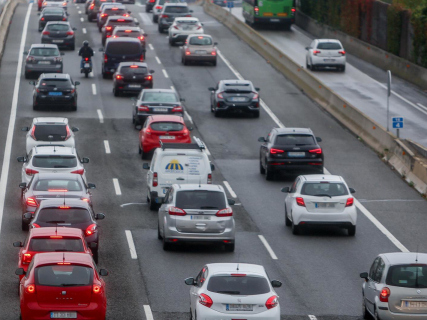

The AP-68 highway, which connects Bilbao and Zaragoza, has changed its toll system since last Wednesday, November 11, 2026. After more than half a century of private operation, the road has been freed from payment over much of its route, though not in its entirety. The end of the concession of Autopista Vasco-Aragonesa (Avasa), belonging to the Abertis group, allows travel for free along the sections in La Rioja, Navarra and Aragón, while the provincial governments of Álava and Bizkaia have decided to keep charging, with considerably lower rates than before.
The change affects one of the main road connections in northern Spain. The AP-68 has a length of 294.4 kilometers, of which 177 kilometers owned by the state have become free of charge, as confirmed by the Ministry of Transport and Sustainable Mobility. To these are added another 39.5 kilometers in Navarra, where the regional government has also removed the toll barriers, such that more than 216 kilometers can be traveled without paying.
The change represents significant savings for regular drivers, especially for those who use the highway for their work commutes or for transporting goods. The ministry estimates that more than five million users per year will benefit from the removal of tolls on the state sections, with an estimated saving of 97 million euros.
However, traveling from Bilbao to Zaragoza via the AP-68 is still not completely free. The cost will depend on the section traveled, the type of vehicle and the applicable discounts, since the Basque Country maintains a pay-per-use system managed by its provincial institutions.
Which sections of the AP-68 are free starting in November
The liberalization mainly affects the kilometers that run through La Rioja, Aragón, Navarra and a small part of Burgos. These sections have stopped being subject to the traditional toll since 00.00 hours on November 11, once the administrative concession has ended.
Specifically, the 119.4 kilometers of the AP-68 that run through La Rioja are free of charge, which allows travel between towns such as Haro, Cenicero, Logroño, Calahorra and Alfaro without paying the rates that were required until now. The measure removes a historic economic barrier for travel within the community.
In Aragón, free access reaches the 57.4 kilometers of the stretch that connects the area around Tudela with Zaragoza, while in Burgos it affects about 300 meters of road that belong to the state network.
The situation in Navarra has a particularity. The regional Government has taken over the management of the 39.5 kilometers of the AP-68 that run through its territory, split into two segments, and has decided to temporarily eliminate tolls while it adapts the regulations. The barriers remain raised and specific signage has been installed to inform users about this new situation.
Therefore, the route between Zaragoza and the border between La Rioja and Álava can be made without paying a toll, crossing the stretches in Aragón, Navarra, La Rioja and the small Burgos section. The free access of the state route is not conditional on having VIA-T or making a minimum number of trips.
Where it is still mandatory to pay: Álava and Bizkaia
The main exception is found in the Basque Country, where the provincial councils of Álava and Bizkaia have chosen to keep the toll system. Both institutions have taken direct responsibility for managing their respective stretches and have introduced new fares that reduce the cost of use.
In Bizkaia, the Provincial Council manages 22.3 kilometers of the AP-68, through the public company Interbiak. The new fares mean an average reduction of 20% for occasional trips. Thus, the route between Bilbao and Arrigorriaga goes from 1.05 to 0.85 euros, while the trip between Bilbao and Arrankudiaga falls from 2.55 to 1.70 euros.
The amount of the trip between Bilbao and Orozko, from 2.55 to 2.05 euros, is also reduced. For those traveling as far as Altube, including the corresponding Álava section, the fare goes from 6.85 to 4.25 euros.
The reduction is even greater in Álava, where the Foral Provincial Council has taken over the management of 55.2 kilometers between the borders with Bizkaia and Burgos. The new system establishes an approximate reduction of 70% for light vehicles and 50% for heavy vehicles.
In general terms, passenger cars will pay a rate of six cents per kilometer traveled within Álava territory. According to the figures released by the institution, crossing the 55 kilometers of Álava will cost approximately 3.35 euros compared with the previous 11.20 euros.
As a reference, the new tariff table places 6.70 euros for the journey in tourism from the accesses of Bilbao to the Alavese limit with Burgos, from where the free section continues toward Zaragoza. However, the specific conditions may vary due to discounts and the transitional measures for adapting the charging system.
A temporary exception: some drivers do not pay for the entire stretch in Álava
The entry into force of the new tariffs has also caused a particular situation in trips toward Bilbao. Álava will temporarily not collect certain routes in the northbound direction while it finishes adapting the facilities and the computer systems that make it possible to calculate the toll.
The exemption affects vehicles coming from the limit with Burgos, Zambrana, Ribabellosa or Subijana that continue to Bilbao and exit via the Biscayan toll of Arrigorriaga. In those cases, the stretch comprising up to Altube is temporarily excluded from charging due to the technical limitations of the new system.
The foral order published on November 13 covers this situation until December 31, 2026, although it allows the deadline to be modified depending on the progress of the works. The Provincial Council has indicated that its operational forecast is to complete the adaptation sooner, around mid-December.
Therefore, this exemption does not equate to the definitive removal of the toll in Álava, nor is it applied generally to all routes. Trips in the southbound direction and certain internal routes continue to be subject to the payment system planned by the institution.
What changes in the toll barriers and discounts
In addition to the new tariffs, drivers will find changes in how the facilities work. On the stretches of Bizkaia and Álava, the need to collect the entry ticket disappears, since the system uses license-plate recognition cameras to identify the routes and calculate the corresponding amounts.
Payment may continue to be made using cash, a bank card or VIA-T devices, depending on the enabled facilities. In the kilometers released, the Ministry of Transport will proceed with the progressive dismantling of the barriers and other elements associated with the old charging system.
Discount mechanisms are also maintained for those who regularly use the motorway. In Bizkaia, the program Bidesaria provides monthly spending limits for users who meet certain requirements. Currently, the maximum applicable to trips along the toll roads in Bizkaia is 39.46 euros per month, while starting in January 2027 it will be reduced to 35 euros for journeys made exclusively within the territory.
For its part, Álava maintains specific aid for residents who make at least 15 trips per month and have an identification and compatible payment device. These bonuses will focus on compensating part of the cost of the Bizkaia section, where the general reduction in fares is lower.
The end of a concession after more than half a century
The liberalization of the AP-68 brings an end to a concession originally awarded in 1973 to Autopista Vasco-Aragonesa to build and operate an infrastructure that came into operation progressively between 1975 and 1980. Although the initial term was much shorter, different extensions made it possible to prolong private management until the 10 November 2026.
From now on, the Ministry of Transport will directly take on the conservation and operation of the state sections, while Navarra, Álava and Bizkaia will handle their respective kilometers. This administrative arrangement explains why the same motorway can have free sections and others subject to payment.
The Government considers that the removal of tolls will favor a better distribution of traffic, by allowing part of the vehicles that used conventional roads to move to the motorway. It also expects improvements in road safety and a reduction in congestion on certain alternative routes.
The transformation will be accompanied by accessibility improvement actions and new connections, especially in La Rioja, where interventions in points such as Arrúbal, Villamediana y Fuenmayor are being studied.
With the new model, the AP-68 leaves behind the concession system that has shaped its operation for decades. Free travel already covers the majority of the route between Bilbao and Zaragoza, but drivers who pass through Álava and Bizkaia will still need to keep paying attention to the new tolls, the available bonuses and the temporary exceptions while the adaptation of the infrastructure is completed.