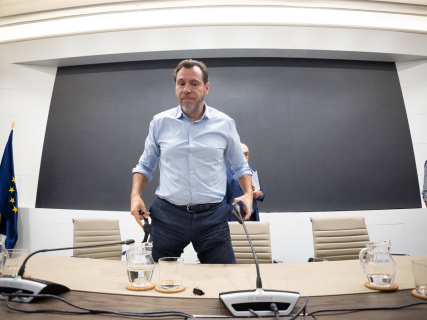

Óscar Puente is facing the Todos los Santos holiday bridge with the backing of Pedro Sánchez and a parliamentary appearance ahead. He has secured the political support that allows him to continue at the head of Transportes, for now and in his own words, but he has not managed to close the debate about his future within the PSOE. Four weeks before the November 29 elections, the discussion is no longer limited to whether he should leave: it extends to when, for what, and with what consequences.
On Tuesday, November 3, when he appears before the Diputación Permanente of Congress, it will be the next public test. Until then, Moncloa has a few days to assess the minister’s explanations, the progress of the investigation and the response of public opinion. According to ABC, surveys have been commissioned to measure the electoral impact of the tragedy and guide the next moves.
The clearest explanation for this move is that Pedro Sánchez is trying to buy time and still does not know how much it is costing to support the minister before deciding whether to change strategy.
Tuesday is a test, not an expiration date
The Congress appearance allows the Government’s response to be organized around an institutional obligation: to provide explanations to political representatives. At the same time, it gives Sánchez room before adopting any decision about his minister.
ABC gathers from its Socialist sources the expectation that there will be no moves before that intervention. El Independiente also places Tuesday as the reference point for leaders who consider it necessary to listen to Puente before assessing his continuity. If Puente presents concrete measures and manages to reinforce confidence in his management ability, his continuity will have new arguments. If the appearance leaves more doubts or intensifies the criticism, the pressure for a change will increase. Not to mention the social pressure, which is at an unsustainable point, with railway workers themselves outraged and the transport network practically collapsed in a critical holiday bridge for travel.
The polls will measure the wear and tear, but will not by themselves resolve the decision
Sánchez’s dilemma does not come down to checking how many citizens want a resignation. One thing is the rejection of the minister and another that his departure changes the Government’s assessment or the intention to vote.
That is the political problem that emerges from the different accounts: keeping Puente can prolong the wear and tear, but dismissing him does not guarantee stopping it either. That is, whether the 'firebreak' effect works or, on the contrary, further worsens the crisis of the Urda railway tragedy. Sánchez again made it clear on Friday that confidence in the railway system was broken.
Puente put his position at Sánchez's disposal: the support also implicates Sánchez
The press conference on Friday modified an important aspect of the narrative. According to the minister, Puente put his position at Sánchez's disposal after the tragedy, but the president rejected his departure because he considered it "unjust".
Therefore, his continuation cannot be described solely as a personal resistance to resign, although many media outlets portray it that way. There is a presidential decision to keep him, according to the version conveyed by the Transport minister himself, but that does not mean it will be indefinitely. It is that phrase from Pedro Sánchez: "it would be an injustice for you to have to resign," which closes the circle immediately but leaves it open for later.
And it also has another political consequence: the more explicit the support is, the harder it is to separate the minister's permanence from the responsibility of the person backing him.
The hypothesis of the «firebreak», present in the interpretations of leaders consulted by several media outlets, thus has a limit. Puente can concentrate the questions and the immediate wear and tear, but not isolate the president indefinitely. Sánchez will also have to explain why he considers that his minister is the right person to regain trust.
The PSOE does not speak with one voice
The information published this Saturday reflects considerable internal pressure, although it does not show unanimity in favor of the dismissal.
The Objective this Saturday quotes socialist officials who call for his departure and distinguish between the eventual guilt for the accident and the political responsibility of heading the department. Others fear that his permanence will condition the entire campaign.
El Independiente offers a more divided picture and gathers both requests for resignation and support from leaders who value Friday's explanations and consider it a priority to keep the minister at the head of the response. Demócrata already spoke yesterday of a party in "shock" over the tragedy that needs time to refocus and make decisions, something very much in keeping with the final stage of Sánchez: let us remember the weekend of "reflection" before calling the general elections of 29N.
Continue as minister and disappear from the campaign
Between keeping Puente with all his previous prominence and dismissing him there is an intermediate possibility: that he remain in Transportes while reducing his electoral involvement to a minimum.
The media point to that front but it will be difficult to erase Puente's words of regret yesterday about this tragedy and the pressure on him in "full campaign". Even so, the minister has downplayed his participation in it and has placed his priority on measures to restore railway confidence.
That withdrawal would allow the PSOE to partially separate two functions: crisis management and mobilization of its voters.
That said, stopping participating in rallies does not mean disappearing from the campaign. The opposition can continue placing him at the center of the debate and his colleagues will have to respond for his continuity. And perhaps that is why the various groups not allied with the government seem, in a subtle way, to already take Puente's departure for granted and point directly at Sánchez.
Valladolid and the succession: the other questions about his future
Vozpópuli today and Demócrata yesterday point further ahead. The issue of the 29N lists and the succession of the PSOE. The former reflects today on the debate over Puente's candidacy for Valladolid and his position within the PSOE after Sánchez.
The outlet gathers doubts from former socialist officials about his ability to head the list and recalls that some sectors viewed him as a possible future benchmark. Just yesterday Demócrata put on the table all the legal difficulties for Puente to 'erase himself' from the ballot box.
Both questions must be distinguished from an adopted decision. No announcement of withdrawal of the candidacy is recorded in the materials consulted. And the expectations about a possible succession never amounted to a formal designation.
Some socialist sources read between the lines the delay in Puente's departure as a measured attempt by Sánchez to determine whether he is already a politically burned asset and whether he could continue to be an eventual successor to the current Prime Minister.
"A sanchismo without Sánchez": succession does not explain Puente's shielding
Vozpópuli places another consequence of the crisis in the weakening of Puente as a possible reference point for a future «sanchismo without Sánchez». The hypothesis has a precedent: in August, the minister left open the possibility of aspiring to the leadership of the PSOE if the time came. However, he also rejected the idea that he was promoting a succession debate and placed any handover several years away. Those statements did not constitute a candidacy or a designation by Sánchez.
Hence attributing his continuity in Transport to an attempt to preserve the heir amounts to making a leap that the available information does not support. One thing is for certain sectors to have seen Puente as a possible successor, and another for the president to be making decisions to ensure that future for him.
Moreover, the argument has a contradiction: keeping a supposed successor at the center of a crisis that erodes his authority may weaken him even further. Keeping the post does not amount to maintaining leadership capacity, and resisting politically does not guarantee regaining credibility.
The explanation most consistent with the known moves is immediate: Sánchez keeps the minister in place to manage the crisis and face Tuesday's appearance, while he evaluates the cost of the alternatives. It is a political interpretation, not a confessed intention. The future leadership of the PSOE may be affected by Urda; there is no proof that protecting that succession is the reason for the presidential backing.
The Mínguez precedent: Sánchez's backing does not guarantee continuity
Montse Mínguez's resignation introduces an awkward precedent in the Socialist debate. On October 16, the then PSOE spokesperson resigned from her responsibilities and from heading the candidacy for Lleida after the controversy over her partner's real estate business. She justified her decision by the interest of the collective project, despite retaining presidential backing. According to RTVE, Sánchez explained that he had tried to dissuade her: «I told her not to do it».
The cases have different causes and responsibilities, but they raise a common political question: when does a leader consider that his or her stay harms the party. Mínguez concluded that he had to step aside. Puente maintains that his duty is to continue at the head of the response and assures that Sánchez has not asked him to leave either.
What Sánchez can do after Tuesday
With the facts known, immediate continuity is the scenario best supported at least until today: Puente retains presidential support, is preparing his parliamentary intervention, and announces that he will continue working on the response to the crisis.
From there, the evolution will depend on three elements: new developments in the investigation, the minister's ability to offer convincing measures, and the extent of the rejection inside and outside the PSOE.
The most prudent interpretation is that Sánchez is buying time to assess a costly decision in any of its versions. This bridge can help him measure the wear and tear; Tuesday will make it possible to check whether Puente retains the capacity to reduce it.