Óscar Puente, Sánchez's firebreak before 29N? The precedents of Marlaska, Ábalos and González Laya

The head of Transport says that he offered his resignation, but the president rejected it because he considered it “unfair.” One month before the 29N elections, his continuation concentrates the opposition’s criticism and also implicates Moncloa

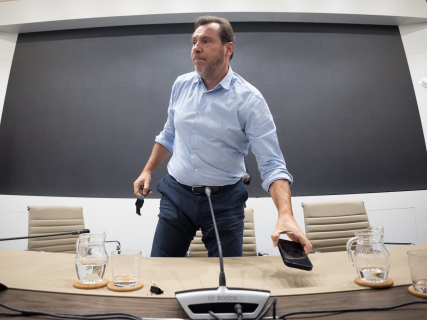
EuropaPress 7879531 ministro transportes movilidad sostenible oscar puente rueda prensa sede

EuropaPress 7879531 ministro transportes movilidad sostenible oscar puente rueda prensa sede

Add DEMÓCRATA to Google

Ask FREN

Published

Last updated

5 minutes

Most read

Elecciones 29N · Encuestas

La media de las encuestas

Media a 27 de octubre de 2026 · 15 institutos

  • PP31,0 %
  • PSOE27,3 %
  • Vox18,9 %
  • Frente Amplio6,3 %
  • Podemos2,9 %
  • ERC2,3 %
010203040ene 2024jul 2024ene 2025jul 2025ene 2026jul 2026

Media del último estudio de cada instituto en 30 días y su evolución semanal desde el 23J. Partidos con al menos un 2 %.

Todas las encuestas

Elecciones generales del 29 de noviembre · Demócrata

Óscar Puente continues at the head of the Ministry of Transport after having put his position at the disposal of Pedro Sánchez. According to what he told journalists this Friday, the president of the Government rejected his departure because he considered it would be "unfair", a conversation that leaves a political consequence difficult to avoid.

The revelation comes when there is one month left until the general elections on 29 November and the Government is trying to respond to the crisis caused by the railway accident in Urda (Toledo), in which at least 69 people have died. Puente concentrates a large part of the explanations about the functioning of the network, the decisions adopted before the crash and the demands for resignation. Sánchez, meanwhile, has focused his interventions on attention to the victims, the clarification of the causes and the need to restore confidence in high speed.

That distribution of roles could allow the president to maintain a certain distance from the controversy surrounding Transport. But the support that Puente attributes to Sánchez also makes it difficult for the political wear and tear to remain confined to the minister. If the head of the department offered to leave and the president asked him to continue, the responsibility for keeping him in the Government reaches Moncloa directly.

Sánchez's support comes through Moncloa and from Puente's own mouth

The presidential support has been known so far through two channels. On Thursday, sources in Moncloa said that Sánchez retained his confidence in the minister and ruled out his dismissal. Those same sources argued that the accident was not related to Puente's political management.

This Friday it was the minister himself who explained that he put his position at the disposal of the president and that the latter asked him to continue.

Sánchez acknowledged this Friday, during his visit to the Cecopi in Toledo, that there is a "broken trust" in the Spanish high-speed system and promised solutions to prevent a similar tragedy from occurring again.

The absence of a personal statement of support does not mean that the president has withdrawn his backing. However, it contrasts with other crises in which Sánchez did decide to publicly defend questioned ministers.

The precedent of Marlaska and an unambiguous defense

Fernando Grande-Marlaska offers one of the clearest examples of Sánchez's resistance to calls for the resignation of a member of his Government.

After the tragedy that occurred at the Melilla fence in June 2022, the Minister of the Interior came under intense pressure over the police action and the explanations from his department. On November 4 of that year, during the Spanish-Portuguese summit, Sánchez personally assumed his defense with an unequivocal statement: "The minister has my support and also my recognition".

Six days later, the president again ruled out his dismissal during an interview on laSexta. Marlaska remained in the Executive despite the criticism and the demands for accountability.

The circumstances of Melilla and Urda are different, both because of the nature of the tragedies and because of the responsibilities that must be investigated. The precedent, however, shows that strong political pressure does not necessarily lead to the dismissal of a minister and makes it possible to appreciate a difference in the way presidential support is communicated.

In the case of Marlaska, Sánchez defended him directly before public opinion. In Puente's case, so far, the most explicit explanation about his continuity has come from the Minister of Transport himself.

González Laya and Ábalos, the other paths chosen by Sánchez

Sánchez's trajectory at the head of the Government also offers examples of ministers who left their responsibilities after episodes of political wear and tear or in reshuffles designed to renew the Executive.

Arancha González Laya left the Ministry of Foreign Affairs in July 2021, after the diplomatic crisis with Morocco triggered by Spain's reception of the leader of the Polisario Front, Brahim Ghali.

Also in July 2021, José Luis Ábalos left the Government, until then Minister of Transport and one of the political figures closest to Sánchez. His replacement was part of a broader reshuffle, in which Carmen Calvo also left and Iván Redondo departed from the head of the presidential Cabinet.

Those changes responded to a different context and Sánchez presented them as a renewal to boost recovery after the pandemic. Their interest as a precedent lies in the fact that not even personal and political closeness to the president guarantees indefinite continuity in the Council of Ministers.

A minister necessary for management, but uncomfortable for the campaign

The Urda accident has altered the socialist campaign when barely a month remains until the general elections. Puente, one of the ministers with the greatest public presence and capacity for political confrontation, must now devote much of his appearances to explaining what happened on the railway network and responding to calls for resignation.

Now, the socialist electoral team is adapting its strategy in the face of the minister’s loss of prominence in the campaign. Thus, any public intervention by Puente runs the risk of being dominated by questions about Urda, even when he intends to address other matters.

His continuity also offers advantages for the Executive. It allows the head of the department to be retained during the investigation and avoids a ministerial reshuffle in the middle of the campaign. In addition, Puente can take on the technical and parliamentary explanations while Sánchez concentrates his appearances on the institutional response to the tragedy.

That distribution of responsibilities feeds the hypothesis that the minister may act as a political firebreak for the president.

The problem for the PSOE is that the debate has already outgrown Puente’s figure. Alberto Núñez Feijóo has linked the Government’s responsibilities with the elections of 29N, so the opposition does not limit its reproaches to the Ministry of Transport, but also directs them at the president.

The decision to keep Puente ties his future to Sánchez's

The account that the minister offered this Friday introduces a circumstance that may condition the coming weeks. By explaining that he wanted to step aside and that Sánchez rejected his departure, Puente has made public the president’s personal intervention in the decision to keep him in office.

But the political effect is difficult to separate from the words chosen. If Sánchez considers it "unfair" for Puente to resign, he will have to defend that decision while the investigations continue and new details about the circumstances of the accident become known.

The president has promised to restore citizens’ confidence in high-speed rail, damaged after the tragedies of Adamuz and Urda, which together add up to at least 115 deaths in 2026. The question is whether he can do so with the same minister at the head of Transport and without the controversy conditioning the socialist campaign.

More key points, information and questions with FREN

AI-GENERATED CONTENT

What is the parliamentary status of the official investigations into the Urda railway accident?

No parliamentary information has been found that allows establishing the status of the official investigations into a railway accident identified as the one in Urda. The consulted documentation contains actions regarding other accidents, especially the one in Adamuz, but does not allow attributing them to the event you ask about. Therefore, it would not be correct to state that there is an investigative commission on Urda, that its work has ended, or that there are official conclusions presented before the Cortes.

The closest parliamentary reference: an accident in Toledo

There is a request from the Popular Parliamentary Group in the Senate for the Minister of Transport and Sustainable Mobility, Óscar Puente, to report before the Transport Commission on the causes and corrective measures aimed at preventing railway accidents in the province of Toledo, such as the one that occurred on August 26, 2023. Its purpose is to ask the Government for explanations and to learn what preventive actions the department plans.

However, the located information does not explicitly identify that accident as the one in Urda. It also does not prove that the appearance actually took place nor does it provide its transcript, a ministerial response, or conclusions derived from it. The Senate link provided for that action does not allow, with the consulted content, to resolve these points. That reference is a documentary clue, not a confirmation that the investigations on Urda have been examined by the Chamber.

What should not be confused with the investigation on Urda

The creation of an investigative commission on the state of the railway network in Spain, promoted by the Popular Parliamentary Group in the Senate, is documented. The request was admitted for processing on January 29, 2026, and approved on February 18, with 150 votes in favor, 96 against, and 15 abstentions. On February 23, the conclusion of the creation procedure was published: this does not mean that the investigative work had concluded. The official publication and the creation request can be consulted.

Its scope includes the renovation works of high-speed lines, especially Madrid-Seville, emergency management, and maintenance and safety contracts of ADIF and Renfe. However, the consulted material does not demonstrate that this commission specifically addressed the Urda accident.

There is also a government response regarding Adamuz, published on March 16, 2026, indicating that the technical investigation was still ongoing and there were no conclusions yet. That response corresponds to another accident and that specific moment; it does not describe the situation of Urda nor allows updating it. It is recorded in the Congress bulletin.

Conclusion

The answer must be limited: there is no verifiable parliamentary status of the investigations on Urda in the consulted sources. The only potentially related action is the request for an appearance regarding an accident in Toledo, but it lacks proof that it refers to the same event. Can you indicate the date of the accident or the affected railway line? That data would allow distinguishing it from other cases without transferring conclusions unrelated to your question.

What are the main competencies and functions of the Minister of Transport according to Spanish legislation?

The Minister of Transport directs the state policy on infrastructures, transport services, and sustainable mobility, as well as exercising the political and administrative leadership of their department. To understand their competencies, it is useful to distinguish the general functions of any minister from the specific matters attributed to the Ministry of Transport and Sustainable Mobility.

1. Political and administrative leadership

Law 50/1997, of the Government frames their action within three principles: leadership by the Prime Minister, collective responsibility of the Government, and autonomy and responsibility of each minister over their department. Therefore, the minister directs their area within the general governmental guidelines; they do not act as an authority independent of the rest of the Executive.

In Transport, this leadership is mainly exercised over the Secretariat of State for Transport and Sustainable Mobility and the Undersecretariat. Technical and management functions are distributed among these bodies, the general directorates, and attached entities: not all Ministry decisions correspond personally to the minister.

2. Transport infrastructures and services

Article 1 of Royal Decree 253/2024, which develops the department's structure, attributes to the minister the proposal and execution of government policy in these main areas:

  • State infrastructures: land, air, and maritime transport infrastructures of state competence, along with the planning and programming of their investments.
  • Transport services: control, organization, and administrative regulation of the corresponding services. The ministerial organization specifically includes roads, the railway sector, and road and rail transport.
  • Air transport: aeronautical policy, planning and organization of the sector, air navigation, and airports of state competence. It also includes actions on transport subsidies and public service obligations aimed at ensuring certain connections.
  • Maritime transport: regulation of navigation and the civil fleet, maritime safety, ship inspection, salvage, and prevention and fight against pollution from ships.
3. Sustainable mobility and territorial cohesion

The department must promote sustainable mobility in its social, economic, and environmental dimensions, including active mobility. Its legal purpose is to guarantee safe and sustainable mobility based on social justice criteria.

This includes coordinating different modes of transport, favoring their connection, and promoting decarbonization, energy efficiency, and innovation. It also includes economic instruments and aids, as well as policies aimed at vulnerable users and companies. In the air and maritime fields, through competent bodies, discounts and actions related to non-peninsular territories are managed.

4. Other competencies and international relations

Their attributions are not limited to transport. The same article 1 includes the normative regulation of postal services and the promotion and direction of state services of astronomy, geodesy, geophysics, and cartography.

Likewise, under the direct dependence of the minister, the department's international relations and its representation in international institutions, especially the European Union, are coordinated, in collaboration with Foreign Affairs.

5. Safety, emergencies, and limits

Royal Decree 690/2025 strengthened crisis coordination and prevention and victim assistance in accidents. That coordination does not replace the direct management of competent bodies nor the functions of the independent investigation authority.

In short, the minister directs and coordinates these policies but must respect the distribution of powers among bodies and the competencies of other administrations and ministries. The regulation itself expressly requires such coordination.

What is Óscar Puente's political and professional background before becoming Minister of Transport?

Before being appointed Minister of Transport and Sustainable Mobility on November 21, 2023, Óscar Puente had worked for twenty years as a lawyer and developed a political career focused on Valladolid. He was a councilor, mayor for eight years, territorial leader of the PSOE, and spokesperson for its federal leadership. His arrival in the Government was preceded by his election as a deputy and his involvement in Alberto Núñez Feijóo's investiture.

Education and professional experience

Born in Valladolid on November 15, 1968, Puente graduated in Law from the University of Valladolid and completed his training with a master's degree in Political Management from the Jaime Vera Foundation. His profession before dedicating himself to municipal management was law, which he practiced from 1995 until June 2015, according to his official biography.

During part of that period, he combined professional practice with responsibilities in the PSOE and his activity as an opposition councilor. He left law upon becoming mayor, at age 46. He also had a connection with theater as an actor, although his main professional career was legal.

Early political positions in Valladolid

He joined the PSOE in 1990. In 2004, he assumed a prominent responsibility in the provincial organization as deputy secretary general of its Executive. In 2007, he was elected councilor of the Valladolid City Council and in 2008 became president of the Socialist Municipal Group. The following year, he became secretary general of the municipal group, a responsibility he held until December 2021, when he began leading the provincial PSOE (official biography).

His institutional learning initially developed in opposition to Mayor Francisco Javier León de la Riva. He remained a councilor for eight years before accessing the city government, according to the Demócrata profile.

Mayor and municipal representative

In June 2015, he was invested mayor of Valladolid. Although the PP had been the most voted candidacy, Puente gathered an alternative majority that ended twenty years of governments by that party. In 2019, the PSOE won the municipal elections and Puente continued leading the City Council (Demócrata).

His institutional experience also included responsibilities in cooperation between municipalities: he presided over the Spanish Network of Healthy Cities, was a member of the Governing Board of the Spanish Federation of Municipalities and Provinces between 2019 and 2023, represented this federation in the Urban Initiatives Network, and was first vice president of the Ibero-American Organization of Intermunicipal Cooperation (La Moncloa profile).

National projection and leap to Government

While mayor, he held the spokesmanship of the PSOE Federal Executive Commission between June 2017 and October 2021, after Pedro Sánchez's return to the General Secretariat. That position gave him national political communication experience, simultaneous with municipal management (official biography).

In the May 2023 municipal elections, the PSOE was again the most voted force in Valladolid, but the agreement between PP and Vox allowed Jesús Julio Carnero to access the mayoralty. Puente left the position in June and obtained a seat for Valladolid in the general elections on July 23. In September, he led the socialist reply to Feijóo during his investiture debate. Two months later, he reached the Ministry, culminating the transition from law and municipal politics to Congress and Government (Demócrata).

Play

Test your knowledge with FREN!

How much do you know about this topic? Answer the following 3 questions.

What reason did Pedro Sánchez give for rejecting Óscar Puente's resignation?

Question 1 of 3

What tragedy has caused the current political crisis in the Ministry of Transport?

Question 2 of 3

What is the main difference mentioned between Marlaska's crisis management and Puente's?

Question 3 of 3