Halloween under surveillance in Madrid and Barcelona: what the Police is preparing in response to the threats from Blocus

Calls for new looting on October 31 keep preventive devices active. Madrid maintains an operation despite cancellation messages, and the Mossos are tracking the calls after the closure of Telegram groups. These are the keys to distinguish threats from confirmed events and know how to act.

fotonoticia 20261025102032 1920

fotonoticia 20261025102032 1920

Add DEMÓCRATA to Google

Ask FREN

Published

Last updated

6 minutes

Most read

Elecciones 29N · Encuestas

La media de las encuestas

Media a 27 de octubre de 2026 · 15 institutos

  • PP31,0 %
  • PSOE27,3 %
  • Vox18,9 %
  • Sumar6,3 %
  • Podemos2,9 %
  • ERC2,3 %
010203040ene 2024jul 2024ene 2025jul 2025ene 2026jul 2026

Media del último estudio de cada instituto en 30 días y su evolución semanal desde el 23J. Partidos con al menos un 2 %.

Todas las encuestas

Elecciones generales del 29 de noviembre · Demócrata

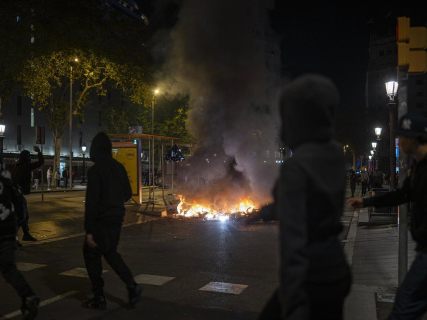
Madrid and Barcelona face Saturday, October 31, with police vigilance in light of calls to repeat the disturbances and looting recorded last weekend in the Catalan capital. The coincidence with Halloween adds a relevant circumstance: the calls circulate for a day of great activity in the streets, with celebrations, shopping, and movements of families and groups of young people.

The situation, however, is different in both cities. In Madrid, accounts linked to Blocus have announced the cancellation of their call, but the National Police maintains a preventive device. In Barcelona, the Mossos are following the new calls spread on social media and are working to prevent attacks on establishments and urban furniture from being reproduced.

The available information does not allow for anticipating a night of widespread violence. It does confirm the circulation of messages that encourage crimes and a police response to prevent its. There is also a precedent that is worth keeping in mind: some calls following the disturbances in Barcelona have not gathered anyone, despite their dissemination on the internet.

What is planned for October 31: scattered calls and contradictory messages

There is no single and verifiable program of events under the Blocus label. The analyzed publications present discrepancies in schedules, meeting places, and even dates. Some profiles were spreading invitations for Halloween while others indicated different days.

This lack of a common call matters. A poster shared thousands of times does not confirm how many people will attend, who organizes it, or if it will still be valid a few hours later. Not all publications also have the same content: alongside violent messages, verifiers have located posters asking to avoid personal and material damage.

The starting point for this Saturday is, therefore, a combination of specific threats spread in certain groups, changing calls, and preventive surveillance. Not a confirmed calendar of incidents.

Blockade and Halloween: situation known as of October 28, 2026
Scope What is known What cannot be taken for granted
Madrid Accounts linked to Blockade announce the cancellation. The Police maintain preventive surveillance. That all accounts have withdrawn their calls or that incidents will occur.
Barcelona Calls for the 31st persist. The Mossos monitor social networks and prepare preventive measures. Actual attendance, a unique route, or a general closure of businesses and transport.
Social networks Telegram groups that spread messages inciting looting have been closed. That all activity linked to that label has disappeared.

Preparation based on information from EFE, 20minutos, Newtral, and Cadena SER. The situation may change: check official notices before traveling.

What is Blockade and who is behind the messages

Blockade, a French term associated with the blocking of educational centers, is used as a label on profiles that call for mobilization in different cities. Its shared use does not alone demonstrate that there is a single organization with an identified direction.

EFE Verifica has located dozens of accounts on TikTok, Telegram, and WhatsApp with heterogeneous messages and claims. Its analysis gathers indications of manipulation and doubts about the spontaneous nature of the dissemination, but does not identify a single promoter or a common roadmap.

VerificaRTVE has documented how open publications on TikTok directed interested parties to private messaging groups. In some of those spaces, messages encouraging damage and looting appeared. This difference between the public poster and the private conversation helps explain why a call presented as a protest may harbor different objectives among its participants.

The similarity with images and slogans from other countries is also not enough to attribute a foreign direction. The report from Golden Owl collected by Infobae expressly states that the analyzed elements do not prove common operators, sponsors, or coordination with organizations from abroad.

What the messages say: threats against businesses and agents

La Razón publishes this Wednesday conversations from groups linked to Blockade that include calls to loot establishments, set containers on fire, and assault police officers. According to the newspaper, some administrators also suggest taking advantage of the Halloween celebration to facilitate those actions.

They are serious messages due to their content, but their publication does not allow knowing how many people are willing to carry them out. The identification of the authors and the determination of possible responsibilities correspond to the investigation.

Madrid maintains prevention despite the canceled "Halloween operation"

"The Halloween operation has failed." That is one of the phrases disseminated by accounts announcing the withdrawal of the Madrid call. The message appears after the attempt to concentrate the previous Saturday did not reproduce the incidents of Barcelona in Madrid.

The cancellation on social media has not meant the withdrawal of the device. According to police sources cited by 20minutos, the National Police maintains a forecast of 80 agents to prevent possible disturbances.

The reason is that the messages from accounts without a clear representation do not offer sufficient guarantees about the behavior of other profiles or groups. Surveillance is maintained even though the sources consulted by that medium express their confidence that no incidents will occur.

Barcelona: monitoring of calls and closure of channels

The Mossos are working on two fronts: investigating the events of the past Saturday and anticipating possible replicas. EFE describes a monitoring of social media to assess new calls and prepare deployments, even in the face of calls that later turn out to be unsuccessful.

The action also extends to digital platforms. El País reports the closure of three Telegram groups following the actions channeled by the Mossos through the National Unit for the Withdrawal of Illegal Content on the Internet, dependent on CITCO. The intervention of that agency does not, by itself, equate to a qualification of the events as terrorism.

One of the closed groups had more than 2,000 members. That figure describes the size of the chat, not the number of people who will attend a concentration or participate in crimes.

What can happen on Halloween and what remains unknown

There are several possible scenarios. The calls may go unanswered, translate into concentrations without incidents, or lead to localized disturbances. What happened the previous weekend justifies the prevention, but does not allow assigning a reliable probability to each outcome.

Neither do the consulted information allow announcing a general closure of the center of Madrid or Barcelona, a global suspension of celebrations, or the interruption of the entire transport network.

On Saturday, it will be more useful to know the specific notices about a street, an access, or a station than to follow a series of videos without verified location or date.

What to do if you go out on October 31 and find incidents

Civil Protection of the Generalitat recommends consulting official information before going to crowded places, locating exits, and agreeing on a meeting point with companions. If you are going with minors, it is advisable that they carry a contact phone.

If an emergency begins, remain calm, follow the instructions of security services, and leave the area through the marked routes. Avoid running, pushing, or stopping at doors and hallways. Do not return to the focus of the incident.

If, once safe, you cannot locate a person from your group, inform the emergency services. In the event of a personal or collective emergency, call 112.

The practical recommendation is not to approach a fight, a fire, or a charge to record. If a business temporarily keeps its customers inside for safety, follow the instructions of the staff and agents on how to exit.

What to check before going out and before forwarding a notice

Consult the official channels of Mossos d'Esquadra, Guàrdia Urbana, and Civil Protection in Barcelona; and those of Policía Nacional, Policía Municipal, and Emergencias Madrid in the capital. For travel, check the incidents reported by the transport operator you are going to use.

At home, especially if someone is going out with friends, it is useful to agree on the planned place, how to return, and how to notify a change of plan. An invitation that arrives through a private group and continuously changes location deserves to be verified before following it.

Before forwarding a video, check when it was published, where it was recorded, and if it really shows a current event. VerificaRTVE has identified posters generated with artificial intelligence within this dissemination: an image of a burning street may be propaganda for a call and not a photograph of something that is happening.

More key points, information and questions with FREN

AI-GENERATED CONTENT

What is the status of the judicial investigation into the previous incidents associated with Blocus in Barcelona?

The investigation into the incidents associated with Blocus in Barcelona remains open and in an initial phase, according to information available as of October 28, 2026. The known actions refer to the riots and looting on October 24: precautionary measures have already been taken against detainees, while the identification of those who disseminated or coordinated the calls continues. Criminal liability of Blocus as an organization has not yet been established.

Status of the detainees

The initial count was 128 detainees, including 72 minors, according to Demócrata. This figure corresponds to police arrests, not convictions or persons who remain deprived of liberty. The Barcelona City Council also confirmed the opening of an investigation into those responsible for the calls, parallel to actions against those who physically participated in the events.

  • Adults: most have been released provisionally, with periodic appearances and, in certain cases, prohibition from attending demonstrations. Two suspects face charges for public disorder related to throwing stones, cobblestones, and other objects at officers, according to information from Infobae and ARA.
  • Minors: three were placed in closed custody; others were subject to supervised release or other measures, including prohibition from participating in gatherings. El Periódico reports these actions. It is important to distinguish the detention request made by the Prosecutor's Office from the measures ultimately agreed upon.
What is being investigated about Blocus

The second line of work seeks to identify the administrators of accounts and groups used for the calls. According to RTVE, the Mossos are studying how to track these channels and plan to request judicial authorization to access data such as IP addresses and communications. The available information does not allow presenting these authorizations as already granted.

Investigators analyze images, messages, connections between accounts, and possible instructions to attack businesses or confront the police. They also try to identify more participants in the looting and determine if there was organized coordination, as explained by El Nacional. The path from TikTok to Telegram and WhatsApp groups is relevant because open posts did not necessarily show all the instructions shared afterward.

What has not yet been established

Sharing the name Blocus does not prove a single leadership. Demócrata points out that it is still necessary to establish who used the accounts, how they related, and what responsibility corresponds to each message or action. An international structure has not been established either, although there are contacts with other European police forces to examine possible connections.

The legal information collected by laSexta distinguishes between administering a group or calling a protest and possible criminal liability: this would require proving a specific incitement to commit a crime or participation in the acts. Therefore, a police hypothesis should not be confused with a judicial conclusion.

The Generalitat has announced it will appear as a private prosecution and the City Council has also announced legal actions for damages. In summary, there are individual actions and precautionary measures, but clarifying coordination and attributing responsibilities remains pending. The consulted sources do not record a sentence or the closure of the investigation.

What are the specific competencies of the National Police and the Mossos d'Esquadra in managing urban disturbances?

In Catalonia, the Mossos d’Esquadra are the body responsible, in general, for maintaining and restoring public order, including urban disturbances. The National Police retains its state competencies and may intervene to exercise them or provide support, but it does not automatically replace the Mossos due to the severity of incidents.

The division is mainly based on the Constitution, Article 164 of the Statute of Autonomy of Catalonia, and Organic Law 2/1986, on Security Forces and Corps. Police action must also respect regulations on citizen security and the right of assembly.

Competencies of the Mossos d’Esquadra

Within Catalonia’s territory, they are responsible for the ordinary response to citizen security and public order. In an episode of disturbances, this includes:

  • Prevention and assessment: evaluating risks, deploying surveillance, and preparing devices ahead of gatherings or situations that may lead to violence.
  • Protection: safeguarding the security of participants, neighbors, and third parties, as well as protecting property and public spaces.
  • Restoration of order: intervening against assaults, damages, and other disruptions, using appropriate units and means.
  • Criminal action: arresting alleged perpetrators and investigating crimes committed, within their competencies as judicial police.
  • Local coordination: organizing collaboration with local police to address the incident’s effects on the municipality.

In demonstrations, their role is not only to control incidents: they must also protect the peaceful exercise of the right of assembly. A gathering alone does not justify coercive intervention.

Competencies of the National Police

The National Police maintains presence and powers in Catalonia. Among its state functions are documentation, immigration, and control of entry and exit from the territory, as well as protection and investigation actions legally assigned to it.

Regarding urban disturbances, its intervention may occur mainly in these cases:

  • Own state competence: for example, protection of state dependencies whose security it is entrusted with. This intervention does not imply assuming all public order of nearby streets.
  • Support to the Mossos: when requested or agreed upon through legal collaboration mechanisms.
  • Joint operations: when autonomous and state responsibilities coincide, with distribution of zones, objectives, and tasks.
  • Situations of state scope: when there is a specific legal authorization for reinforced coordination or command.

Therefore, the severity of the disturbance alone is not enough to displace the Mossos. Nor does autonomous competence prevent the National Police from legitimately acting in its own matters.

Coordination and command

The Security Board of Catalonia is the main bilateral coordination body. Specific operations are articulated through plans, protocols, information exchange, and operational centers, delimiting each body’s responsibilities.

In major events, autonomous responsibility over citizen security and public order may coexist with state missions of protection. The ordinary direction of the autonomous operation should not be confused with command of all participating forces: the specific scheme must be defined in operational coordination.

Common limits of intervention

Both bodies must act according to the principles of consistency, opportunity, and proportionality, respecting fundamental rights. The use of coercive means must respond to circumstances and existing risk, not simply to the presence of a protest.

In summary: the Mossos ordinarily manage urban disturbances in Catalonia; the National Police exercises its state competencies and collaborates when appropriate. Exceptional direction requires a concrete legal basis, not a generic invocation of public security.

What legal requirements must be met for a call to be considered illicit or illegal under Spanish law?

In Spain, a call is not illegal simply because it is controversial, annoying, or contrary to an authority’s position. To consider it unlawful, an applicable obligation or prohibition must be identified and the facts that violate it justified. Additionally, three issues must be distinguished: a formal defect, a possible prohibition of the act, and the commission of a crime.

As a "call" can refer to a demonstration, a strike, elections, or a corporate meeting, there is no single answer for all these cases. The following explanation focuses on citizen meetings and demonstrations, with a final clarification on strikes.

1. Identify the applicable right and norm

The framework for meetings and demonstrations is found in Article 21 of the Constitution and Organic Law 9/1983, regulating the right of assembly. Its application must respect one premise: these are basic political freedoms and their limitations must be interpreted restrictively, as recalled by the Constitutional Court Ruling 133/2021.

Therefore, it is not enough to publicly label a call as "illegal." It must be specified whether its purpose, organization method, compliance with communication obligations, or behaviors during its celebration are questioned.

2. Differentiate formal breaches and material limits

Lack of prior communication does not, by itself, constitute a crime. Jurisprudence distinguishes the exercise of the right of assembly from failure to notify certain gatherings or demonstrations. Ruling 172/2020 addresses precisely this separation.

There are also organizational obligations. Ruling 61/2023 reminds that organizers must adopt measures for the proper development of the meeting and that the communication must include the security measures planned or requested from the authority.

These requirements must be analyzed separately from the material limits of the right: a documentary irregularity and violent conduct are not legally the same nor do they automatically allow attributing identical responsibility.

3. Justify prohibition or intervention

The decision to prevent a meeting requires relating the facts to the applicable constitutional limits. It cannot rest solely on disagreements with the message of those calling it.

The examination does not end when the act begins either. Ruling 42/2000 explains that violations of those limits may occur during its development. Therefore, circumstances known before the call, subsequent behaviors, and the specific actions of each participant must be distinguished.

4. Do not confuse administrative and criminal liability

To affirm that a crime exists, conduct fitting a Penal Code figure must be identified and its elements proven. Threats, coercion, injuries, damages, or public disorder require their own analysis; they cannot be deduced simply from attending a protest.

Likewise, it must be explained to whom the acts are attributed and why: caller, organizer, or participant. Individual responsibility should not be replaced by a generic imputation to all attendees.

5. If it is a strike

The call requires a different analysis, according to strike right regulation. Not every administrative restriction is valid either: Ruling 2/2022 examines the proportionality of minimum services and their effect on the effective exercise of the right.

In summary: the type of call, the breached norm, the proven facts, the responsible persons, and the corresponding legal consequence must be specified. Without this distinction, calling a call "illegal" does not constitute sufficient legal justification.

Play

Test your knowledge with FREN!

How much do you know about this topic? Answer the following 3 questions.

What measure has the National Police in Madrid taken despite the cancellation of the call linked to Blocus?

Question 1 of 3

What have the Mossos d'Esquadra managed to shut down after violent calls in Barcelona?

Question 2 of 3

What does the Generalitat's Civil Protection recommend in case of possible incidents during Halloween?

Question 3 of 3