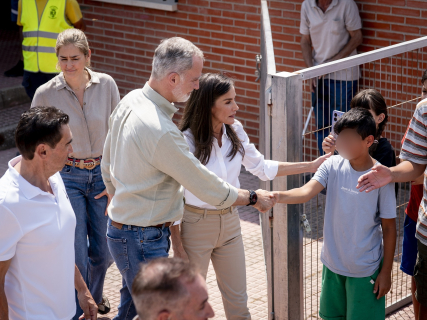

The King Felipe VI has called for the unity of the Spaniards in the face of the virulent wildfires affecting various points of the country and has asked political leaders to convey to the public the certainty that all possible means are being used to combat the emergency. The monarch made these statements after visiting, along with Queen Letizia, the sports center of La Chopera, in Villamanta, one of the reception points set up in the Community of Madrid to assist residents evacuated due to the advance of the fire.
The visit of the Kings has had a marked character of institutional support for the evacuated people, who in many cases have had to leave their homes without knowing when they will be able to return or in what condition they will find their houses, animals, farms, or businesses. Felipe VI has focused on the need to maintain social cohesion and trust in the teams working on the ground, in an emergency that has forced the displacement of thousands of residents and kept tens of thousands of people confined due to smoke, the advance of the flames, and the risks associated with the wind.
Sánchez will approve the declaration of severely affected areas on Tuesday
The president of the Government, Pedro Sánchez, has announced from the Advanced Command Post of Navaluenga, in Ávila, that the Council of Ministers will approve next Tuesday the declaration of the areas ravaged by the fires as severely affected areas by civil protection emergencies, a figure commonly known as a declaration of a catastrophic area, which allows for the activation of state aid for damage repair.
Sánchez appeared accompanied by the Minister of the Interior, Fernando Grande-Marlaska, and met with the president of the Junta de Castilla y León, Alfonso Fernández Mañueco, and with the mayor of Navaluenga, Armando García Cuenca. The declaration must be specified through a royal decree law and set what measures are activated to respond to the damage to homes, belongings, farms, businesses, infrastructures, and public services affected by the fire.
What the declaration of severely affected area implies
For an area to acquire the condition of severely affected by a civil protection emergency, the Council of Ministers must approve the declaration at the proposal of the ministries of Finance and Interior, although the affected public administrations can also request it. That is the route announced by Castilla y León, as previously advanced by President Mañueco, after attributing the origin of the fire to negligence and announcing that the Junta will appear as a prosecution.
The Law of the National Civil Protection System contemplates a wide catalog of measures for these cases, including economic aid to citizens for damages to their habitual residence or for loss of essential belongings, as well as support for industries, companies, and individuals who have had to provide services as a consequence of the disaster. The Government may specify in Tuesday's decree the scope of these aids and add other measures if it considers that the magnitude of the emergency requires it.
77,000 hectares burned between Ávila, Toledo, and Madrid
According to data from Civil Protection, the fires in Ávila, Toledo and Madrid have already burned about 77,000 hectares, a figure that reflects the territorial dimension of an emergency affecting several autonomous communities and that has forced the deployment of extinction, security, health assistance, and reception devices in numerous municipalities.
Only in the Community of Madrid, more than 35,000 people have had to be displaced and more than 20,000 remain confined. In addition, about 3,000 neighbors are housed in reception points spread across other 14 municipalities, a network of assistance that seeks to respond to those who have had to leave their homes due to the proximity of the flames, the presence of smoke, or the preventive decisions made by the emergency services.
Sánchez warns that the magnitude of the disaster is “very difficult to bear”
The President of the Government has acknowledged that the night has been “very positive” in relation to the control of the fire, but has asked the population to remain cautious because the magnitude of the disaster is still “very difficult to bear.” Sánchez has insisted that there are still complicated hours ahead and that the instructions of the emergency services must be strictly followed to avoid additional risks.
The head of the Executive has recalled that in less than 24 hours Spain has gone from 135,000 charred hectares to more than 150,000, an evolution that, as he has emphasized, means multiplying by six the burned area compared to the same period last year. For Sánchez, these figures require addressing the fires from a triple perspective: prevention, response, and reconstruction, with all administrations involved and with sufficient economic resources to act before, during, and after each emergency.
A new call to science and institutional cooperation
Sánchez has argued that the response to the fires must be supported by scientific knowledge and cooperation between administrations. In his opinion, Spain needs to adapt its public policies to increasingly intense climate emergencies, not only to respond better when the fire is already active but also to reduce risks in the territory, improve prevention, and rebuild with criteria that avoid repeating vulnerabilities.
The president has praised the functioning of the national Civil Protection system, which he considers proven by years of emergencies and based on coordination between institutions. He has also insisted that reconstruction must be approached with the same level of cooperation as the immediate response because once the flames are extinguished, there will be damage to homes, forests, roads, livestock farms, local businesses, and basic services.
The UME advances, but maintains active heads
On the operational front, Lieutenant Colonel Alfonso Arribas, of the Military Emergency Unit, has pointed out that the work carried out during the night has allowed for “quite” a bit of progress in stabilizing the large fire affecting Ávila and Madrid, although there are still active heads on which efforts will be concentrated during the day.
Arribas explained on RTVE that Saturday afternoon was “quite unstable” and forced the recommendation of evacuations in the south of the province of Ávila and the north of Toledo. Now, he has indicated, “the entire front is contained,” although there are “certain parts” that remain out of control. The difference is significant: the fire is not advancing in a disorderly manner throughout the perimeter, but it still retains points with sufficient activity to require direct attack, surveillance, and reinforcement of defense lines.
The emergency enters a decisive phase
The favorable evolution during the night offers room to work, but the teams maintain caution because the wind, temperature, and humidity can change the behavior of the fire again in the coming hours. The priority remains to protect lives, keep the roads clear for emergency services, avoid unauthorized returns to evacuated areas, and consolidate the advances made in the perimeter.
The message from the King, the statement announced by Sánchez, and the operational advance of the UME outline an emergency that enters a decisive phase: there is still active fire and areas at risk, but the administrations are already beginning to prepare for reconstruction. Institutional unity, assistance to those affected, and coordination on the ground will be key to facing a crisis that has left thousands of hectares devastated and tens of thousands of people out of their homes or confined.