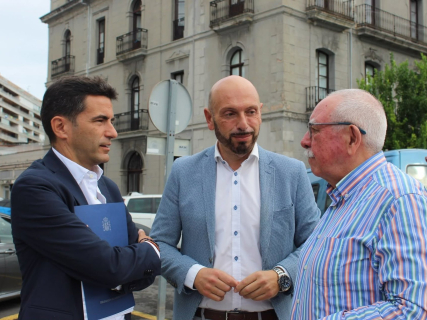

The mayor of Laredo, Miguel González (PP), has reiterated that the locality is "safe" and "calm," and has denounced a "constant lynching" and a "permanent campaign of discredit" against the municipality after two "isolated" episodes of assaults on young Basque tourists. He emphasized that the complaints are under investigation but "do not represent the reality" of the town.
The mayor expressed this on Tuesday before the media after the meeting of the Local Security Board, held at the Town Hall, in which the Government delegate in Cantabria, Pedro Casares (PSOE), also participated. He specified that the alleged authors of the two assaults are already identified and are the same individuals: two minors who have been detained and placed at the disposal of the judiciary.
"Enough of sowing fear," González demanded, referring to the information that has appeared in some Basque media about attacks on vacationers, which, in his opinion, are projecting a "false and absolutely unfair" image of Laredo "as if it were an unsafe place."
The mayor explained that since mid-July there have only been two complaints of this type and insisted that "no relationship can be established between these events and the origin of the people who visit the municipality."
In this regard, he recalled that one of the victims "has made it clear that he does not believe that what happened was related to the fact that the victims were Basque."
When asked by journalists, González admitted that there may be "some gang" in the locality, but emphasized that "no one is terrorizing anyone."
"It is not fair, it is not responsible, and it does not correspond to reality," the mayor insisted, who highlighted that the State Security Forces "are doing their job, and very well."
He added that he does not question any testimony or complaint and that he condemns any assault, crime, or behavior that violates the freedom, security, or integrity of individuals.
González reiterated that Laredo is a "calm, safe, open, and welcoming" locality, and emphasized that they have been "receiving thousands and thousands of visitors, especially during the summer" for years.
"There are many people who come from the Basque Country to enjoy our beaches, our festivals, our hospitality, and our activities. Just yesterday was the chupinazo and the start of the Laredo festivals, and absolutely nothing happened. So that you can see that we coexist perfectly with all kinds of visitors," he concluded.
Casares denies hate crimes and provides crime data
In the same vein, Casares has defended that Laredo is a municipality "safe, calm, and friendly for those who visit us," who "have been doing so for many years" as it is one of the most touristy destinations in Cantabria and, this year, "an example of coexistence."
The delegate has sent a message of "calm" to "combat those interested discourses that want to position the Laredo City Council as an unsafe place." "It is not true," he stated.
To support this, he detailed that in 2025 Laredo recorded a 3% decrease in overall crime, with significant drops in both cybercrime (-8%) and conventional crime (-1.6%).
He added that last year there were reductions in burglaries in homes, businesses, and other facilities. Overall, these crimes fell by 24.4%; specifically, burglaries in homes decreased by 33.3%, robberies with violence and intimidation by 50%, and thefts by 11.9%. Regarding crimes against individuals, those committed against sexual freedom decreased by 50%.
Furthermore, he indicated that from June 1 to date, 19 complaints have been registered in Laredo, a figure he has described as "very low" considering that in summer the population reaches 100,000 people. Most are linked to alcohol consumption, drugs, or nightlife, "usual" factors that can lead to fights with injuries.
Of the total complaints, he specified that "only" two — the last on July 12 — are related to people from the Basque Country and that the crime "has nothing to do" with their origin.
Thus, Casares has denied that hate crimes or assaults against those coming from the Basque Country are occurring in Laredo, something that, he said, has also been confirmed by the Civil Guard.
The delegate has condemned "any isolated incident that may occur," but has emphasized that "it is not true that there is a campaign of persecution against any visitor in the municipality of Laredo, much less against those from the Basque Country."
"It is a summer similar in terms of security, calm and where coexistence reigns," he has emphasized.
Special device for the Semana Grande and the Battle of Flowers
In the Local Security Board, the head of the Civil Guard of Cantabria, Colonel Jorge Bodelón, other commanders of the Armed Institute, the head of the Coordination Unit for Violence against Women of the Delegation, Diana Mirones, and representatives of the Local Police of Laredo have also participated.
In the meeting, the operation for the Semana Grande of Laredo, which is celebrated until Sunday, August 30, and for the 115th edition of the Battle of Flowers, a National Tourist Interest festival scheduled for Friday the 28th, has also been outlined.
The Civil Guard plans to reinforce the Citizen Security and Traffic Sector forces, as well as deploy specialized units such as the Canine Unit, the Pegaso Team with drones, and the Cavalry Unit. The entire operation will be coordinated with the Local Police.